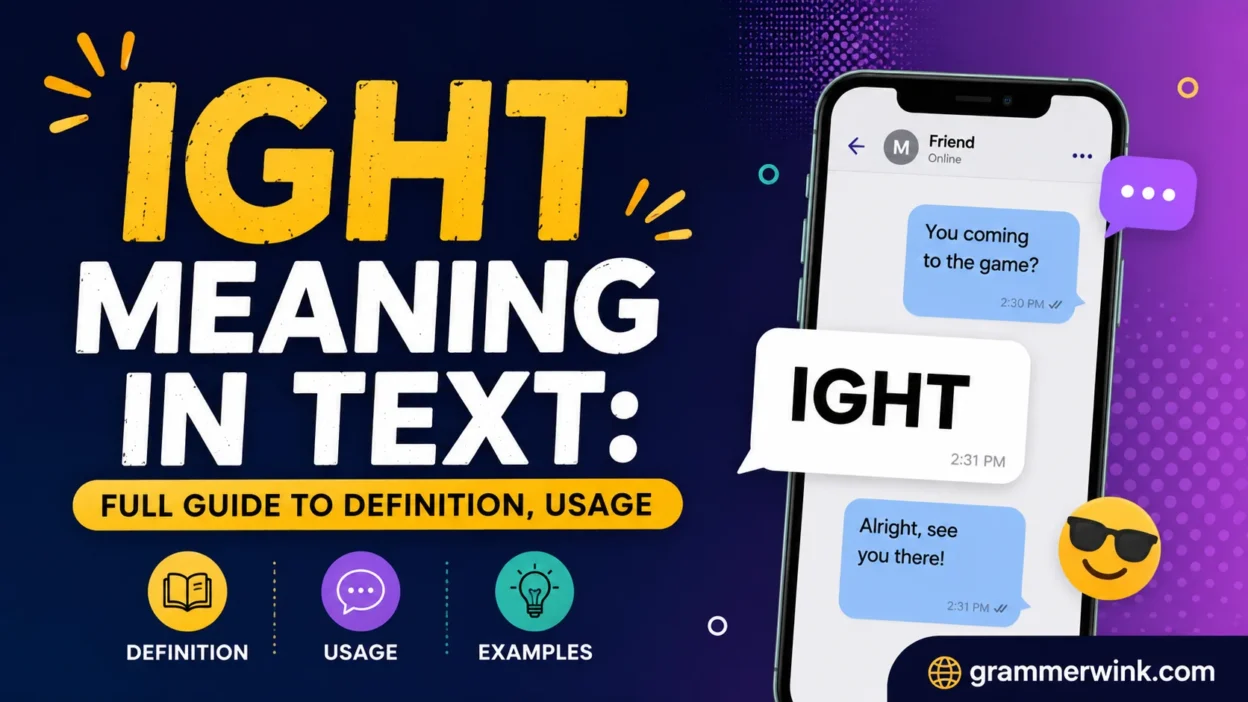
When you come across the abbreviation IGHT in a text message, social media chat, or online conversation, it can seem confusing if you are unfamiliar with modern internet slang. However, IGHT is one of the most commonly used casual expressions in digital communication. It is simply a shortened version of “alright,” often used to show agreement, acceptance, understanding, or confirmation in a quick and friendly way. As texting continues to evolve, abbreviations like IGHT help people communicate faster while keeping conversations relaxed and natural.
Whether you’re chatting with friends, reading TikTok comments, scrolling through Instagram, or messaging someone on Snapchat, you’re likely to see IGHT used in different situations. Depending on the conversation, it can mean “okay,” “sounds good,” or even “I understand.” Learning the meaning of IGHT not only helps you understand modern texting language but also allows you to respond confidently without feeling left out. Since online slang changes quickly, knowing popular expressions like IGHT can improve your digital communication skills.
In this complete guide, you’ll discover the exact IGHT meaning in text, where the term originated, how people use it in everyday conversations, and when it’s appropriate to include it in your own messages. We’ll also explore real-life examples, common mistakes, similar text abbreviations, and the differences between IGHT, OK, and ALRIGHT. By the end of this article, you’ll have a clear understanding of how IGHT fits into today’s online language and how to use it naturally in different texting situations.
IGHT Meaning in Text: What It Actually Means
At its core, “ight” means “alright.”
But texting doesn’t work like formal grammar. People don’t always use words for literal accuracy. They use them for speed, tone, and vibe.
So when someone types “ight”, they usually mean:
- Okay
- Alright
- I understand
- I agree
- Sure, whatever works
However, the meaning shifts slightly depending on context. That’s where most confusion happens.
The simplest breakdown
TextMeaningToneightokay / alrightneutralight.slight distance or seriousnessflatight…hesitation or mild annoyancecoldight betagreement + confidencepositiveight 👍friendly confirmationwarm
So the word itself is small, but the emotional signal behind it can change fast.
Origin of IGHT in Text and Internet Slang
The word “ight” didn’t appear randomly in texting culture. It evolved naturally from spoken English.
Step-by-step evolution:
- “Alright” (formal spoken English)
- “Aight” (casual spoken slang, especially in African American Vernacular English)
- “Ight” (text-friendly compressed version)
People didn’t sit down and invent it. It formed naturally as speech became faster and texting demanded shorter words.
Why it stuck in digital communication
Three big reasons:
- Speed: fewer letters mean faster typing
- Tone: it sounds casual, not formal
- Identity: slang often signals group belonging
Social platforms like Snapchat, TikTok, and Twitter helped spread it. You’ll also hear it in music, especially hip-hop, where casual speech shapes lyrical rhythm.
How People Use IGHT in Real Conversations
You won’t usually see “ight” in serious discussions. It lives in casual communication where speed matters more than grammar.
Common real-life uses
- Confirming plans
- Agreeing without enthusiasm
- Acknowledging instructions
- Ending a short conversation
- Responding when you don’t want to over-explain
Example scenarios
Making plans
- “We leaving at 6.”
- “ight.”
Simple agreement
- “Pizza tonight?”
- “ight.”
Instruction response
- “Don’t forget the assignment.”
- “ight.”
In each case, the message is short because the conversation doesn’t need expansion.
IGHT Meaning Changes Based on Tone and Context
This is where things get interesting. The same three letters can carry different emotional weight depending on how they appear.
Neutral “ight”
This is the most common version. It means:
- Okay
- Got it
- Understood
No emotion. Just acknowledgment.
Slightly annoyed “ight…”
When you see dots after it, something changes.
- “ight…”
- “ight.”
This often signals:
- Disinterest
- Mild frustration
- Reluctant agreement
It’s not always negative, but it often feels less engaged.
Friendly “ight bet”
Now the tone flips completely.
- “ight bet” = okay, I’m in, let’s do it
It feels:
- Confident
- Supportive
- Positive
You’ll see this a lot among friends making plans.
Emotional layering with emojis
Emojis reshape meaning quickly:
TextInterpretationight 👍friendly confirmationight 😂relaxed agreementight 😐indifferent toneight 🔥hype agreement
So the same word becomes flexible depending on emotional signals attached.
Examples of IGHT in Real Text Conversations
Let’s look at realistic exchanges so you can feel how it works in practice.
Example 1: Casual planning
Friend A: “Movie at 8?” Friend B: “ight”
👉 Meaning: simple yes, no extra emotion needed
Example 2: Slight hesitation
Friend A: “Can you help me move tomorrow?” Friend B: “ight…”
👉 Meaning: agreement, but maybe not fully excited
Example 3: Strong agreement
Friend A: “Let’s hit the gym early.” Friend B: “ight bet”
👉 Meaning: confident yes, motivated response
Example 4: Short acknowledgment
Friend A: “Lock the door when you leave.” Friend B: “ight”
👉 Meaning: I heard you, I’ll do it
These examples show something important: context carries more meaning than the word itself.
Variations and Related Slang Terms
“ight” doesn’t exist alone. It belongs to a bigger ecosystem of slang.
Common related expressions
- Aight → older, slightly more spelled-out version
- Ok / okay → neutral and formal
- K → extremely short, sometimes cold
- Bet → agreement with confidence
- Say less → strong confirmation, no further explanation needed
Quick comparison table
ExpressionToneUsageightneutraleveryday textingaightcasual + older slangspoken or older chatsokneutralgeneral usekcold / minimalquick repliesbetpositiveagreement with energysay lessstrong agreemententhusiasm
Each one signals a slightly different emotional temperature.
IGHT in Social Media and Pop Culture
Slang doesn’t live in isolation. It spreads through culture.
TikTok and short-form content
On TikTok, “ight” often appears in:
- captions
- comment replies
- reaction videos
It usually signals agreement or casual approval.
Snapchat culture
Snapchat rewards quick replies. So “ight” fits perfectly:
- fast response
- low effort
- clear meaning
Music and hip-hop influence
Hip-hop culture has played a major role in normalizing slang like:
- aight
- bet
- yo
This language style emphasizes rhythm, flow, and casual realism.
When You Should and Shouldn’t Use IGHT
Slang works best in the right environment. Misusing it can create confusion.
Good situations for “ight”
- Talking to friends
- Group chats
- Casual planning
- Informal replies
Situations to avoid it
- Job emails
- School essays
- Professional messages
- Formal requests
Simple rule
If you wouldn’t say it in a relaxed conversation out loud, don’t type it in formal contexts.
Common Misunderstandings About IGHT
People often misread this word. That leads to awkward moments.
Misunderstanding 1: “It means excitement”
Not always. Most of the time, it’s neutral.
Misunderstanding 2: “It’s just a typo”
No. It’s intentional slang.
Misunderstanding 3: “It always sounds positive”
Not true. “ight…” can feel distant or uninterested.
Misunderstanding 4: “It equals ‘right’”
No. It comes from “alright,” not “right.”
How to Respond When Someone Sends IGHT
Your reply depends on tone. You don’t want to misread it.
If it’s neutral
- “Cool”
- “Got it”
- “Sounds good”
If it’s friendly
- “Bet 👍”
- “Nice”
- “Let’s go”
If it feels distant
You can clarify:
- “All good?”
- “You still in?”
This keeps communication clear without overthinking it.
Case Study: How IGHT Shapes Real Digital Conversations
Let’s look at a realistic scenario.
Scenario: Group trip planning
A group of friends is planning a weekend trip.
- Person A: “We leaving at 7 am sharp.”
- Person B: “ight”
- Person C: “ight bet”
- Person D: “ight…”
Even though everyone replies with similar words, the tone shifts:
- Person B → neutral agreement
- Person C → excited participation
- Person D → uncertain or slightly reluctant
Key takeaway
The group still moves forward, but emotional signals differ subtly. That’s the hidden power of slang—it communicates feeling without explanation.
Read More: Cubical vs Cubicle: Meaning, Differences, Examples
Why IGHT Matters in Modern Digital Language
You might think it’s just slang. But it reflects something bigger.
1. Speed over structure
People want fast communication, not perfect grammar.
2. Emotion through minimal text
One word can carry tone, mood, and intent.
3. Identity and belonging
Using slang signals cultural awareness and familiarity.
4. Context-driven meaning
Unlike formal English, meaning depends heavily on situation.
FAQ: IGHT Meaning in Text
What does IGHT mean in texting?
It means “alright” and usually signals agreement or acknowledgment.
Is IGHT rude?
Not usually. But “ight…” can sound distant depending on tone.
Is IGHT the same as OK?
They are similar, but “ight” feels more casual and expressive.
Why do people type IGHT instead of okay?
It’s shorter, faster, and feels more natural in casual speech.
Does IGHT mean yes?
Most of the time, yes. But it depends on context.
Conclusion: IGHT Meaning in Text Depends on More Than Just Words
At first glance, “ight” looks simple. Just three letters. Nothing special.
But once you look closer, it becomes clear that it carries tone, personality, and intent.
It can mean:
- “okay”
- “sure”
- “I’m in”
- “whatever”
Or even subtle emotion like hesitation or indifference.
Here’s the real lesson: you don’t just read the word—you read the situation around it.
So next time someone texts you “ight,” don’t rush to interpret it. Look at the context, the relationship, and the flow of conversation. That’s where the real meaning lives.
Let’s extend this further and go deeper into how IGHT meaning in text behaves in real communication patterns, especially in fast-moving digital spaces where tone shifts instantly.
How IGHT Changes Across Different Online Platforms
“ight” doesn’t stay the same everywhere. The platform shapes how people interpret it.
IGHT on iMessage or SMS
Here, conversations tend to be more personal and slower.
- “ight” feels direct
- Tone matters more
- People often read deeper emotion into it
Example:
- “ight” might feel neutral
- “ight…” might feel like something is off
IGHT on Snapchat
Snapchat rewards speed, not depth.
- “ight” becomes a default response
- Less emotional interpretation
- Used to keep streaks or quick replies going
Think of it like a nod in real life. Quick. Simple. Done.
IGHT on TikTok comments
On TikTok, “ight” often becomes performative.
- Agreement with content
- Casual approval
- Sometimes used humorously
Example comments:
- “ight this actually true 💀”
- “ight bro cooked with this one”
Here, it’s less about conversation and more about reaction.
IGHT on Discord or gaming chats
In gaming spaces, speed and clarity matter.
- “ight” = ready, acknowledged, or understood
- Often used before action starts
Example:
- “Push left side”
- “ight”
It signals readiness without slowing the team down.
Psychology Behind IGHT: Why People Use It
Slang like “ight” isn’t random. It reflects how humans behave under digital pressure.
1. Cognitive efficiency
Typing full words feels unnecessary in fast chats. “ight” saves effort while still communicating intent.
2. Emotional control
Short responses help people control how much emotion they reveal.
- “Okay” feels neutral
- “ight” feels even more detached or casual
So users can soften emotional exposure without going silent.
3. Social signaling
People use “ight” to signal:
- familiarity
- belonging
- relaxed tone
It subtly says, “I’m comfortable here.”
4. Conversation pacing
Sometimes people don’t want to end a chat, but they also don’t want to extend it.
“ight” acts like a soft landing. It keeps the flow alive without commitment.
Subtle Variants of IGHT You Might See
Slang evolves quickly, and “ight” is no exception. Small variations change tone dramatically.
Common variations
- “ight.” → flat, slightly closed tone
- “ight…” → hesitation or emotional pause
- “iight” → stretched casual tone, often playful
- “aiight” → older expressive variant
- “ight lol” → softens seriousness with humor
Tone comparison chart
VariantEmotional MeaningInterpretationightneutralsimple agreementight.firm / finalconversation may endight…unsure / distantemotional hesitationiightrelaxedplayful acceptanceight lolhumorouslight agreement
Real-Life Communication Breakdown Using IGHT
Let’s analyze a realistic modern chat exchange.
Scenario: Miscommunication risk
Friend A: “You mad at me or something?” Friend B: “ight”
Now this response can be interpreted in multiple ways:
- Neutral: “No, I’m okay”
- Defensive: “I don’t want to talk about it”
- Dismissive: “I’m done with this topic”
What actually decides meaning?
You look at:
- past messages
- timing of reply
- relationship tone
- punctuation or emojis
Without context, “ight” becomes emotionally ambiguous.
How Gen Z and Younger Users Shape IGHT Usage
Younger users didn’t just adopt “ight.” They reshaped it.
Key patterns:
- Shorter replies dominate conversations
- Emotional expression shifts into punctuation and emojis
- Slang replaces full sentences
Example transformation:
Old style:
- “Okay, that sounds good to me.”
Modern style:
- “ight”
Same meaning. Different energy. Different speed.
Misinterpretation Risks of IGHT
Because “ight” is so flexible, misunderstandings happen often.
Common mistakes people make:
- Thinking it always means agreement
- Assuming it signals excitement
- Interpreting it as rudeness too quickly
Real-world confusion example:
Person A: “We still meeting?” Person B: “ight”
Person A might think:
- “Are they upset?”
- “Are they canceling?”
But Person B might simply mean:
- “Yes, still on.”
This gap between intention and perception is why slang can feel tricky.
How IGHT Compares to Full-Length Responses
Let’s break down how meaning changes with expansion.
Message TypeExampleEmotional DetailFull sentence“Yes, that works for me.”clear and formalCasual phrase“sounds good”friendlySlang“ight”fast, minimalUltra-minimal“k”cold or distant
So “ight” sits in the middle—less formal than “sounds good,” but warmer than “k.”
How to Use IGHT Naturally Without Sounding Forced
If you want to use “ight” correctly, don’t overthink it. Match the vibe of the conversation.
Use it when:
- You already have casual rapport
- The message doesn’t require detail
- You want quick acknowledgment
Avoid it when:
- Someone expects emotional clarity
- The topic is serious
- Misunderstanding could cause confusion
Natural usage examples:
- “ight, I’m on my way”
- “ight bet, see you there”
- “ight 👍”
The key is balance. Don’t use it everywhere or it loses impact.
Why IGHT Will Keep Evolving
Language online never stays still.
“ight” will likely:
- gain new variations
- shift tone in different communities
- mix with emojis and new slang forms
We already see hybrids like:
- “ight bet fr”
- “ight say less”
- “ight 😂 bet”
This shows something important: digital language grows like a living system, not a fixed dictionary.
Final Takeaway on IGHT Meaning in Text
At the end of the day, “ight” is more than shorthand. It’s a tone marker.
It tells you:
- how someone feels
- how engaged they are
- how much effort they want to put into the conversation
But it never tells the full story on its own.
So if you see “ight,” don’t rush to decode it in isolation. Look at the conversation around it. That’s where the real meaning lives.
Because in modern texting, words don’t stand alone anymore. Context does most of the talking.
FAQs
What does IGHT mean in text messages?
“IGHT” is a casual slang version of “alright.” People use it to show agreement, understanding, or simple acknowledgment in a quick and informal way.
Is IGHT rude in texting?
Not usually. However, tone changes everything. A plain “ight” feels neutral, while “ight…” can sound distant or slightly annoyed depending on the situation.
Is IGHT the same as “OK”?
They mean similar things, but they don’t feel the same. “OK” feels more neutral and standard, while “ight” feels more casual, relaxed, and conversational.
Why do people use IGHT instead of typing “alright”?
People prefer “ight” because it’s faster to type and fits modern texting culture. It also feels more natural in informal conversations where speed matters more than grammar.
Does IGHT always mean yes?
Most of the time, yes. But it can also mean acknowledgment without strong enthusiasm. Context decides whether it’s a firm yes or just a simple “I heard you.”
Conclusion
“IGHT” looks simple on the surface, but it carries more weight than people expect. It can signal agreement, acknowledgment, hesitation, or even mild detachment depending on how someone uses it.The key takeaway is straightforward: you don’t interpret “ight” in isolation. You read the situation around it.
When conversations move fast, people choose short expressions like “ight” to save time and still communicate intent. That’s why it thrives in texting, gaming chats, and social media replies.So next time you see “ight,” don’t overthink it too quickly. Look at the tone, the timing, and the relationship behind the message. That’s where the real meaning shows itself.