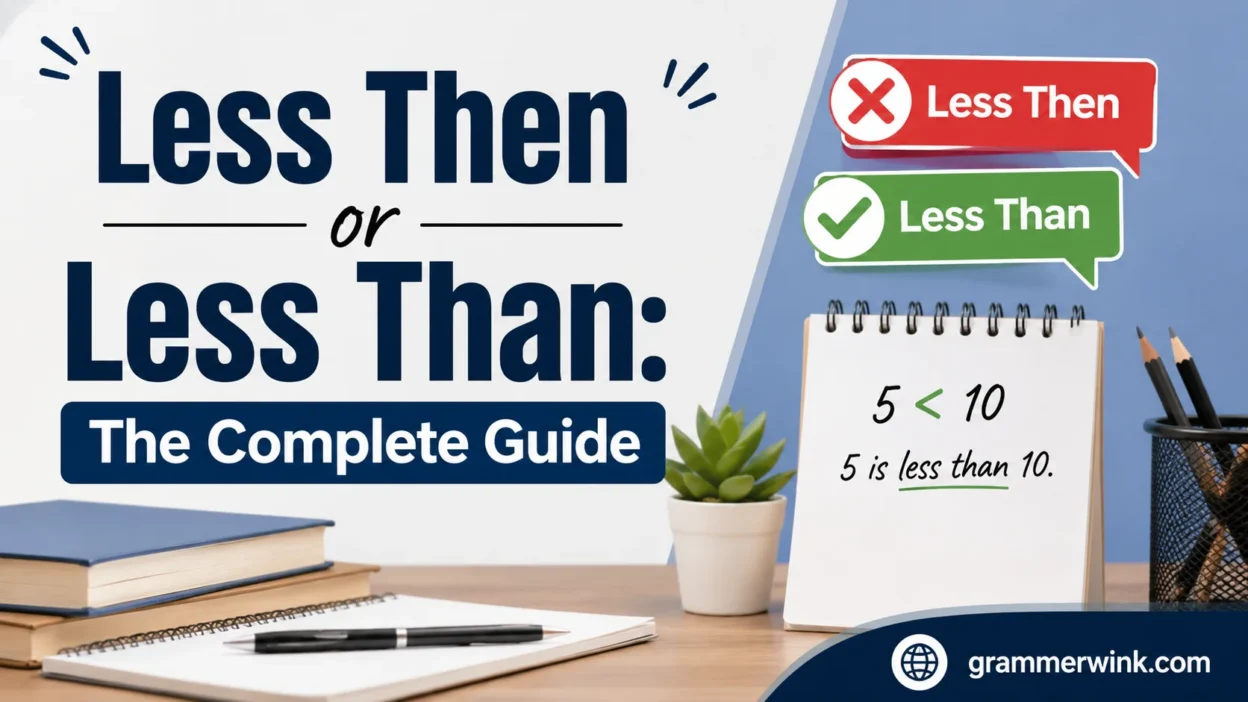
Less Then or Less Than is a common grammar question that confuses many English learners and writers.Although “then” and “than” sound similar, they have different meanings and uses.Understanding this small difference can make your writing clearer, more accurate, and professional.The word “than” is mainly used for comparisons, while “then” relates to time or sequence.For example, we say “less than” when comparing amounts, numbers, or quantities in a sentence.Learning this simple grammar rule can help you avoid mistakes in everyday English.
The confusion between less then and less than often appears in writing, texting, and online communication.Many people choose “then” because it sounds similar, but the correct expression is usually “less than.”For instance, “less than ten” means a number or amount is below ten in value.In contrast, “then” usually shows what happens next or describes a specific time.Knowing this key distinction makes it easier to choose the correct word confidently.It also improves your grammar skills, especially when writing comparisons and explanations.
In this complete guide, we’ll explain less than and less then with clear examples.You’ll discover which phrase is correct, why the mistake happens, and how to remember the difference.We’ll also explore common sentences, practical examples, and useful grammar tips for everyday writing.Whether you’re a student, writer, teacher, or English learner, these guidelines can make grammar easier.By the end, you’ll clearly understand when to use “than” and when “then” is appropriate.So, let’s explore this common grammar confusion and learn how to use both words correctly.
Less Then or Less Than: The Core Difference Explained
Let’s clear the confusion right away.
- Less than → correct phrase (used for comparison)
- Less then → incorrect in standard English
Here’s the key idea:
“Than” compares. “Then” talks about time.
That one distinction solves almost every mistake.
Quick Examples
- ✔ I have less than five dollars.
- ✔ She runs faster than me.
- ❌ I have less then five dollars. (wrong)
Now compare that with “then”:
- ✔ We went to the store, and then we went home.
- ✔ Finish your homework, then watch TV.
Simple rule: If you are comparing two things, you need than, not then.
Read More: Home Made or Homemade: The Complete Guide to Spelling
Why People Confuse “Less Then” and “Less Than”
This mistake happens for a few real reasons, not carelessness.
1. Sound similarity in speech
When spoken quickly, than and then sound almost identical. Your brain hears the same sound and guesses the wrong spelling.
2. Fast typing habits
Most errors happen while typing quickly on phones or laptops. Autocorrect doesn’t always catch it because “then” is a real word.
3. Weak grammar memory
Many learners remember “then = time” but forget the comparison rule tied to “than.”
4. Influence of casual writing
On social media, grammar rules often break down. People copy what they see instead of what’s correct.
The Simple Grammar Rule You Must Remember
Here’s the golden rule:
Use than for comparisons. Use then for time or sequence.
Think of it like this:
WordFunctionExampleThanComparisonShe is taller than me.ThenTime / orderWe ate dinner, then slept.
If you only remember this table, you’ll avoid 95% of mistakes.
Deep Dive: What “Than” Actually Does in English
“Than” is a comparative conjunction. That sounds technical, but the idea is simple.
It connects two things you are comparing.
Examples of comparison:
- He is smarter than his brother.
- This phone is cheaper than that one.
- Coffee is stronger than tea.
Notice the pattern:
Something + verb/adjective + than + comparison point
A closer look
- “bigger than”
- “faster than”
- “more interesting than”
Even when sentences get long, the structure stays the same.
For example:
- This book is more interesting than the one I read last week during my trip.
Still just a comparison.
What “Then” Actually Means (So You Never Mix It Again)
“Then” is about time, order, or consequence.
Think of it as a timeline marker.
Main uses of “then”:
- Sequence of actions
- Cause and effect
- Future planning steps
Examples:
- I finished work, then I went home.
- If it rains, then we’ll cancel the trip.
- First eat, then study.
Memory trick:
“Then” = “When things happen next”
If you feel a sentence moving forward in time, “then” is your word.
Side-by-Side Comparison: Less Than vs Less Then
Let’s make this crystal clear.
Sentence TypeCorrect VersionWhyComparisonI have less than 10 minutesComparing quantityTime orderI studied, then I sleptSequence of eventsIncorrectI have less then 10 minutes“Then” is not for comparison
Once you see them side-by-side, the difference becomes obvious.
Real-World Usage Examples
Here’s how “less than” appears in real writing and speech.
Everyday life:
- I spend less than an hour on social media daily.
- This bag weighs less than 2 kilograms.
- We have less than five seats available.
School and learning:
- The exam took less than 60 minutes.
- She scored less than 50 percent.
Business context:
- The project cost less than expected.
- We need less than a week to finish.
Notice something? It always compares quantity, time, or value.
Common Mistakes People Make
Let’s break down typical errors so you can avoid them.
Mistake 1: Using “then” for comparison
- ❌ This is less then perfect
- ✔ This is less than perfect
Mistake 2: Mixing time and comparison
- ❌ I have less then five minutes then I leave
- ✔ I have less than five minutes, then I leave
Mistake 3: Overthinking grammar rules
Some learners try to translate directly from their native language, which leads to confusion.
A Simple Memory Trick That Actually Works
Try this mental shortcut:
“Than compares, then tells when.”
Say it out loud a few times.
Now imagine this scenario:
- You compare apples → than
- You plan steps in cooking → then
Visual analogy:
Think of a scale:
- “Than” = weighing two things
- “Then” = stepping stones in time
Mini Case Study: A Real Writing Error
Let’s look at a realistic example from informal writing:
“I have less then 10 minutes to finish this task.”
What went wrong?
The writer intended a comparison but used a time word instead.
Correct version:
“I have less than 10 minutes to finish this task.”
Why it matters:
In professional writing, small grammar mistakes can:
- Reduce clarity
- Affect credibility
- Distract the reader
Even a tiny word like “then” vs “than” changes meaning completely.
Grammar Insight: Why “Less Than” Works This Way
English evolved from multiple language systems, especially Germanic and Latin roots. Over time:
- “Than” became the standard comparison connector.
- “Then” developed separately to show time or sequence.
Even though they look similar, they serve completely different grammatical roles.
Quick Practice Section
Try fixing these sentences:
- I have less then 20 dollars.
- She is better then me at chess.
- We will eat, then we will leave.
- This box weighs less then 5 kg.
Answers:
- I have less than 20 dollars.
- She is better than me at chess.
- (Correct) We will eat, then we will leave.
- This box weighs less than 5 kg.
Comparison Table: Than vs Then vs Other Confusing Words
WordMeaningExampleThanComparisonBigger than yoursThenTime/orderWe ate then leftTherePlacePut it thereTheirPossessionTheir house is bigThey’reThey areThey’re coming
This shows how small spelling differences change meaning completely.
Expert Tip: Train Your Brain for Automatic Correct Usage
You don’t need to memorize grammar rules endlessly. Instead, train pattern recognition.
Try this method:
- Read 5 sentences with “than” daily
- Write 5 sentences using comparisons
- Replace “then” mistakes immediately when you spot them
Over time, your brain starts correcting it automatically.
Common Questions About Less Then or Less Than
Is “less then” ever correct?
No. In standard English, it is always incorrect when used for comparison.
Why do people still use it?
Because speech doesn’t clearly separate the two sounds.
Can autocorrect fix it?
Sometimes yes, but not always. You still need to understand the rule.
Final Summary: The One Rule That Solves Everything
If you forget everything else, remember this:
Use than when comparing things. Use then when talking about time or order.
That single distinction removes nearly all confusion around less then or less than.
Closing Insight
Language mistakes like this are small, but they matter more than people think. They shape clarity, confidence, and how others perceive your writing.
Once you master this rule, you won’t just avoid an error—you’ll write with more precision and confidence every time you compare or explain something.
FAQs
Why do people confuse less then or less than so often?
Most confusion comes from sound. When you speak quickly, “than” and “then” sound almost identical. On top of that, typing habits and autocorrect mistakes make it worse. Your brain often relies on sound instead of spelling, which leads to the error.
Is “less then” ever grammatically correct?
No. In standard English, “less then” is always incorrect when you are comparing things. The correct phrase is always “less than”. The only time “then” works is when you talk about time or sequence, not comparison.
What is the easiest way to remember the difference?
I have less than 10 dollars.I finished my work, then I relaxed. Say it a few times and it starts to stick naturally.
Does “less than” only apply to numbers?
No. You can use less than for numbers, time, feelings, or anything measurable.It always works when you compare quantities or levels.
Can writing “less then” affect professionalism?
Yes, it can. In formal writing, even small grammar mistakes like this can reduce clarity and make your writing feel less polished. Readers may pause and question your attention to detail, even if the meaning is still understandable.
Conclusion
The difference between less then and less than is small, but it carries big meaning. One word compares. The other shows time. That’s it.Once you lock in this rule, you stop guessing and start writing with confidence:Think of it like a mental switch. If your sentence compares, flip to than. If it moves through time, go with then.With practice, this choice becomes automatic. You won’t even think about it—you’ll just write it correctly.