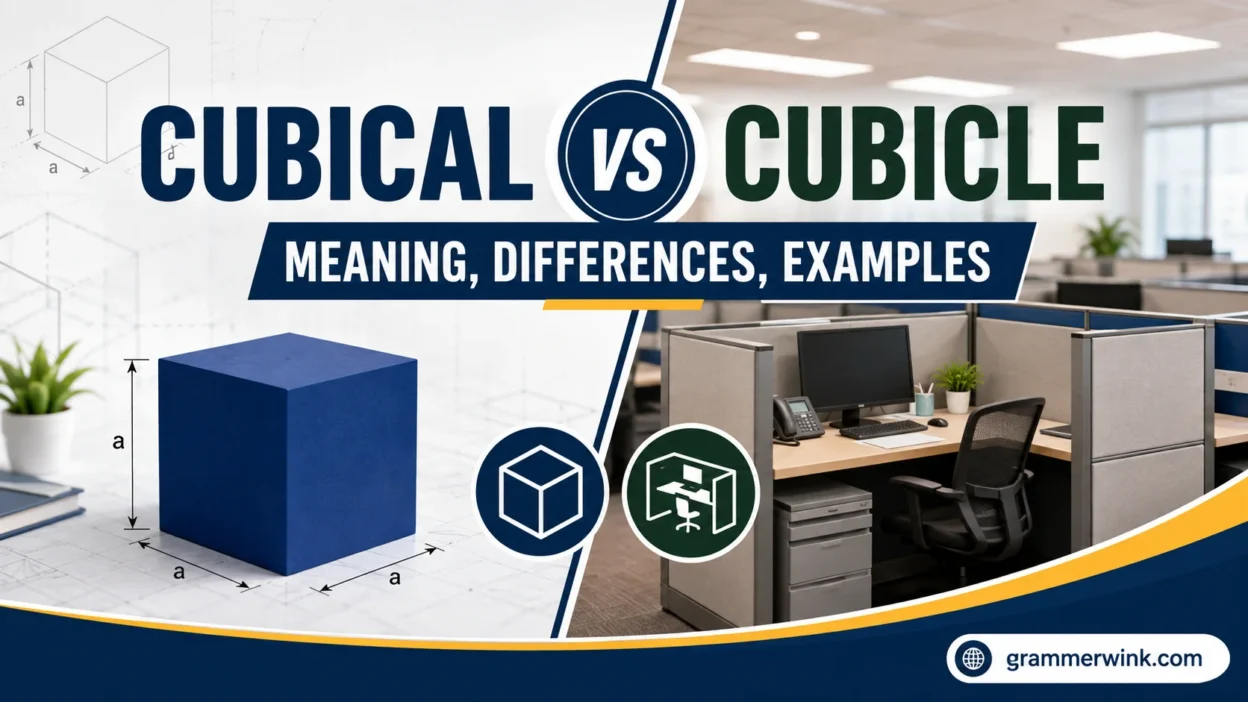
Cubical vs. Cubicle can be confusing because these two words look and sound very similar, but they have different meanings and are used in different situations. The word cubical is mainly an adjective that describes something shaped like a cube, with equal dimensions on all sides. In contrast, cubicle is a noun that refers to a small enclosed space, especially one used as an office or workplace. Understanding this key difference can help you avoid common vocabulary mistakes. Although both words begin with “cub,” their meanings developed in different ways. Cubical is often connected with shape, structure, and geometry, while cubicle is more commonly connected with spaces, offices, and privacy. Learning how each word works in a sentence makes the distinction much easier to remember.
The term cubical is used when something has a cube-like shape or relates to a cube. For example, you might describe a cubical box, a cubical room, or a structure with equal-length sides. It is closely related to the noun cube and is often found in descriptions involving mathematics, architecture, design, or objects. Meanwhile, a cubicle is a small section of a larger room that is usually separated by walls, panels, or partitions. You may see cubicles in an office, workplace, school, hospital, or changing area. Because the words sound so alike, writers sometimes accidentally use one when they mean the other. Knowing their parts of speech, meanings, and examples can prevent this confusion.
When comparing cubical vs. cubicle, the easiest way to remember the difference is to focus on shape versus space. Cubical describes something that resembles a cube, whereas cubicle names a small divided area where people may work, change clothes, study, or perform another activity. For instance, “The artist created a cubical sculpture” describes the sculpture’s shape, while “She works in a cubicle” identifies her workspace. These words also differ grammatically because cubical is usually an adjective, while cubicle is a noun. Once you connect cubical with cubes and cubicle with enclosed spaces, the distinction becomes simple. In this guide, we’ll explore their definitions, differences, usage, and examples to make both words easy to understand and use correctly.
Cubical vs Cubicle: Quick Meaning Overview
Before we go deep, you need a clean mental picture of both words.
- Cubical → an adjective that describes something shaped like a cube
- Cubicle → a noun that refers to a small enclosed space
Think of it like this:
Cubical = geometry and shape Cubicle = workplace or compartment
That’s the foundation. Everything else builds from it.
Now let’s explore each word in detail so you never mix them up again.
What Does Cubical Mean?
The word cubical comes from “cube,” a three-dimensional shape with equal sides. When you use “cubical,” you describe something that resembles or relates to that cube shape.
Cubical Meaning in Simple Terms
Cubical = cube-shaped
It describes form, not function. You never use it to describe a room or workspace.
Where You See “Cubical” in Real Life
You won’t hear “cubical” in casual office talk. Instead, you’ll find it in technical or descriptive contexts.
Common uses include:
- Geometry and math descriptions
- Scientific modeling
- Engineering structures
- Design descriptions
Examples of Cubical Usage
- The experiment used a cubical container to hold liquid evenly.
- The architect designed a cubical structure for better symmetry.
- The toy consists of small cubical blocks that stack easily.
- The ice crystals formed a cubical pattern under a microscope.
Each example focuses on shape, not purpose.
Key Characteristics of Cubical
Let’s simplify what makes “cubical” distinct:
- It describes shape only
- It works as an adjective
- It connects to geometry and physical form
- It rarely appears in daily conversation
- It never refers to a room or workplace
Here’s a quick memory trick:
If you can visualize a cube in your head, “cubical” fits.
Read More: What Do You Call Someone Who Loves Nature
What Does Cubicle Mean?
Now let’s switch gears completely.
The word cubicle has nothing to do with geometry in daily usage. Instead, it describes a small, enclosed space designed for privacy or function.
You see cubicles everywhere in modern life, especially in workplaces.
Simple Definition of Cubicle
Cubicle = a small enclosed compartment or workspace
It acts as a noun. You can physically sit inside it or use it.
Where You Find Cubicles in Real Life
Cubicles appear in many environments where privacy or separation matters.
Common places include:
- Office workspaces
- Hospitals and clinics
- Changing rooms in stores
- Library study booths
- Testing centers
Real Examples of Cubicle Usage
Let’s make this practical:
- She decorated her office cubicle with plants and photos.
- The hospital uses cubicles to separate patients.
- He waited inside a cubicle at the voting center.
- The store provides private changing cubicles for customers.
Notice how each example describes a physical space you can enter or use.
Key Characteristics of Cubicle
Here’s what defines “cubicle”:
- It is a noun
- It describes a physical space
- It often includes walls or partitions
- It provides privacy or separation
- It appears frequently in workplace language
A simple way to remember it:
If you can sit or stand inside it, it’s a cubicle.
Cubical vs Cubicle: The Core Differences Explained
Now let’s put both words side by side so the contrast becomes crystal clear.
FeatureCubicalCubicleWord typeAdjectiveNounMeaningCube-shapedSmall enclosed spaceFocusShapeFunction or placeUsageTechnical, geometricEveryday, workplaceCan you sit inside it?NoYesExampleCubical objectOffice cubicle
This table alone clears most confusion. But let’s go deeper so you never rely on memory tricks again.
Why People Confuse Cubical vs Cubicle
This confusion doesn’t happen randomly. There are real linguistic reasons behind it.
Similar spelling
Both words share:
- “cubi”
- Similar rhythm
- Almost identical pronunciation in fast speech
That alone causes mistakes in writing.
Shared root word: “cube”
Both words come from the idea of a cube, but they evolved differently:
- Cubical stayed close to geometry
- Cubicle evolved into a spatial term
So even though they look related, they serve totally different purposes.
Workplace exposure
Most people encounter “cubicle” at work, not “cubical.” That makes “cubical” feel like a natural variation, even when it’s incorrect.
Autocorrect and typing errors
People often type quickly and rely on autocorrect. That sometimes reinforces wrong usage if the system “accepts” the wrong form.
The Simple Trick to Never Mix Them Up Again
You don’t need grammar rules memorized. You just need one mental shortcut.
Ask yourself this question:
Am I talking about shape or space?
- Shape → use cubical
- Space → use cubicle
Another memory trick
- Cubical = Cube-shaped → think geometry class
- Cubicle = Little room → think office desk
If you visualize it, your brain locks it in faster.
Common Mistakes with Cubical vs Cubicle
Let’s fix real errors people make every day.
Wrong usage examples
- ❌ He works in a cubical
- ❌ The cubicle shape is strong
- ❌ She redesigned her cubical at work
Correct versions
- ✔ He works in a cubicle
- ✔ The structure has a cubical shape
- ✔ She decorated her cubicle at work
Small difference. Big impact on clarity.
Real-World Scenarios: How Each Word Works in Context
Now let’s bring both words into realistic situations so you see how natural usage looks.
Cubical in Academic and Technical Writing
In scientific or mathematical writing, “cubical” often appears when describing shapes or structures.
Example scenario:
A student writes a physics report:
“The experiment used a cubical container to ensure equal pressure distribution.”
Here, “cubical” describes form, not function.
Cubicle in Office Life
Now shift to a real workplace.
Imagine walking into an open-plan office. You see rows of desks with small partitions.
Someone says:
“I’ve decorated my cubicle to make it feel more personal.”
That’s natural, correct usage.
You wouldn’t say “cubical” here because it makes no sense.
Cubical vs Cubicle in Everyday Communication
Let’s compare how both words sound in real conversations.
Conversation Example 1
Person A: Where do you sit at work? Person B: In a cubicle near the window.
Conversation Example 2
Teacher: What shape is this object? Student: It has a cubical structure.
Notice how context completely determines the correct word.
Case Study: How Misuse Creates Confusion in Professional Writing
Let’s look at a real-world communication problem.
Situation
A company posts a job listing that says:
“Work in a modern cubical environment with flexible seating.”
Problem
The word “cubical” is incorrect here. It confuses applicants and makes the company look careless.
Correct version
“Work in a modern cubicle-based environment with flexible seating.”
Impact of correction
- Clear meaning improves readability
- Professional tone increases trust
- No ambiguity in workplace description
This shows how small word errors affect perception.
Expert Insight on Word Precision
Linguists often emphasize one simple idea:
“Precision in language reduces misunderstanding.”
That applies perfectly here.
When you choose between cubical vs cubicle correctly, you:
- Improve clarity
- Avoid confusion
- Strengthen professional writing
- Communicate intent more effectively
Quick Reference Summary
Let’s compress everything into one simple recap.
Cubical
- Adjective
- Describes cube-like shape
- Used in geometry or science
- Focuses on structure
Cubicle
- Noun
- Describes small enclosed space
- Common in offices and public areas
- Focuses on function and use
Final Takeaway: Cubical vs Cubicle Made Simple
You don’t need to overthink this anymore.
Just remember:
- If you describe shape, use cubical
- If you describe a space you can use, use cubicle
That’s it. No complicated grammar rules. No exceptions to memorize.
Once you internalize that distinction, you’ll never confuse them again—even when typing fast or writing under pressure.
And honestly, that’s the real goal here: clear communication that just works.
FAQs
What is the main difference between cubical and cubicle?
The main difference is simple. Cubical describes a shape that looks like a cube, while cubicle refers to a small enclosed space, often used in offices or changing rooms. One talks about form. The other talks about a place you can actually use.
Is “cubical” a correct English word?
Yes, “cubical” is a correct English word. It works as an adjective. You use it when describing something that has a cube-like shape. For example, you might say, “The structure has a cubical design.”
Can I use cubicle instead of cubical?
No, you cannot swap them. They serve different meanings. If you say “cubicle shape,” it sounds wrong because cubicle is not a shape descriptor. It refers to a space, not geometry or form.
Why do people confuse cubical and cubicle so often?
People confuse them because they look and sound similar. Both come from the root word “cube,” so the brain assumes they are related in meaning. On top of that, most people hear “cubicle” more often in daily life, especially in office settings, which increases the mix-up.
Where do we most commonly use the word cubicle?
You mostly hear “cubicle” in workplaces, hospitals, and public spaces. For example:
- Office workstations with partitions
- Changing rooms in stores or gyms
- Private booths in clinics or testing centers
It always refers to a small enclosed area, not a shape.
Conclusion
At first glance, cubical vs cubicle looks like a small spelling issue, but the meaning difference runs much deeper. One belongs to the world of shape and geometry. The other lives in real-world spaces like offices and public buildings.Here’s the simplest way to lock it in:If you remember that one line, you’ll avoid almost every mistake.So next time you write about an office setup or describe a shape, pause for a second. Ask yourself: Am I talking about form or function? That quick check will keep your writing clean, accurate, and professional every single time.