When learning English, spelling differences can sometimes create confusion between two similar-looking words.Connector and connecter may appear almost identical, but their usage is not always the same.The word connector is widely accepted in modern English and appears frequently in dictionaries.It can describe something that joins, links, or brings two things together.For example, a cable connector, sentence connector, or transport connector serves a linking purpose.Understanding the correct spelling helps you communicate more clearly in writing and conversation.
The spelling connecter is also possible in certain English contexts, although it is much less common.It generally refers to a person or thing that connects something with another thing.However, most writers and speakers prefer connector because it is the more standard and familiar form.This difference can be especially important in formal writing, education, and professional communication.Knowing when to use each spelling can prevent grammar mistakes and improve your writing accuracy.It also helps learners recognize why some words have different endings but similar meanings.
In this guide, we will explore the meaning, spelling, and practical difference between connector and connecter.You will learn why connector is generally the preferred choice in modern English usage.We will also examine examples showing how the word works in technology, grammar, and everyday language.Understanding these examples makes the correct spelling easier to remember and apply naturally.Whether you’re a student, writer, or English learner, this distinction can improve your language skills.By the end, you’ll know which form is more appropriate and how to use it with confidence.
Connector or Connecter: The Short Answer
Here’s the simplest rule:
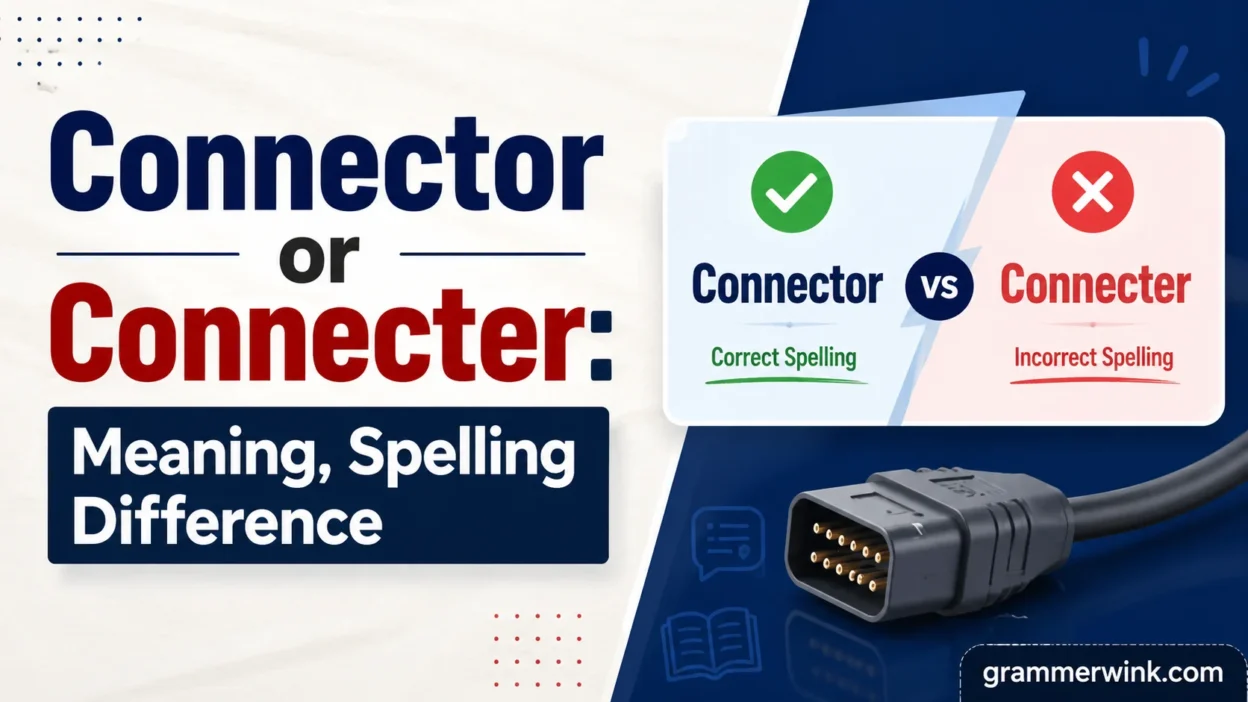
“Connector” is the standard, widely accepted modern spelling. “Connecter” is rare and considered outdated or variant usage.
If you’re writing for school, business, technical content, or everyday communication, you should always use:
✔ Connector
The spelling “connecter” may still appear in older texts or specific regional usages, but modern English strongly favors “connector.”
Why “Connector or Connecter” Causes Confusion
This confusion doesn’t come out of nowhere. English actually invited it.
Let’s break it down.
The root word: “connect”
The verb connect comes from Latin connectere, meaning “to bind together.”
From there, English creates nouns using suffixes like:
- -or (actor, doctor, connector)
- -er (teacher, worker, connecter)
Both suffixes feel natural. That’s the problem.
Two competing patterns in English
English often allows multiple noun forms:
Base VerbVariant AVariant Bactactor—teachteacher—connectconnectorconnecter (rare)
So historically, both forms could exist. But usage patterns eventually decided the winner.
Connector vs Connecter: Modern Usage Reality
Today’s English strongly prefers connector across almost every domain.
Here’s how it breaks down in real-world usage:
1. General English usage
- ✔ connector → standard
- ✖ connecter → rarely used
Example:
- The cable uses a USB connector.
Not:
- The cable uses a USB connecter.
2. Technical and engineering usage
In engineering, electronics, and manufacturing, connector is the official term.
Examples:
- electrical connector
- fiber optic connector
- data connector
- pipeline connector
These terms appear in:
- IEEE documentation
- engineering manuals
- product specifications
No major technical standard prefers “connecter.”
3. Software and data systems
In programming and data engineering, “connector” is dominant.
Examples:
- database connector
- API connector
- Salesforce connector
- integration connector
You will never see “connecter” in modern API documentation.
4. British vs American English
This is where things get interesting.
Some people assume:
- “connector” = American English
- “connecter” = British English
But that’s not accurate today.
Both American and British English overwhelmingly use:
connector
“Connecter” appears only occasionally in older British texts.
What Dictionaries Say About Connector or Connecter
Let’s look at how major references treat both forms.
Oxford-style usage trend
- Primary entry: connector
- “Connecter” listed as rare or variant
Merriam-Webster usage
- Main form: connector
- “Connecter” rarely included in modern entries
Cambridge Dictionary
- Uses only: connector
Real conclusion from dictionaries:
Modern dictionaries agree: “connector” is the correct and preferred form.
Where “Connecter” Still Appears Today
Even though “connector” dominates, “connecter” hasn’t completely vanished.
You might still see it in:
1. Older literature
Books and technical documents from the 19th and early 20th centuries sometimes use “connecter.”
2. Regional or stylistic preferences
Some writers or small publications may still use it out of habit.
3. Non-standard or informal writing
Occasionally appears in:
- forums
- drafts
- non-edited content
4. Historical linguistic preservation
Some dictionaries still list it as a variant to preserve linguistic history.
But in all modern professional contexts, it’s considered outdated.
Meaning of Connector (Clear Definition)
Let’s define it properly so you can use it confidently.
A connector is something that joins, links, or attaches two or more things together.
That definition applies across fields.
Read More: Home Made or Homemade: The Complete Guide to Spelling
Types of Connectors in Real Life
To make this practical, let’s break connectors into categories you actually encounter.
Electrical connectors
Used in electronics to join circuits.
Examples:
- USB connector
- HDMI connector
- coaxial connector
Mechanical connectors
Used in physical structures.
Examples:
- pipe connector
- joint connector
- fastener connector
Data connectors
Used in software and databases.
Examples:
- API connector
- cloud connector
- database connector
Linguistic connectors
In grammar, connectors link ideas.
Examples:
- and
- but
- however
- therefore
Connector in Grammar: A Hidden Layer People Miss
In writing, connectors matter more than people realize.
They shape how ideas flow.
Example without connectors:
I went to the store. I bought milk. I came home. It rained.
Example with connectors:
I went to the store, and I bought milk. Then I came home before it rained.
The second version feels natural because connectors guide the reader.
Connector or Connecter in SEO Writing
If you’re writing content online, this choice actually matters.
Search engines standardize language based on usage frequency.
SEO reality:
- “connector” has high search volume
- “connecter” has low search volume
- most users search “connector”
Keyword impact table
KeywordSearch DemandSEO RecommendationconnectorHighUse thisconnecterVery lowAvoid unless necessary
If you use “connecter,” you risk:
- lower ranking
- confusion
- reduced credibility
Real-World Case Study: Product Naming Consistency
Let’s look at how companies handle this.
Example: Tech hardware brands
Most manufacturers standardize on:
- USB connector
- HDMI connector
- power connector
They never label products as “connecter.”
Why?
Because:
- Standardization improves clarity
- Global markets expect one spelling
- Technical documentation must stay consistent
Even minor spelling differences can cause confusion in engineering specs.
Common Mistakes with Connector or Connecter
Here are mistakes writers often make:
Mistake 1: Thinking both are equally correct
They are not. One dominates modern usage.
Mistake 2: Using “connecter” in formal writing
This weakens credibility in professional contexts.
Mistake 3: Overthinking regional variation
Modern English doesn’t split this word geographically anymore.
Mistake 4: Mixing usage in the same document
This creates inconsistency and looks unpolished.
Simple Memory Trick to Remember the Correct Form
Here’s an easy way to lock it in your mind:
Think of “connectOR” like “actOR” or “directOR.”
Most English words for agents (a person or thing that does something) end in -or, not -er.
So:
- act → actor
- direct → director
- connect → connector
That pattern makes “connector” easier to remember.
Connector or Connecter: Side-by-Side Comparison
FeatureConnectorConnecterModern usageStandardRareDictionary preferenceYesLimitedTechnical writingAlways usedNot usedSEO valueHighVery lowClarityHighConfusingRecommendationUse itAvoid it
Practical Examples You Can Copy
Here’s how “connector” appears in real sentences:
- The technician replaced the damaged connector.
- This software includes a database connector for MySQL.
- Make sure the HDMI connector is firmly attached.
- Grammar connectors improve sentence flow.
- The pipe connector prevents leakage.
Notice something important: Every example sounds natural and professional.
Now compare:
- The technician replaced the damaged connecter. ❌ (unnatural in modern usage)
Expert Insight on Language Evolution
Language evolves based on usage, not rules written in stone.
Over time, English simplifies toward:
- clarity
- frequency
- consistency
That’s why connector won the battle while “connecter” faded into historical usage.
Linguists often describe this process as standardization through dominance—the most commonly used form becomes the default.
When (If Ever) Should You Use “Connecter”?
Honestly, almost never.
You might only consider it when:
- quoting historical documents
- analyzing older texts
- preserving original spelling in academic work
Even then, you should usually add a note explaining it.
Final Takeaway
If you remember only one thing from this guide, make it this:
Use “connector” in all modern writing. Avoid “connecter” unless you are referencing historical or rare usage.
It keeps your writing clear, professional, and aligned with current English standards.
FAQs
Is “connector” or “connecter” correct in modern English?
Connector is the correct and widely accepted spelling today. You will see it in dictionaries, technical writing, and everyday usage. “Connecter” exists, but people rarely use it in modern contexts.
Why do some people still write “connecter”?
Some writers use “connecter” because older English texts included it as a variant. In some cases, it comes from habit or confusion with other “-er” nouns like teacher or worker. However, modern usage strongly favors “connector.”
Does British English use “connecter” instead of “connector”?
No. Both British and American English primarily use connector. The idea that “connecter” belongs to British English is a common myth. Today, British publications also use “connector” almost exclusively.
Is “connecter” wrong or just old-fashioned?
It’s not technically “wrong,” but it is outdated and non-standard in modern writing. If you use it in business, technical, or academic work, it will likely look incorrect or unprofessional.
Conclusion
At the end of the day, the choice is simple once you see how modern English works.“Connector” has become the standard because it dominates real-world usage across industries, education, and technology. It appears in official documentation, product naming, and academic writing. That consistency makes it the safest and most professional choice.
On the other hand, “connecter” survives mostly as a historical or rare variant. You might still stumble across it in older books or informal writing, but it no longer holds a place in modern standards.If you want your writing to stay clear, credible, and future-proof, stick with connector every time. It aligns with how people actually write, search, and communicate today.