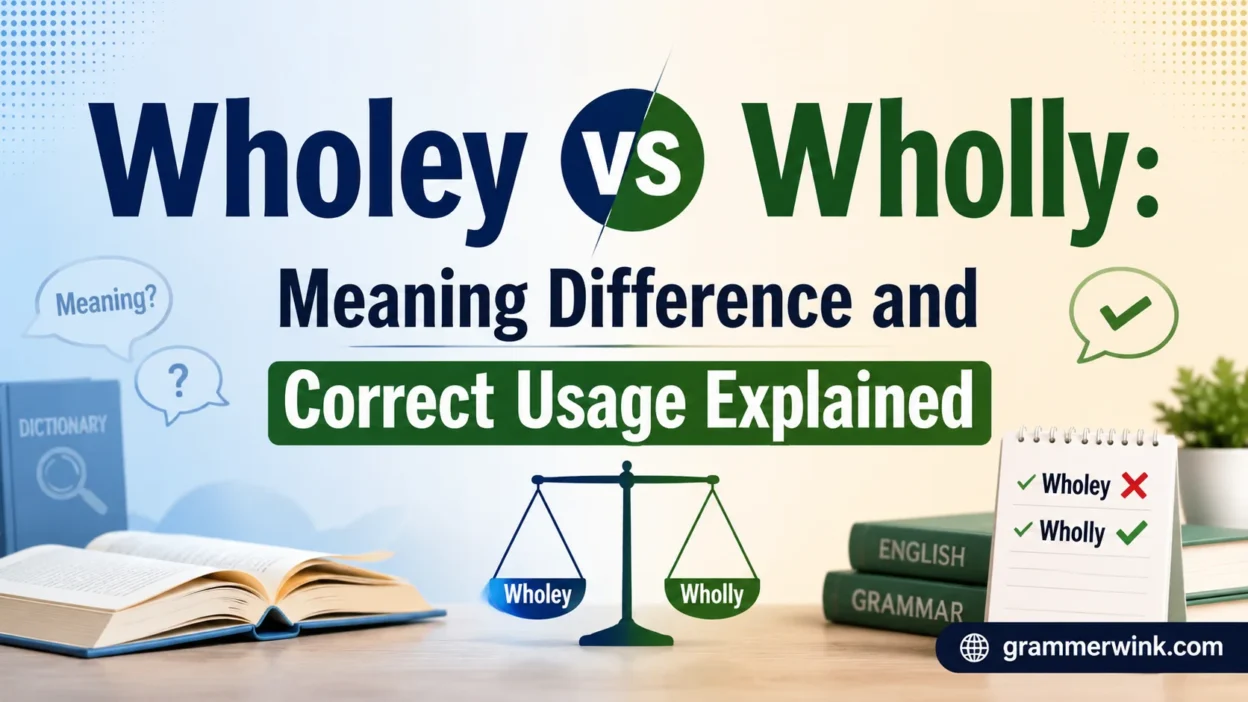
The difference between Wholey vs Wholly can be confusing because both words look and sound very similar at first glance. However, only “wholly” is the correct standard English spelling when you mean completely, entirely, or fully. The spelling “wholey” is generally incorrect and is usually treated as a common spelling mistake. Understanding this small difference can help you improve your writing, spelling, and overall communication. Whether you’re writing an article, email, essay, or everyday message, choosing the correct word makes your writing clearer.
The word “wholly” means completely or entirely and is often used to emphasize that something is total or absolute. For example, “She was wholly responsible” means she was completely responsible for something. Likewise, “I wholly agree” expresses complete agreement with an opinion or statement. The word comes from “whole,” meaning complete, and the “-ly” ending changes it into an adverb. Learning this connection makes the spelling easier to remember and helps you use wholly correctly in sentences.
In this guide, we’ll explore Wholey vs Wholly, including their meanings, differences, and correct usage in English. You’ll learn why “wholey” is considered incorrect, while “wholly” is the accepted form in standard English. We’ll also provide clear examples, useful explanations, and simple tips to help you remember the correct spelling. By understanding how wholly functions in different sentences, you can avoid common mistakes and write with greater confidence. Whether you’re a student, writer, or English learner, this guide will make the difference easy to understand.
Wholey vs Wholly: Quick Answer (No Confusion Version)
Let’s get straight to the point:
- Wholly = completely, entirely, fully (correct English word)
- Wholey = not a standard English word (usually a spelling mistake)
That’s it. The confusion comes from how closely “wholly” resembles the word whole, but English spelling doesn’t always behave the way logic suggests.
Here’s a quick example:
- ❌ I am wholely responsible for the mistake.
- ✅ I am wholly responsible for the mistake.
Small difference in letters. Big difference in correctness.
What “Wholly” Means in English
To understand Wholey vs Wholly, you first need to understand what wholly actually does in a sentence.
Definition of Wholly
Wholly (adverb) means:
- Completely
- Entirely
- Fully
- To the fullest extent
Think of it as a “100% signal” word. When you use it, you’re saying something is not partial or mixed—it is total.
How “Wholly” Works in Real Sentences
Let’s see it in action:
- “She is wholly committed to her studies.”
- “The report is wholly inaccurate.”
- “I am wholly convinced this is the right decision.”
- “The system is wholly dependent on internet access.”
Notice something? It strengthens meaning. It removes doubt.
Simple Mental Image
Imagine filling a glass with water.
- Half full → not wholly
- Almost full → still not wholly
- Filled to the brim → wholly
That’s the idea: completeness without leftovers.
Where “Wholey” Comes From (And Why It Fails)
Now let’s talk about the impostor in the pair: wholey.
Is “Wholey” a real English word?
No. In standard English:
- It is not listed as a recognized adverb
- It has no grammatical function
- It appears mainly as a misspelling of “wholly”
Why people write “wholey”
There are three main reasons:
1. Logical spelling assumption
Writers think:
whole → whole + ly → wholely → wholly
But English doesn’t always follow that neat pattern.
2. Pronunciation confusion
“Wholly” sounds like:
“hole-lee”
So people naturally try to match spelling to sound.
3. Influence of the word “whole”
Since “wholly” comes from “whole,” many assume the spelling should stay intact.
But English often modifies spelling for smoother structure.
Important takeaway
Just because a spelling looks logical doesn’t mean it exists in standard usage.
Is “Wholey” Ever Used at All?
Technically, yes—but not as a standard word.
1. As a misspelling
Most of the time, “wholey” appears in:
- Student essays
- Online posts
- Autocorrect mistakes
- Fast typing errors
2. As a proper noun (rare cases)
Sometimes “Wholey” appears as:
- A surname
- A brand name
- A fictional label
But these are names, not grammar rules.
Bottom line
You should never use “wholey” in formal writing unless you are referring to a specific proper noun.
Wholey vs Wholly: Side-by-Side Comparison
Let’s make this crystal clear.
| Feature | Wholly | Wholely |
| Correct spelling | Yes | No |
| Standard English word | Yes | No |
| Meaning | Completely / entirely | None |
| Usage in writing | Formal, academic, professional | Incorrect / typo |
| Dictionary listing | Yes | No |
| Example sentence | “I am wholly satisfied.” | Not valid |
Why “Wholly” Is Spelled That Way (Grammar Insight)
This is where things get interesting.
Root word origin
“Wholly” comes from:
- Whole (meaning complete or entire)
- adverb suffix -ly
But instead of becoming “wholely,” English simplifies it to:
wholly
Why the spelling changes
English often adjusts spelling to:
- Improve pronunciation flow
- Avoid awkward double vowel patterns
- Standardize adverb forms
We see similar changes in words like:
- true → truly (not truely)
- due → duly (not duely)
So “wholly” follows a known English pattern.
Key grammar rule
When forming adverbs from certain adjectives ending in silent “e,” English often drops or modifies the vowel structure for smoother spelling.
Read More: Less Then or Less Than: The Complete Guide
Pronunciation of Wholly (Why It Confuses Writers)
“Wholly” is pronounced:
/ˈhoʊ.li/ → “HO-lee”
It sounds identical to:
- holy (sacred)
- holey (full of holes)
That’s where confusion grows.
Quick tip
If you hear it in a sentence, you cannot rely on sound alone to spell it correctly.
Common Mistakes with Wholly vs Wholey
Let’s look at real writing errors people make.
Mistake 1: Adding an extra “e”
- ❌ wholely
- ❌ wholey
- ✅ wholly
Mistake 2: Confusing it with “whole”
- ❌ I whole agree with you
- ❌ I am wholely convinced
- ✅ I am wholly convinced
Mistake 3: Autocorrect dependence
Sometimes devices “correct” it incorrectly, especially in informal apps.
Mistake 4: Overthinking grammar rules
Writers assume consistency where English doesn’t provide it.
Memory Tricks to Never Mix It Up Again
Here are simple ways to lock it in your memory.
1. The “One L Rule”
Wholly = one “l” in the middle of seriousness
If you see extra letters creeping in, it’s wrong.
2. Replace it with “completely”Try this:
- If “completely” fits → use “wholly”
Example:
- “I am completely satisfied.”
- “I am wholly satisfied.”
Same meaning → correct usage confirmed.
3. Visual trick
Think:
Whole → Whole world → Fully complete → Wholly
4. Rhythm trick
Say it aloud:
WHO-ly = fully complete
Short, sharp, memorable.
Real-World Usage Case Studies
Let’s see how this plays out in real writing situations.
Case Study 1: Student Essay
Scenario:
A student writes:
“The author is wholely responsible for the character’s downfall.”
Problem:
- Spelling error weakens credibility
- Teacher flags it as grammatical mistake
Fix:
“The author is wholly responsible for the character’s downfall.”
Outcome:
Cleaner academic tone and higher score.
Case Study 2: Business Report
Scenario:
A manager writes:
“The project is wholely dependent on external funding.”
Problem:
- Looks unprofessional in formal documentation
Fix:
“The project is wholly dependent on external funding.”
Outcome:
Improved clarity and professionalism.
Case Study 3: Marketing Copy
Scenario:
A brand writes:
“We are wholely committed to customer satisfaction.”
Problem:
- Damages brand trust due to spelling error
Fix:
“We are wholly committed to customer satisfaction.”
Outcome:
Stronger credibility and polished tone.
Key insight from all cases
One small spelling error can quietly reduce authority—even if the meaning is clear.
Related Words That Cause Confusion
Understanding nearby words helps prevent mistakes.
Wholly vs Whole
- Whole = adjective or noun
- “a whole cake”
- Wholly = adverb
- “wholly satisfied”
Wholly vs Holistically
- Wholly = completely
- Holistically = considering the whole system or context
Example:
- “I am wholly convinced.”
- “We approached the issue holistically.”
Whole vs Hole
These sound similar but mean different things:
- Whole = complete
- Hole = empty space
A classic spelling trap.
FAQ:
Is “wholey” ever correct?
No. It is not a standard English word.
What does “wholly” mean in simple terms?
It means completely or entirely.
Why do people confuse the spelling?
Because it comes from “whole,” and pronunciation doesn’t clearly show spelling.
Can I use “wholly” in formal writing?
Yes. It is correct in academic, professional, and legal contexts.
What is the easiest way to remember it?
Think: “wholly = completely = 100%”
Conclusion
At this point, the confusion between wholey vs wholly should feel a lot less mysterious. The difference isn’t subtle once you strip it down. One word carries real meaning in English. The other doesn’t belong in standard usage at all.Here’s the clean takeaway:That’s really the whole story.What makes this pair tricky isn’t complexity—it’s familiarity. You see the word whole, you hear “ho-lee,” and your brain tries to rebuild the spelling logically. English doesn’t always cooperate with logic like that, though.
It follows convention, not instinct.So if you ever hesitate again, use a quick mental shortcut:If you can swap it with “completely,” then wholly is the right choice.Simple, fast, and reliable.In writing, small details like this matter more than people expect. A single letter can shift how polished your work looks. Once you get used to spotting it, you won’t just avoid a mistake—you’ll write with more confidence and flow.And that’s the real goal here: not memorizing a rule, but making the right choice feel automatic.