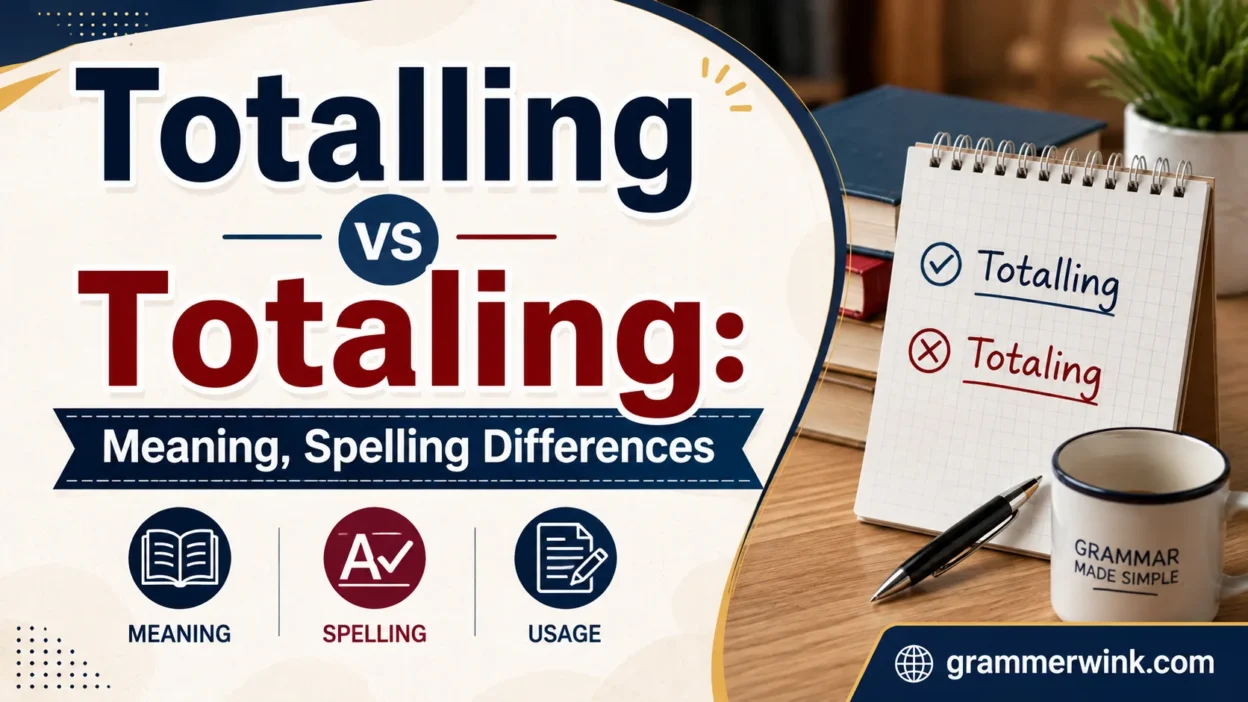
Totalling vs Totaling is a common spelling difference that often confuses writers, students, professionals, and English learners. While both words describe the act of adding numbers, calculating a sum, or reaching a final amount, their usage depends on the type of English spelling being followed. In British English, Totalling is the preferred form because verbs ending in -l usually double the final consonant before adding -ing. In American English, however, Totaling is the accepted spelling since the final l is generally not doubled. Understanding this distinction helps improve writing accuracy, grammar skills, professional communication, and overall language confidence.
Whether you are preparing an academic assignment, writing a business report, editing a financial document, or creating online content, knowing when to use Totalling or Totaling makes your writing more consistent and professional. Although the meanings are exactly the same, choosing the correct spelling depends entirely on your intended audience, country, and style guide. Many grammar mistakes occur because writers mix British English and American English within the same document. Learning these regional spelling rules ensures your content remains clear, credible, and easy for readers to understand regardless of the topic or industry.
In this complete guide, you’ll discover the meaning of Totalling vs Totaling, explore the major spelling differences, understand why the two forms exist, and learn when each version should be used. We’ll also examine practical examples, compare British and American English, highlight common grammar mistakes, and share useful writing tips for everyday communication. By the end of this article, you’ll confidently know which spelling fits your location, writing style, publication, and target audience, helping you avoid confusion and write polished, accurate English every time.
Totalling vs Totaling: What’s the Real Difference?
The difference between totalling and totaling comes down to regional spelling rules.
- Totalling → British English
- Totaling → American English
Both words come from the verb “to total,” which means to add numbers or determine a final amount.
So in practice:
- “She is totalling the expenses” → UK spelling
- “She is totaling the expenses” → US spelling
Simple rule. Different regions. Same meaning.
However, the story gets more interesting once you look at grammar rules behind the spelling change.
Meaning of Totalling / Totaling in Simple Terms
Both forms describe the same action: adding things together to reach a final number or result.
You’ll see it in contexts like:
- Accounting and finance
- Mathematics
- Inventory tracking
- Budgeting
- Data analysis
Core meaning breakdown:
- To calculate a final sum
- To combine multiple values
- To determine an overall amount
Example sentences:
- The cashier is totaling the bill after discounts.
- The accountant is totalling quarterly expenses.
- The app automatically totals your monthly spending.
Notice something important here. The meaning never changes. Only spelling shifts based on region.
Why Totalling and Totaling Are Spelled Differently
This difference comes from a broader spelling rule in English involving verb endings.
When you add “-ing” to a verb ending in “l”, you usually double the consonant in British English.
British English rule:
- travel → travelling
- cancel → cancelling
- total → totalling
American English rule:
- travel → traveling
- cancel → canceling
- total → totaling
So American English simplifies the spelling by dropping the extra letter. British English keeps it.
This difference didn’t happen randomly. It evolved over time as English split into regional standards.
Quick Comparison Table: Totalling vs Totaling
FeatureTotallingTotalingRegionBritish EnglishAmerican EnglishVerb baseTotalTotalGrammar formPresent participle / gerundPresent participle / gerundMeaningAdding numbers or calculating totalAdding numbers or calculating totalExampleShe is totalling receiptsShe is totaling receipts
This table shows the key point clearly. You don’t deal with two different meanings. You deal with two spelling systems.
Where You Will See Totalling vs Totaling in Real Life
Let’s make this practical. You’ll encounter these words in very specific environments.
Finance and Accounting
This is the most common usage area.
- Businesses total expenses
- Accountants total invoices
- Software totals revenue
Example:
- The system is totaling all transactions for the report.
In British firms, you may see:
- The system is totalling all transactions.
Same action. Different spelling.
Education and Mathematics
Teachers and students use both forms when discussing sums.
- Students total marks in exams
- Teachers total scores for grading
Example:
- The teacher is totalling exam scores before final grading.
In US classrooms:
- The teacher is totaling exam scores.
Technology and Software
Modern apps use this word constantly.
- Budget trackers
- Accounting tools
- Spreadsheets
- Analytics dashboards
Example:
- The app is totaling your weekly spending automatically.
This usage dominates in US-based software products.
Everyday Use
You also see it in daily life situations:
- Grocery bills
- Restaurant checks
- Personal budgeting
Example:
- The cashier is totaling your order.
Or in UK settings:
- The cashier is totalling your order
Read More: 10 Other Ways to Say “Thank You for Your Concern”
Grammar Role of Totalling / Totaling
Both forms function as:
- Present participle
- Gerund (noun form of a verb)
As a present participle:
- The accountant is totaling the figures.
As a gerund:
- Totaling expenses takes time during audits.
You can think of it like this:
- Present participle = action happening now
- Gerund = action used as a noun
This dual role makes the word flexible in writing.
Common Mistakes Writers Make
Even native speakers mix this up. Here are the most frequent errors.
Mixing British and American spelling
Wrong:
- She is totaling the invoices (UK article)
Wrong:
- She is totalling the invoices (US business report)
Correct depends on consistency, not preference.
Overthinking the double “L”
Writers often hesitate and second-guess the spelling.
A simple trick:
- If you use US English → one “l”
- If you use UK English → double “l”
Don’t overcomplicate it.
Confusing “total” and “totals”
These are related but different:
- Total (verb) → to add up
- Total (noun) → final amount
- Totals (plural noun) → multiple sums
Example:
- He will total the receipts.
- The total is $200.
- The totals are listed separately.
Real-World Case Study: Accounting Software Consistency
Let’s look at a practical example from accounting systems.
Many global platforms like spreadsheets and financial tools face a choice:
- Should they use “totaling” or “totalling”?
What most systems do:
- US-based systems → “totaling”
- UK localized versions → “totalling”
Why this matters:
A mismatch in spelling can:
- Look unprofessional
- Confuse users in regional markets
- Reduce perceived credibility
Example scenario:
A UK business using American software might see:
“System totaling completed.”
This feels slightly off to UK readers, even though it’s correct grammatically.
Localization fixes this by switching spelling based on region settings.
Why This Difference Still Matters Today
You might wonder: why care about one letter?
Here’s the reality.
It matters in:
- Academic writing
- Business communication
- content
- Publishing
- Software localization
Even small spelling differences signal:
- Professionalism
- Regional awareness
- Attention to detail
Search engines also recognize spelling variations, so using the correct version helps content match user intent better.
Insight: Totalling vs Totaling in Search
Search behavior splits along regional lines.
US search trends:
- “totaling expenses”
- “totaling calculator”
- “how to total numbers”
UK search trends:
- “totalling expenses”
- “totalling calculator”
- “how to tot up numbers” (informal variant)
Key takeaway:
Smart content often includes both variations naturally.
Not like this:
totaling / totalling / totalling / totaling repeated unnaturally
But like this:
- Use totaling in US-focused content
- Use totalling in UK-focused content
- Or mention both when targeting global readers
Practical Usage Examples (Side-by-Side)
Let’s make this crystal clear with real sentence pairs.
ContextBritish EnglishAmerican EnglishFinanceThe accountant is totalling expensesThe accountant is totaling expensesEducationShe is totalling exam scoresShe is totaling exam scoresRetailThe cashier is totalling the billThe cashier is totaling the billSoftwareThe system is totalling dataThe system is totaling data
Notice something consistent here. Only spelling changes. Meaning stays identical.
A Simple Memory Trick
If you struggle to remember which one to use, use this shortcut:
“Double L = London”
- Totalling → British English → London → double “L”
“Single L = USA”
- Totaling → American English → single “L”
This mental hook helps you pick the right form quickly without thinking too hard.
Why English Keeps These Variations
English doesn’t follow one strict global rulebook. Instead, it evolves across regions.
That’s why we see differences like:
- colour vs color
- travelling vs traveling
- organise vs organize
- totalling vs totaling
Language adapts to culture, history, and usage habits.
And honestly, that flexibility keeps English alive and dynamic.
Final Thoughts on Totalling vs Totaling
At the end of the day, totalling and totaling mean the same thing.
The only real difference comes down to:
- Geography
- Writing standards
- Audience expectations
If you write for the UK, use totalling. If you write for the US, use totaling.
And if you write for a global audience, just stay consistent within one style system.
One letter may seem small. But in writing, small details shape how professional your content feels.
So choose your spelling. Stick with it. And let clarity do the heavy lifting.
FAQs
Is “totalling” correct English?
Yes, totalling is correct in British English. It follows standard UK spelling rules where verbs ending in “l” double the consonant before adding “-ing.” You’ll commonly see it in UK newspapers, academic writing, and financial documents.
Is “totaling” wrong?
No, totaling is not wrong. It is the correct American English spelling. In the US, English simplifies many doubled consonants, so “totaling” replaces “totalling” without changing meaning.
Why does British English use double “l” in totalling?
British English follows a spelling convention where final consonants often double before suffixes like “-ing.” This rule applies to words like:
Which spelling should I use in professional writing?
It depends on your audience:For global audiences, pick one style and stay consistent throughout your documentConsistency matters more than preference.
Does the spelling affect meaning or ?
No, the meaning stays the same. However, spelling can affect search visibility. Users in the US tend to search “totaling,” while UK users search “totalling.” Using the correct version helps your content match regional search intent more accurately.
Conclusion
The difference between totalling and totaling is simple on the surface but important in practice. Both words describe the same action—adding numbers to reach a final result—but spelling shifts depending on regional English rules.British English prefers totalling, while American English uses totaling.
That one-letter difference reflects a broader pattern in English spelling, where regions evolved their own standards over time.If you remember one thing, keep it this: the meaning never changes, only the audience does. Choose the spelling that fits your readers, stay consistent, and your writing will always feel polished and professional.