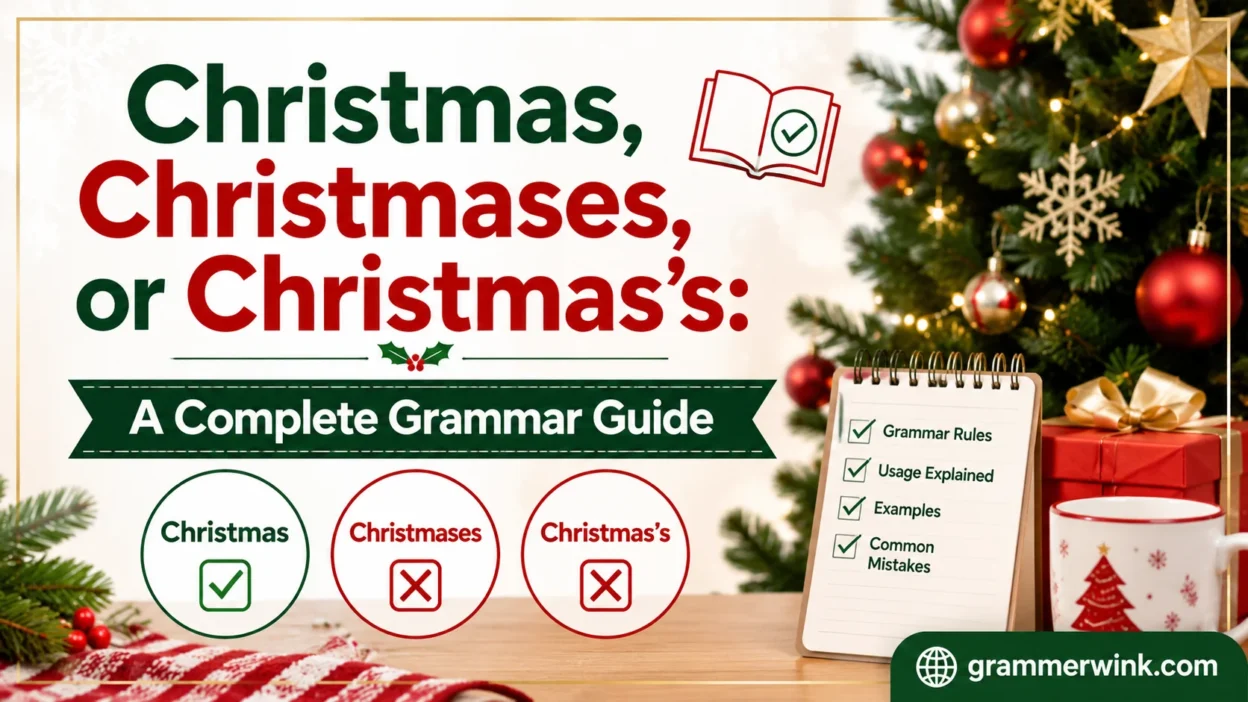
Christmas, Christmases, or Christmas’s can confuse many English learners because these similar-looking words follow different grammar rules. While they all come from the same noun, each form has a unique purpose in writing and speaking. Understanding the correct usage helps you avoid common grammar mistakes and communicate with greater confidence. Whether you are writing holiday greetings, school assignments, or professional emails, knowing the difference makes your writing more accurate and natural. This guide explains Christmas, Christmases, and Christmas’s in a simple, clear, and easy-to-understand way. By the end, you will know exactly when, where, and how to use each form correctly.
The word Christmas is the singular noun that refers to the Christian holiday celebrated on December 25 each year. Christmases is the plural form, used when talking about multiple Christmas celebrations across different years, families, or countries. Meanwhile, Christmas’s is the possessive form, showing that something belongs to or is associated with Christmas. These grammar rules may seem small, but they have a big impact on the clarity and professionalism of your writing. Learning these distinctions also improves your punctuation, sentence structure, and overall communication skills. Once you understand the pattern, using these forms becomes easy and natural.
In this complete grammar guide, you’ll discover the meaning, usage, and examples of each form with easy explanations and real-life sentences. We’ll also cover common mistakes, helpful grammar tips, and simple tricks to remember the correct spelling every time. Whether you’re a student, teacher, content writer, or someone who simply wants better English, this guide offers practical advice you can use immediately. You’ll learn the difference between singular, plural, and possessive nouns without complicated grammar terms. With plenty of examples, comparisons, and easy rules, you’ll gain the confidence to use Christmas, Christmases, and Christmas’s correctly in every situation.
Christmas: The Base Word You Start With
Let’s begin at the foundation: Christmas.
At its core, Christmas is a proper noun. It refers to the holiday celebrated on December 25 in many parts of the world. Because it is a proper noun, we always capitalize it.
How “Christmas” works in sentences
You’ll see it used in two main ways:
As a noun
- Christmas is my favorite holiday.
- We travel home for Christmas.
As an adjective
- Christmas lights brightened the street.
- She baked a Christmas cake.
In both cases, nothing changes in spelling. No apostrophes. No extra letters. Just Christmas.
A simple way to remember it
Think of Christmas as the “base version.” Everything else—plural or possessive—builds from it.
If you get this right, the rest becomes much easier.
Christmases: When You Talk About More Than One Year
Now things start to shift.
When you talk about multiple Christmas holidays, you use Christmases.
Yes, it looks slightly strange at first. That “-es” ending can feel heavy. But it follows a standard English plural rule for words ending in “s.”
What “Christmases” actually means
You use Christmases when referring to different years or repeated holiday experiences.
Real-world examples
- I’ve spent many Christmases traveling abroad.
- Those Christmases in my childhood felt magical.
- We haven’t had snow on recent Christmases.
Notice something important here: you are not talking about one holiday. You are talking about multiple instances of the holiday across time.
Why we don’t just say “Christmas”
If you say:
- I’ve had many Christmas…
It sounds incomplete. It refers to a single holiday, not repeated events. English solves this by turning it into a plural: Christmases.
Grammar breakdown (simple version)
- Christmas → ends in “s”
- To make plural → add “-es”
- Result → Christmases
This follows the same pattern as:
- bus → buses
- class → classes
- kiss → kisses
Common mistake writers make
One of the most frequent errors is using an apostrophe:
- ❌ Christmas’s memories (when meaning multiple holidays)
- ❌ Christmas’s I’ve spent abroad
That apostrophe changes the meaning completely. It turns plural into possessive, which is not what you want.
Memory trick
Here’s a simple mental shortcut:
If you can count it across years, use Christmases.
Christmas’s: The Possessive Form That Causes Confusion
Now we arrive at the most controversial form: Christmas’s.
This one triggers hesitation because it looks wrong to many people. Some writers avoid it completely. Others use it freely. So what’s going on?
What “Christmas’s” actually means
The apostrophe + “s” shows possession or association.
It means something belongs to or is linked with Christmas.
Examples in real usage
- Christmas’s magic fills the air.
- Christmas’s traditions differ around the world.
- The Christmas’s spirit is felt in every home.
Here, Christmas is acting like it owns or produces something: magic, traditions, spirit.
Why it feels awkward
Even though it is grammatically correct, it often sounds slightly heavy in modern writing.
Because of that, many writers prefer a smoother alternative:
- The magic of Christmas feels real.
- The traditions of Christmas vary by country.
- The spirit of Christmas spreads everywhere.
These versions avoid the apostrophe entirely while keeping the meaning clear.
Grammar rule behind it
Possessive form follows a simple structure:
- Singular noun + ’s → possession
So:
- Christmas + ’s = Christmas’s
Style guide reality check
Most grammar references agree:
- “Christmas’s” is correct in formal grammar.
- Many editors still prefer rewriting it for flow.
So you are not dealing with right vs wrong. You are dealing with grammar vs style.
Read More:Cubical vs Cubicle: Meaning, Differences, Examples
Christmas, Christmases, or Christmas’s: The Core Differences Explained
Let’s simplify everything into one clear comparison.
FormTypeMeaningExampleChristmasSingular nounOne holidayChristmas is in DecemberChristmasesPlural nounMultiple years/holidaysI’ve had many ChristmasesChristmas’sPossessive nounBelonging to ChristmasChristmas’s spirit is strong
This table alone removes most confusion.
But let’s go deeper so you can actually feel the difference when writing.
Think in meaning, not spelling
Instead of asking:
- “Which spelling is right?”
Ask:
- “What do I mean?”
That one shift changes everything.
The Real Confusion: Why People Mix These Up
The confusion usually comes from three sources:
Apostrophe overload
English uses apostrophes for:
- Possession (Christmas’s)
- Contractions (don’t, it’s)
But never for plural nouns. That’s where mistakes happen.
Visual similarity
“Christmases” and “Christmas’s” look almost identical when spoken quickly in your head.
Spoken English influence
When people speak, they don’t hear apostrophes. So writing becomes guesswork.
Style Guides and Real-World Usage
Grammar rules are one thing. Real writing habits are another.
What formal writing tends to do
- Uses Christmas’s when needed grammatically
- Often avoids it by rewriting the sentence
What casual writing does
- Uses “Christmas’s” more freely
- Mixes styles without strict rules
What professional editors prefer
Many editors choose clarity over strict possessive form.
Instead of:
- Christmas’s traditions are old.
They prefer:
- The traditions of Christmas are old.
Why? Because it reads more naturally and avoids apostrophe clutter.
Common Mistakes with Christmas, Christmases, or Christmas’s
Let’s break down errors you should watch for.
Using apostrophe for plural
- ❌ I remember five Christmas’s in Paris
- ✅ I remember five Christmases in Paris
Using plural instead of possessive
- ❌ Christmases spirit is beautiful
- ✅ Christmas’s spirit is beautiful
Forgetting capitalization
- ❌ christmas was fun
- ✅ Christmas was fun
Overthinking apostrophes
Sometimes writers freeze and overcorrect. That leads to awkward phrasing or inconsistent spelling.
Side-by-Side Fixes (Practical Examples)
Here’s where things get real.
Example 1
❌ I’ve experienced three Christmas’s in Europe. ✔ I’ve experienced three Christmases in Europe.
Example 2
❌ The Christmases spirit brings joy. ✔ The Christmas’s spirit brings joy. ✔ The spirit of Christmas brings joy.
Example 3
❌ We celebrate many Christmas’s together. ✔ We celebrate many Christmases together.
Case Study: ESL Learner Confusion
Let’s look at a real-world learning scenario.
An ESL learner writing a personal essay might say:
“I remember many Christmas’s with my family in Canada.”
Why does this happen?
- The learner understands “Christmas” as a noun.
- They know apostrophes show connection.
- They assume plural + possession works the same way.
Correction process
Step 1: Identify meaning
- Multiple years → plural needed
Step 2: Apply rule
- Christmas → Christmases
Step 3: Rewrite sentence
- I remember many Christmases with my family in Canada.
What improved here
- Clarity increased
- Grammar became accurate
- Meaning stayed intact
This is exactly how real editing works in practice.
Easy Memory Tricks That Actually Work
Let’s simplify everything into quick mental shortcuts.
Trick 1: The “years test”
If you mean different years → Christmases
Trick 2: The “ownership test”
If something belongs to Christmas → Christmas’s
Trick 3: The “rewrite test”
If you can replace it with “of Christmas” → it’s possessive
Example:
- Christmas’s spirit → the spirit of Christmas
Trick 4: The “no apostrophe for plural” rule
This applies across English:
- No apostrophe = more than one thing
Quick Decision Guide
When you hesitate, use this flow:
- Talking about one holiday → Christmas
- Talking about multiple holidays → Christmases
- Showing possession → Christmas’s
Simple. Fast. Reliable.
Why Getting This Right Actually Matters
You might wonder, “Does this really matter?”
Yes. Especially in writing where clarity counts.
Correct usage:
- Makes your writing easier to read
- Improves credibility
- Prevents misunderstanding
- Shows attention to detail
Even in casual writing, clean grammar creates smoother communication.
Think of it like wrapping a gift neatly. The content matters most, but presentation still shapes the experience.
Final Summary: The Simple Rule to Remember
Let’s lock it in:
- Christmas → the holiday itself
- Christmases → multiple holiday years
- Christmas’s → something belonging to Christmas
If you remember only one thing, remember this:
Meaning always comes before spelling.
Once you know what you want to say, the correct form almost chooses itself.
And the next time you pause mid-sentence, you won’t guess. You’ll know exactly which version belongs there.a
FAQs
1. What is the difference between Christmas, Christmases, and Christmas’s?
Christmas is the name of the holiday. Christmases is the plural form used when referring to multiple Christmas celebrations or years. Christmas’s is the singular possessive form, showing that something belongs to Christmas.
2. When should I use “Christmases”?
Use Christmases when talking about more than one Christmas, such as holidays celebrated over different years or in different places.
Example: We’ve spent many memorable Christmases with our grandparents.
3. Is “Christmas’s” grammatically correct?
Yes. Christmas’s is an accepted singular possessive form in many style guides, especially when you pronounce the extra -iz sound.
Example: Christmas’s traditions vary from country to country.
4. How do I show possession with the word “Christmas”?
To show that something belongs to Christmas, add an apostrophe and s (Christmas’s) or, depending on your style guide, just an apostrophe (Christmas’).
Example: Christmas’s spirit brings people together.
5. What are the most common mistakes with Christmas, Christmases, and Christmas’s?
The most common mistakes are using Christmases when possession is intended or adding an apostrophe where none is needed. Remember:
Conclusion
Understanding the difference between Christmas, Christmases, or Christmas’s comes down to one simple idea: meaning drives grammar.You use Christmas when you talk about the holiday itself. You use Christmases when you refer to multiple holiday seasons across time. You use Christmas’s when you want to show possession or association, even if many writers prefer to rephrase it for smoother style.
Once you stop focusing on spelling alone and start focusing on meaning, the confusion fades quickly. You begin to choose the correct form naturally, without second-guessing every sentence.English can feel tricky at times, but this particular rule becomes simple once you see the pattern. Keep the meaning clear in your mind, and the grammar will follow.