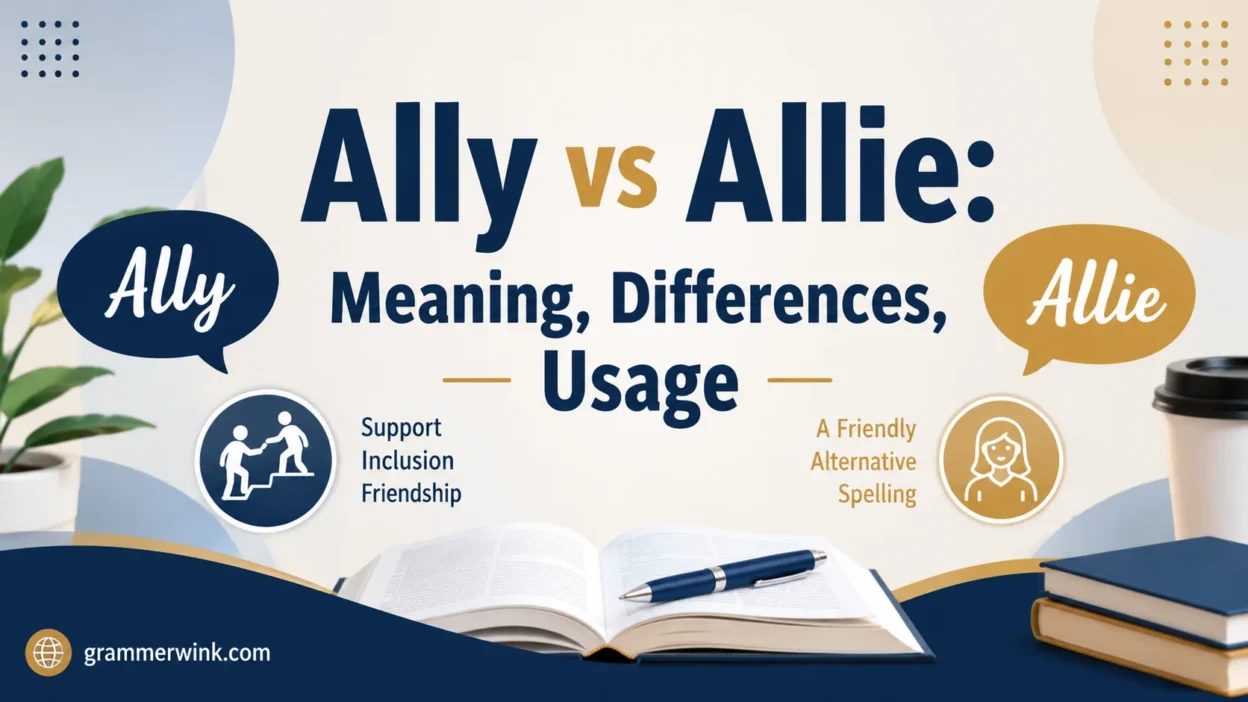
Choosing the right spelling can make a big difference when you’re writing a name, using a word, or understanding its meaning. Ally vs Allie is a common point of confusion because both forms look similar and can refer to names. While Ally and Allie are often used as feminine names, they can have different origins, meanings, and uses. Ally can also be a regular English word meaning a friend, supporter, or partner, while Allie is mainly used as a personal name or nickname. Understanding these differences can help you choose the correct form for the situation. Whether you’re selecting a baby name, writing about someone, or simply curious about spelling, knowing how these names developed can make the distinction much clearer.
The name Ally is commonly associated with names such as Alison, Allison, Alexandra, and Alice, depending on the naming tradition. It may also be used independently as a given name, while the word ally has a broader meaning connected with friendship, support, and cooperation. In contrast, Allie is usually a nickname or given name and often has a softer, more informal feel. Although the two names may have similar pronunciation, their spelling can suggest different styles or preferences. Some people choose Ally because it looks simple and modern, while others prefer Allie for its friendly and playful appearance. These small differences can matter when deciding which spelling best fits a person or purpose.
In this guide, we’ll explore Ally vs Allie in detail, including their meanings, origins, pronunciations, and common uses. You’ll learn when Ally works as an ordinary English vocabulary word and when it functions as a personal name. We’ll also look at how Allie is commonly used as a nickname, along with the names it may represent. Understanding the difference can help you avoid spelling confusion and communicate more accurately. By the end, you’ll have a clear idea of whether Ally or Allie is the better choice for your specific situation. Whether you’re comparing names or checking the correct spelling, this guide will make the difference easy to understand.
What Does Ally Mean in Ally vs Allie?
The word “ally” functions as both a noun and a verb in English. It carries a strong sense of support, cooperation, and shared purpose.
Core definition of ally
An ally is a person, group, or nation that supports another in a common effort or struggle.
Everyday meaning
In modern English, “ally” shows up in three main contexts:
- Social support (friendship, advocacy, inclusion)
- Politics and global relations
- Workplace or team collaboration
Examples in real use
- She became an ally to students advocating for mental health support.
- The two countries acted as allies during the conflict.
- A good manager acts as an ally to their team, not just a supervisor.
Verb form of ally
You can also use it as a verb:
- The organization allied with local schools to improve literacy programs.
Modern cultural meaning
In recent years, “ally” has taken on a stronger social meaning. It often describes someone who actively supports marginalized communities.
For example:
- An ally in LGBTQ+ spaces supports equality and inclusion.
- An ally in racial justice movements stands against discrimination.
“Being an ally is not about identity alone. It’s about consistent action and support.” — Common principle in advocacy education
What Does Allie Mean in Ally vs Allie?
Now let’s shift to “Allie.”
Unlike “ally,” this word is almost always a proper name.
Allie as a given name
“Allie” typically serves as:
- A standalone first name
- A nickname for longer names
Common full names behind Allie
People named Allie often have names such as:
- Allison
- Alexandra
- Alison
- Aliyah (sometimes informally shortened)
Tone and personality of the name
Names carry emotional tone, and “Allie” feels:
- Friendly
- Casual
- Warm
- Approachable
It often appears in personal, informal settings rather than formal writing.
Real-world usage examples
- Allie just started her first year at college.
- I met Allie at the conference last week.
- Allie forgot her phone charger again.
Unlike “ally,” it never refers to support or advocacy on its own. It always points to a person.
Ally vs Allie: Key Differences Explained Clearly
Even though they sound identical, the difference becomes obvious when you compare them side by side.
| Feature | Ally | Allie |
| Type | Common noun / verb | Proper noun (name) |
| Meaning | Supporter or partner | Personal name or nickname |
| Usage context | Social, political, professional | Personal identity |
| Emotional tone | Formal or conceptual | Friendly and informal |
| Grammar role | Can function in sentences as noun or verb | Functions as a name only |
| Example | “She is an ally in the movement.” | “Allie went to the store.” |
This table clears up the biggest confusion point: Ally describes a role. Allie identifies a person.
Pronunciation: Do Ally and Allie Sound Different?
Here’s where things get tricky.
They sound almost exactly the same.
Phonetic pronunciation
Both words typically use:
- /ˈæli/
Why pronunciation doesn’t help
Since they sound identical, spoken language does not distinguish them. Only written context does.
That’s why people often confuse them in texts, emails, or social media posts.
Quick takeaway
You can’t rely on your ears here. You must rely on meaning.
Why People Confuse Ally vs Allie So Often
This confusion doesn’t come from carelessness. It comes from how language works.
Let’s break down the real reasons.
1. Same pronunciation
Both words sound identical in conversation. That alone causes confusion.
2. Overlapping familiarity
People hear “ally” in conversations about support and assume it could be a name.
3. Informal texting culture
In texting, capitalization and context often blur:
- “I met Ally yesterday” could mean a person or a misspelling of “allie.”
Read More: Cacoon Hanging Tent: Complete Guide, Benefits
4. Name variations in English
English has many names ending in “-ie”:
- Katie
- Sophie
- Allie
So it feels natural to assume “Allie” is just a spelling variation of “ally.”
When to Use Ally in Real WritingUse ally when you mean support, partnership, or cooperation.
Situations where “ally” fits best
- Social justice discussions
- Workplace collaboration
- Political or global alliances
- Team-based environments
Examples in context
- A strong mentor acts as an ally for new employees navigating workplace culture.
- Countries often rely on allies for economic stability.
- Students need allies when dealing with academic pressure.
A simple memory trick
Think: “ally = align”
If someone aligns with you in purpose or support, they are your ally.
When to Use Allie in Real Writing
Use Allie only when referring to a person.
Correct usage scenarios
- Writing about a friend named Allie
- Referring to fictional characters
- Mentioning someone in conversation or storytelling
Examples
- Allie decided to move to New York after graduation.
- My cousin Allie loves painting landscapes.
- Allie appears in several episodes of the series.
Important rule
If you can replace it with “she” or “he” and the sentence still makes sense, you’re probably dealing with Allie, not “ally.”
Real-Life Case Study: How One Spelling Changed Meaning
Let’s look at a simple but realistic scenario.
Scenario
A student writes:
“I met an ally in my biology class.”
Possible interpretations
This sentence could mean two very different things:
- The student met someone supportive in class.
- The student accidentally misspelled a friend’s name, Allie.
Outcome difference
- If it’s “ally,” the sentence describes emotional or academic support.
- If it’s “Allie,” it refers to a specific person.
Why this matters
In academic writing, resumes, or storytelling, this small difference changes meaning entirely.
Cultural Meaning of Ally in Modern Language
The word ally has evolved beyond grammar. It now plays a role in cultural identity and social responsibility.
Modern usage in society
You’ll often hear phrases like:
- Allyship in workplaces
- Being an ally in diversity efforts
- Becoming an ally in community support programs
What “allyship” means
Allyship refers to consistent action, not just intention.
It includes:
- Listening to lived experiences
- Supporting fair treatment
- Speaking up against injustice when appropriate
Key insight
An ally is not just someone who agrees. An ally acts.
Popularity and Usage of Allie as a Name
“Allie” remains a widely used name in English-speaking countries.
Why people choose it
Parents often choose “Allie” because it feels:
- Soft in tone
- Easy to pronounce
- Friendly and modern
Name flexibility
“Allie” works well in both:
- Childhood settings (cute and simple)
- Professional settings (short and memorable)
Nickname culture
English-speaking cultures often shorten names for familiarity:
- Alexandra → Allie
- Allison → Allie
This keeps names personal and approachable.
Common Mistakes in Ally vs Allie Usage
People repeatedly make a few predictable mistakes.
Mistake 1: Using “Allie” for support roles
Incorrect:
- She is my allie in the project.
Correct:
- She is my ally in the project.
Mistake 2: Using “Ally” as a name without context
Incorrect:
- Ally went to the concert. (if referring to a person named Allie)
Correct:
- Allie went to the concert.
Mistake 3: Ignoring context in writing
People often rely on sound instead of meaning.
Quick Decision Guide: Ally vs Allie
If you ever get stuck, use this simple checklist.
Ask yourself:
- Am I talking about support or cooperation?
- Yes → Use ally
- Am I talking about a person’s name?
- Yes → Use Allie
Fast mental shortcut
- Ally = Action (support)
- Allie = Identity (person)
FAQs
Are Ally and Allie pronounced the same?
Yes. Both typically sound like /ˈæli/.
Is Allie a real name?
Yes. It is a common nickname and standalone first name.
Can Ally be a name too?
Yes, but it is less common and usually spelled differently for names.
Why do both words exist?
They developed separately:
- “Ally” comes from Latin roots related to alliance.
- “Allie” comes from nickname traditions in English naming.
Conclusion
The trick isn’t memorizing rules. It’s reading the context. If you’re talking about people working together or supporting a cause, you’re dealing with ally. If you’re referring to someone’s name in a conversation or story, it’s almost always Allie.Think of it this way: language works like a map, not a spelling quiz. Once you know the landmarks, you stop second-guessing every turn.
So the next time you pause mid-sentence wondering which version to use, slow down and ask one simple question: Am I describing support or naming a person? That single step clears things up almost every time.And honestly, that’s the beauty of it. Small differences in spelling can carry very different meanings, but clarity comes from understanding—not memorizing.