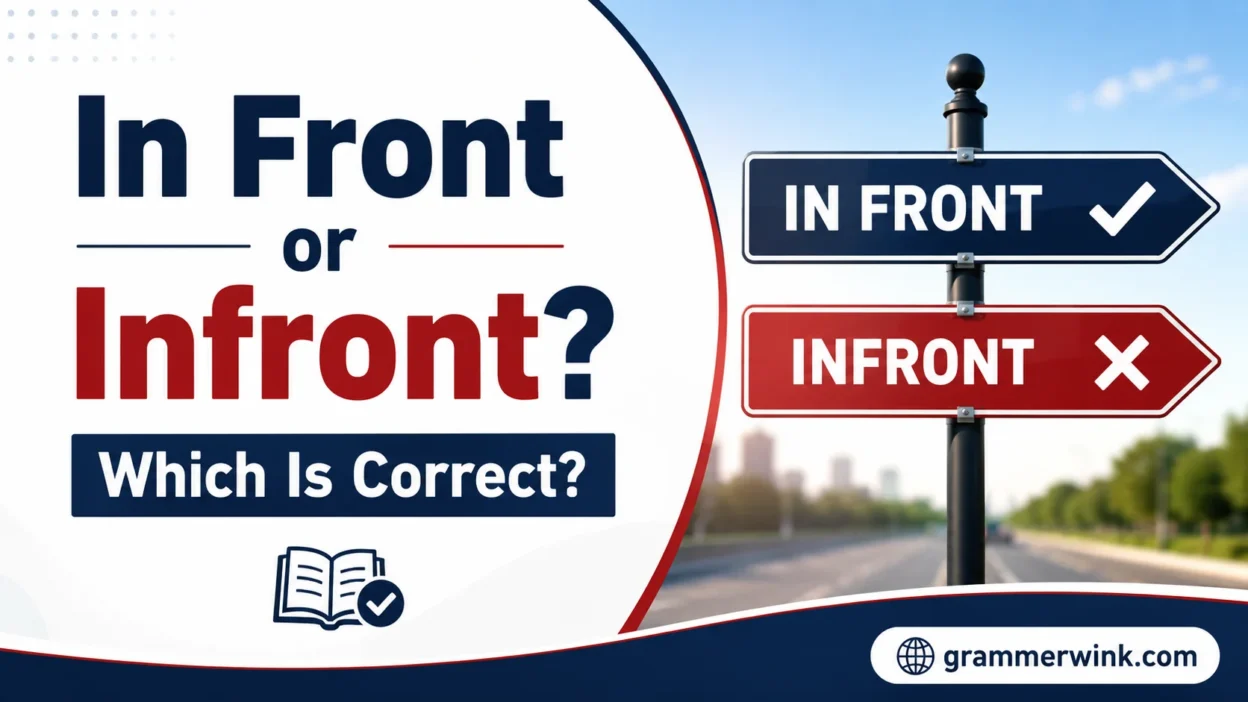
Choosing between “in front” and “infront” can be confusing, especially for English learners, students, and professional writers. While both forms may appear online, only “in front” is considered correct in standard English. It is a two-word prepositional phrase that describes the position of a person or object located ahead of someone or something else. On the other hand, “infront” written as a single word is a spelling mistake and should be avoided in academic writing, business communication, and everyday English. Understanding this simple grammar rule will help you write with greater accuracy, confidence, and clarity.
Many people mistakenly type “infront” because the two words are often spoken quickly in conversation. However, every major English dictionary, grammar guide, and style manual recognizes only “in front” as the proper form. Whether you are writing an email, a school assignment, a blog post, or a social media caption, using “in front” demonstrates strong grammar skills and careful attention to detail. Learning the difference also prevents common writing errors that can affect your credibility and make your content appear less professional.
In this guide, you’ll discover the correct spelling, the meaning of “in front,” common grammar rules, practical examples, and easy tips to remember the difference forever. We’ll also explain why “infront” became a common misspelling, highlight frequent mistakes, and answer the most asked questions about this topic. By the end of this article, you’ll know exactly when to use “in front”, avoid incorrect forms, and write clear, natural, and grammatically correct English with confidence.
The Quick Answer: Is It “In Front” or “Infront”?
The correct form is:
✅ In front
The incorrect form is:
❌ Infront
Featured Snippet Answer
“In front” is the correct spelling in standard English. It is written as two separate words and means ahead of, before, or facing something. “Infront” is considered a spelling error and should generally not be used in formal or informal writing.
Examples
✅ The car is in front of the house.
✅ She stood in front of the audience.
✅ The statue is in front of the museum.
❌ The car is infront of the house.
❌ She stood infront of the audience.
What Does “In Front” Mean?
The phrase “in front” refers to a position that is ahead of, before, or facing something else.
It is commonly used to describe physical locations, directions, and relationships between objects or people.
Dictionary Meaning
In front means:
Situated before or ahead of someone or something.
Basic Examples
- The bus stopped in front of the school.
- A dog sat in front of the door.
- She parked her car in front of the building.
In each example, the phrase tells us where something is located in relation to another object.
Why “Infront” Is Incorrect
Many English learners assume that “infront” is a single word because it sounds like one when spoken quickly.
However, standard English grammar treats “in front” as an open compound phrase, meaning the words remain separate.
Understanding Open Compounds
English contains three main compound types:
| Type | Example |
| Open Compound | Ice cream |
| Hyphenated Compound | Mother-in-law |
| Closed Compound | Notebook |
The phrase “in front” belongs to the first category.
The two words work together but remain separate.
Why People Write “Infront”
Several factors contribute to the mistake:
- Fast typing
- Autocorrect errors
- Pronunciation habits
- Confusion with words like inside and outside
- Lack of familiarity with grammar rules
Incorrect vs. Correct Usage
| Incorrect | Correct |
| Infront of the house | In front of the house |
| Infront of me | In front of me |
| Infront of the audience | In front of the audience |
| Infront of the store | In front of the store |
In Front vs. Infront Comparison Table
The simplest way to understand the difference is through a side-by-side comparison.
| Feature | In Front | Infront |
| Standard English | ✅ Yes | ❌ No |
| Accepted by Dictionaries | ✅ Yes | ❌ No |
| Used in Academic Writing | ✅ Yes | ❌ No |
| Used in Business Writing | ✅ Yes | ❌ No |
| Accepted in Exams | ✅ Yes | ❌ No |
| Recommended by Grammar Experts | ✅ Yes | ❌ No |
The evidence overwhelmingly supports the use of “in front.”
Understanding the Phrase “In Front Of”
Most often, the phrase appears as “in front of.”
The word “of” connects the location to another object.
Structure
Subject + Verb + In Front Of + Object
Examples
- The bike is in front of the garage.
- She stood in front of the mirror.
- The restaurant is in front of the hotel.
Why “Of” Matters
Without “of,” the sentence may feel incomplete.
Compare:
✅ The car is in front of the building.
⚠️ The car is in front.
The second sentence is grammatically possible, but it provides less information.
Read More: What Is the Plural of Loaf? A Complete Guide to Using It Correctly
How to Use “In Front” Correctly in Sentences
Understanding context is the best way to master the phrase.
Physical Position
This is the most common usage.
Examples
- The mailbox is in front of the house.
- A tree stands in front of the school.
- The fountain is in front of the library.
Movement and Direction
The phrase can also describe movement.
Examples
- He stepped in front of the camera.
- The child ran in front of the car.
- She walked in front of the group.
Public Speaking
This usage appears frequently in education and business.
Examples
- The professor spoke in front of the class.
- She presented her findings in front of the committee.
- The CEO addressed employees in front of hundreds of attendees.
Everyday Communication
- Please stand in front of the line.
- Meet me in front of the café.
- The taxi is waiting in front of the hotel.
In Front vs. Before: What’s the Difference?
Many people confuse “in front” with “before.”
Although they sometimes overlap, they are not always interchangeable.
Meaning of “In Front”
Usually refers to physical position.
Example:
- The car is in front of the house.
Meaning of “Before”
Usually refers to time, sequence, or order.
Example:
- Finish your homework before dinner.
Comparison Table
| In Front | Before |
| Physical position | Time or sequence |
| The bus is in front of the school. | The bus arrived before noon. |
| She stood in front of me. | She spoke before I did. |
Key Rule
If you’re discussing location, use in front.
If you’re discussing time or sequence, use before.
In Front vs. Ahead Of
Another phrase commonly confused with in front is ahead of.
Similarities
Both can indicate position.
Differences
In front usually describes a visible location.
Ahead of often suggests progress, movement, or distance.
Examples
- The statue is in front of the building.
- The runners are ahead of the competition.
Quick Comparison
| Phrase | Primary Meaning |
| In Front | Physical location |
| Ahead Of | Progress, distance, advancement |
Common Grammar Mistakes Related to “In Front”
Even experienced writers occasionally make errors.
Writing “Infront”
This is the most common mistake.
❌ Infront of the school
✅ In front of the school
Forgetting “Of”
❌ The statue is in front the museum.
✅ The statue is in front of the museum.
Using “Before” Incorrectly
❌ The car is before the house.
✅ The car is in front of the house.
Wrong Word Order
❌ Front in of the building
✅ In front of the building
Overusing Positional Phrases
Sometimes a simpler sentence works better.
Instead of:
- The chair located in front of the table near the wall beside the window
Try:
- The chair is in front of the table.
Clear writing improves readability.
Examples of “In Front” in Different Contexts
Seeing the phrase used naturally helps reinforce correct usage.
At Home
- The garden is in front of the house.
- A bicycle is parked in front of the garage.
- The mailbox stands in front of the gate.
At School
- Students gathered in front of the classroom.
- The flagpole is in front of the main building.
- Teachers stood in front of the assembly.
At Work
- The manager spoke in front of the team.
- Visitors waited in front of reception.
- The company logo hangs in front of the entrance.
While Driving
- A truck stopped in front of us.
- The traffic light is in front of the intersection.
- A cyclist rode in front of the bus.
During Presentations
- The speaker stood in front of the screen.
- She presented her report in front of investors.
- The candidate spoke in front of a large audience.
Synonyms and Alternatives for “In Front”
Sometimes you may want variety in your writing.
Several alternatives can replace in front, depending on context.
Ahead Of
Example:
- The runner was ahead of the group.
Before
Example:
- The king stood before his people.
Facing
Example:
- The hotel faces the ocean.
Opposite
Example:
- The bank is opposite the post office.
At the Forefront Of
Example:
- The company is at the forefront of innovation.
Comparison Table of Alternatives
| Alternative | Meaning | Best Use |
| Ahead Of | Further forward | Movement |
| Before | Earlier or in front | Formal writing |
| Facing | Looking toward | Directions |
| Opposite | Across from | Locations |
| Forefront Of | Leading position | Business and leadership |
Is “In Front” a Preposition or an Adverbial Phrase?
From a grammar perspective, in front is generally classified as a prepositional phrase when followed by of.
Example
- The car is in front of the house.
Here, the phrase functions as a preposition describing location.
When used alone, it may function adverbially.
Example
- The leader walked in front.
In this case, it describes where the leader walked.
Understanding this distinction helps improve sentence structure and grammatical accuracy.
The Origin and History of “In Front”
The word front has fascinating origins.
It comes from the Latin word frons, meaning forehead or face.
Over time, the term entered Old French as front before becoming part of English vocabulary.
Historical Development
The phrase in front of became common because it naturally described something positioned before another object.
Unlike some English compounds that merged into one word over time, in front remained an open compound.
Why It Never Became “Infront”
Language evolves based on widespread accepted usage.
Writers, editors, dictionaries, publishers, and educational institutions consistently maintained the two-word form.
As a result, “infront” never gained acceptance in standard English.
How Major Dictionaries Define “In Front”
Leading dictionaries consistently recognize in front as the standard form.
Dictionary Comparison
| Dictionary | Recognition |
| Merriam-Webster | ✅ In front |
| Cambridge Dictionary | ✅ In front |
| Oxford Dictionary | ✅ In front |
| Collins Dictionary | ✅ In front |
| Macmillan Dictionary | ✅ In front |
Common Definition
Most dictionaries define it as:
Ahead of, before, or facing something else.
Notably, major dictionaries do not list “infront” as a standard word.
Real-World Case Study: Why This Mistake Matters
Imagine two job applicants.
Applicant A
The parking area is located infront of the office.
Applicant B
The parking area is located in front of the office.
The second sentence demonstrates correct grammar and attention to detail.
While a single spelling error may seem minor, employers, teachers, and editors often view such mistakes as indicators of writing quality.
Key Lesson
Small grammar details can influence:
- Academic grades
- Professional credibility
- Business communication
- Publishing opportunities
- First impressions
Quick Practice Quiz
Test your understanding.
Question 1
Which sentence is correct?
A. The car is infront of the garage.
B. The car is in front of the garage.
Answer: B
Question 2
Which phrase follows standard English?
A. Infront of the building
B. In front of the building
Answer: B
Question 3
Choose the correct sentence.
A. She stood in front of the audience.
B. She stood infront of the audience.
Answer: A
Question 4
Which word refers to time rather than position?
A. In front
B. Before
Answer: B
Question 5
Which sentence is grammatically correct?
A. The statue is in front of the museum.
B. The statue is infront the museum.
Answer: A
Quick Tips to Remember the Correct Spelling
Remember these simple tricks:
Think of “Front Door”
You naturally write:
- Front door
Not:
- Frontdoor
The same logic applies to in front.
Remember the Three Words
The full phrase is usually:
In + Front + Of
Thinking of all three words together helps prevent mistakes.
Use Spell Check
Most writing tools will flag “infront” as an error.
Read Professional Writing
Books, newspapers, and academic articles consistently use “in front.”
Regular exposure reinforces correct spelling habits.
Key Takeaways
- “In front” is the correct spelling in standard English.
- “Infront” is considered a misspelling.
- The phrase means ahead of, before, or facing something.
- It is commonly used as “in front of.”
- Major dictionaries recognize only the two-word form.
- The phrase remains an open compound rather than a closed compound word.
- Using the correct form improves clarity and professionalism in writing.
Conclusion
The debate between “in front” and “infront” has a straightforward answer: “in front” is correct, while “infront” is not accepted in standard English.Although many people accidentally combine the words into a single term, major dictionaries, grammar guides, educators, editors, and style manuals consistently recommend the two-word form. Whether you’re writing an essay, business email, social media post, or professional report, using “in front” ensures your writing follows accepted English standards
Faqs:
Is it “in front” or “infront”?
“In front” is correct. “Infront” is considered a misspelling in standard English.
Why is “infront” incorrect?
Because major dictionaries and grammar authorities recognize only the two-word phrase “in front.”
Can I use “infront” in informal writing?
It is not recommended. Even in casual writing, “in front” is the accepted form.
Is “in front” one word in British English?
No. Both British and American English use “in front” as two separate words.
What does “in front of” mean?
It means ahead of, before, or facing another person, object, or place.