When learning English grammar, many people become confused about Check In vs Check-In because these two forms look almost identical but serve different purposes. Although they contain the same words, the way they are used depends on whether they function as a verb or a noun/adjective. Understanding this small distinction can greatly improve your writing accuracy, professional communication, and everyday conversations. Whether you are traveling, writing emails, checking into a hotel, or discussing airport procedures, using the correct form helps your sentences sound more natural, clear, and grammatically correct.
The phrase check in is used as a verb, meaning to register, arrive, or report your presence at a place. For example, you check in at a hotel, check in for a flight, or check in with your manager after completing a task. On the other hand, check-in with a hyphen is commonly used as a noun or an adjective. You might say the check-in was quick, or refer to the check-in counter at an airport. Learning this simple grammar rule allows you to avoid common mistakes, write with confidence, and communicate more effectively in both formal and informal situations.
In this complete guide, you’ll discover the meaning, usage rules, grammar differences, and real-life examples of Check In vs Check-In. We’ll explain when to use each form, highlight the most common errors, and share easy memory tricks to help you remember the difference forever. By the end of this article, you’ll understand exactly which version belongs in every sentence, making your English writing, business communication, academic work, and daily conversations more accurate, polished, and professional.
What “Check In” and “Check-In” Actually Mean
At a basic level, both terms come from the same idea: registering your presence or confirming arrival. But English changes the form depending on how you use the phrase in a sentence.
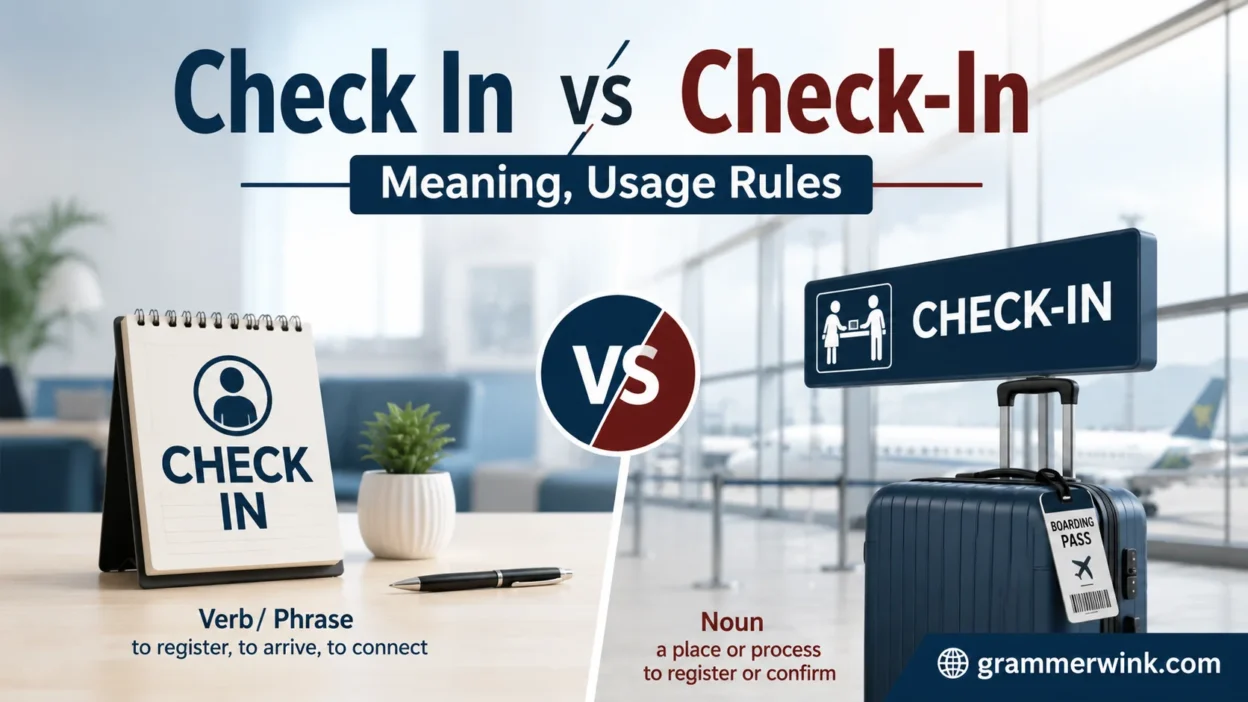
Here’s the core difference:
- Check in (two words) → a verb phrase (an action)
- Check-in (hyphenated) → a noun or adjective (a thing or description)
That small hyphen changes everything.
Think of it like this:
You check in to a hotel, but you complete the check-in process at the front desk.
Simple idea. Different grammatical jobs.
Quick Comparison Table: Check In vs Check-In
| Form | Type of speech | Meaning | Example |
| check in | Verb phrase | To register or report arrival | I will check in at the hotel at 3 PM |
| check-in | Noun | The process or event of registering | The check-in was fast and easy |
| check-in | Adjective | Describes something related to registration | Check-in time starts at 2 PM |
This table alone solves most confusion people have.
How to Use “Check In” Correctly
Use it as an action
Whenever you are talking about doing something, use check in as two separate words.
Examples:
- I will check in at the airport early.
- Please check in with the receptionist.
- They checked in after landing.
- We need to check in before the meeting starts.
Notice something important here: it always behaves like a verb.
Tense changes
The phrase changes depending on time:
- Present: I check in
- Past: I checked in
- Future: I will check in
No hyphen is ever used in these cases.
Read more: Simpler or More Simple: Which Is Correct?
How to Use “Check-In” Correctly
Use it as a noun
When you talk about the process itself, you need the hyphen.
Examples:
- The check-in took less than five minutes.
- Online check-in is available 24 hours before departure.
- Early check-in may cost extra.
Here, you are not doing the action. You are talking about the system, event, or process.
Use it as an adjective
You also use check-in to describe something.
Examples:
- We arrived at the check-in counter.
- Follow the check-in instructions carefully.
- She received a check-in email before the event.
In these cases, it works like a descriptive word.
Real-World Examples That Make It Clear
Let’s break it into everyday situations.
Hotels
- ✔ I will check in at 2 PM.
- ✔ The check-in desk is near the entrance.
- ✔ Hotel check-in starts at 3 PM.
Airports
- ✔ We need to check in two hours before the flight.
- ✔ The check-in counter is crowded.
- ✔ Online check-in saves time.
Workplaces
- ✔ Employees must check in before starting work.
- ✔ The daily check-in meeting starts at 9 AM.
- ✔ Our team uses a check-in system to track attendance.
Why the Hyphen Matters So Much
The hyphen in check-in is not random. It signals grammar structure.
English often uses hyphens to:
- Turn verbs into nouns
- Turn phrases into adjectives
- Improve readability
Without the hyphen, meaning becomes unclear.
Compare:
- The check in was smooth ❌ (confusing)
- The check-in was smooth ✔ (clear)
The second version tells the reader exactly what you mean.
Common Mistakes People Make
Even fluent speakers mix this up. Here are the most frequent errors.
Using a hyphen when it’s a verb
❌ I will check-in at the hotel
✔ I will check in at the hotel
Missing the hyphen in noun form
❌ The check in was fast
✔ The check-in was fast
Overusing one form everywhere
Some writers incorrectly use “check-in” for everything. That makes writing look unnatural and grammatically weak.
Simple Memory Trick to Get It Right
Here’s an easy way to remember:
- If you are doing it → check in
- If you are naming it → check-in
Or even simpler:
Action = two words
Thing = hyphen
That rule works in 95% of cases.
Grammar Insight: Why English Does This
English often evolves by turning actions into objects.
For example:
- “work out” → “workout”
- “sign up” → “signup”
- “check in” → “check-in”
This process is called nominalization, where verbs become nouns.
The hyphen acts like a bridge during this transition. Over time, some words even lose the hyphen completely as usage becomes standard.
Industry Usage Differences
Different industries apply these terms slightly differently.
Travel and Hospitality
- Strict about hyphen usage
- Uses “check-in time,” “check-in desk”
Tech and Apps
- Often drops hyphens in UI text
- Uses “Check in” as a button label
- Uses “check-in” in documentation
Journalism and Writing
- Follows formal grammar rules
- Uses hyphen for nouns and adjectives consistently
Case Study: Airline Check-In Systems
Modern airlines have changed how “check in” works.
Traditional method:
- Passenger arrives at airport
- Checks in at counter
- Receives boarding pass
Modern method:
- Passenger checks in online or via app
- Receives digital boarding pass
- Skips counter entirely
Key insight:
Airlines still use both terms correctly:
- “You must check in 24 hours before departure.”
- “Complete your online check-in early to avoid delays.”
This shows how grammar stays consistent even when technology evolves.
Industry Statistics (Real-World Context)
Here are some useful facts about check-in systems globally:
- Over 90% of airline passengers now use online check-in systems for major carriers.
- Hotels report that online check-in reduces front desk wait times by up to 60%.
- Mobile check-in adoption continues to grow, especially in business travel.
These systems rely heavily on clear communication, which is why correct usage matters.
Advanced Usage: Idiomatic Expressions
The phrase “check in” also appears in informal English.
Emotional or social meaning
- I like to check in with my friends once a week.
- She checks in on her parents regularly.
Here, it means to make contact or show concern, not just arrival.
Workplace usage
- Let’s do a quick check-in meeting.
- We should check in with the team before finalizing the plan.
This usage is extremely common in modern workplaces.
Visual Summary
Here’s a simple breakdown:
CHECK IN → action (verb)
↓
You perform it
CHECK-IN → thing (noun/adjective)
↓
You talk about it
Common Synonyms and Related Terms
To improve writing variety, you can also use:
For “check in”:
- register
- report arrival
- sign in
- log in (digital systems)
For “check-in”:
- registration
- admission process
- onboarding step
- arrival procedure
Using synonyms helps avoid repetition in longer writing.
Final Takeaway
The difference between check in vs check-in is small in appearance but important in meaning.
Here’s the simplest rule you need:
- Use check in when someone performs the action
- Use check-in when referring to the process or describing something
Once you internalize this, your writing instantly becomes clearer and more professional.
And honestly, English gets easier when you stop memorizing rules and start seeing patterns. This is one of those patterns that sticks for life once you notice it.
If you want, I can also turn this into:
- An landing page
- A downloadable grammar cheat sheet
- Or a comparison article like “check in vs check out vs sign in”
FAQs
Is it “check in” or “check-in” in formal writing?
It depends on how you use it. You write check in when it acts as a verb, like “I will check in at the hotel.” You use check-in when it functions as a noun or adjective,
Why does English use a hyphen in “check-in”?
English uses the hyphen to turn a verb phrase into a noun or adjective. In simple terms, it helps readers understand that you are talking about a thing or process instead of an action. Without the hyphen, the sentence can feel unclear or awkward.
Can “check-in” be written as one word?
In most standard English usage, no. “Check-in” stays hyphenated in formal writing. However, in some tech interfaces or branding, you might see “checkin” or “check in” used differently. Those are style choices, not strict grammar rules.
Is “check-in time” correct grammar?
Yes, “check-in time” is correct. It uses “check-in” as a compound adjective describing the word “time.” You will commonly see it in travel, especially in hotels and airlines, such as “Check-in time starts at 2 PM.”
Conclusion
Understanding check in vs check-in comes down to one simple idea: function. When you describe an action, you use check in as two words. When you talk about the process, event, or description, you use check-in with a hyphen.This small distinction improves clarity in writing and helps you sound more precise in both professional and everyday communication. Whether you are booking a hotel, boarding a flight, or writing an article, using the correct form ensures your message stays clear and easy to understand.