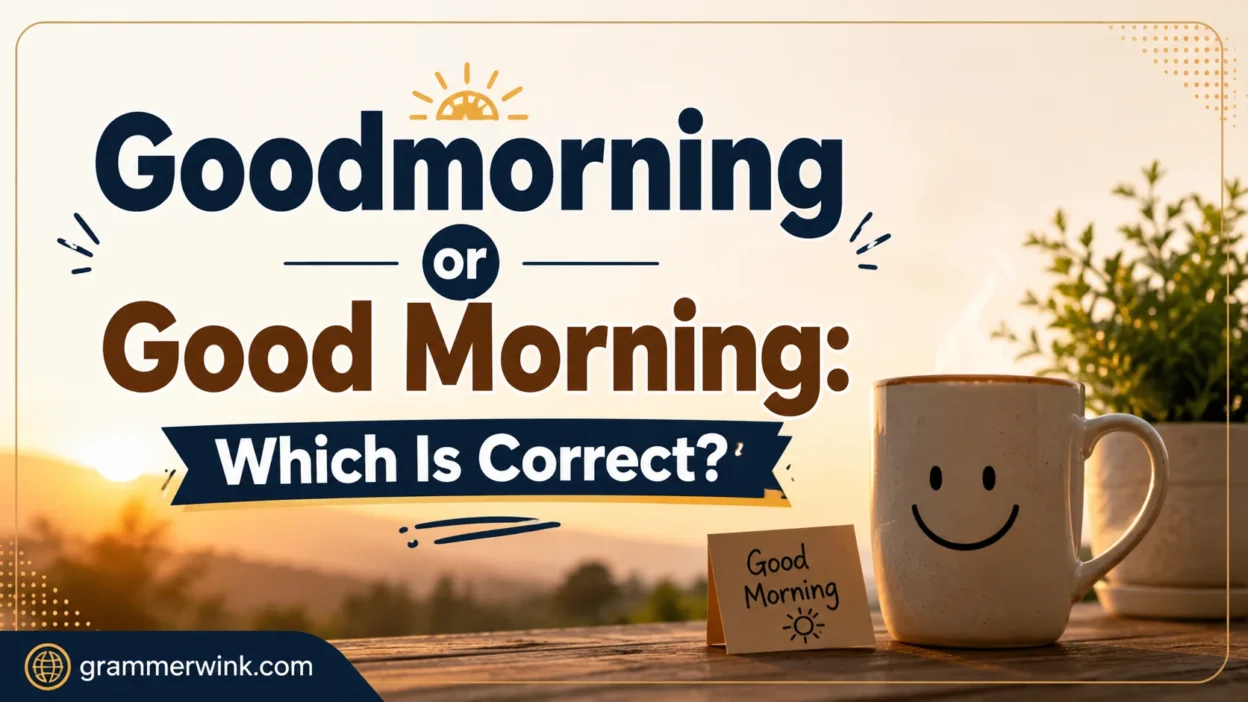
When writing or speaking, many people wonder whether Good Morning or Goodmorning is the correct spelling. This simple greeting is used every day in emails, text messages, business conversations, and casual chats, yet it often causes confusion. The truth is that Good Morning is the standard English form accepted by dictionaries and grammar experts, while Goodmorning written as one word is considered incorrect in modern English. Understanding this small difference can help you create a more professional, polished, and grammatically accurate impression.
Whether you are greeting a friend, colleague, teacher, or client, using the correct phrase shows attention to grammar, communication, and writing etiquette. In formal situations, the greeting Good Morning appears at the beginning of emails, letters, presentations, and meetings because it follows standard English writing rules. Although many people accidentally type Goodmorning as one word, especially on social media or in quick messages, it should be avoided in professional writing. Learning this distinction improves your English skills and helps you communicate with greater confidence in every situation.
In this guide, you’ll discover the difference between Good Morning and Goodmorning, learn the grammar rule, see correct examples, and understand when to use this greeting in both formal and informal settings. We’ll also explain why the two-word version is universally accepted by style guides, dictionaries, and English teachers around the world. By the end, you’ll know exactly how to write Good Morning correctly and avoid one of the most common English writing mistakes, making your everyday communication more clear, natural, and professional.
Goodmorning vs. Good Morning: The Short Answer
If you’re looking for the quick answer, here it is:
✅ Good morning — Correct
❌ Goodmorning — Incorrect
In standard English, good morning is written as two separate words.
Examples
Correct:
- Good morning, everyone.
- Good morning, Sarah.
- I hope you have a good morning.
Incorrect:
- Goodmorning, everyone.
- Goodmorning, Sarah.
- I hope you have a goodmorning.
The phrase consists of two words:
- Good (an adjective)
- Morning (a noun)
Together, they form a greeting that wishes someone a pleasant morning.
Quick Rule to Remember
If you’re greeting someone, always write:
Good morning
Think of it this way:
| Greeting | Correct Form |
| Good morning | ✓ Two words |
| Good afternoon | ✓ Two words |
| Good evening | ✓ Two words |
| Goodmorning | ✗ Incorrect |
A simple memory trick:
If you can insert someone’s name after the greeting, it should remain two words.
Example:
- Good morning, John.
- Good morning, Lisa.
- Good morning, team.
What Does “Good Morning” Mean?
The expression good morning is a polite greeting used when meeting someone during the morning hours.
It serves two purposes:
- To acknowledge another person.
- To express goodwill and courtesy.
Although most people don’t consciously think about the meaning, the phrase literally means:
“I hope your morning is good.”
Over time, it became one of the most common greetings in the English language.
Definition of Good Morning
Good morning is an interjection and greeting used when meeting, speaking to, or addressing someone in the morning.
Example
- Good morning, Mr. Smith.
- Good morning, class.
- Good morning, everyone.
The greeting is appropriate in both formal and informal situations.
When Do People Use Good Morning?
Most people use the phrase:
- Early morning
- During breakfast hours
- At the start of work
- During morning meetings
- Before noon
While customs vary by region, “good morning” is generally used from sunrise until around 12:00 PM.
The Origin of the Phrase “Good Morning”
The phrase has deep roots in English history.
For centuries, English speakers have used greetings based on the time of day:
- Good morning
- Good afternoon
- Good evening
- Good night
These greetings evolved from older expressions that conveyed respect and good wishes.
Historically, greetings weren’t just polite words. They reflected social customs and mutual respect.
Even today, saying “good morning” often creates a positive first impression.
Why Do People Write “Goodmorning” as One Word?
If “good morning” is clearly two words, why do so many people write it incorrectly?
Several factors contribute to this common mistake.
Fast Typing and Mobile Devices
Modern communication happens quickly.
People often type messages while:
- Walking
- Traveling
- Working
- Multitasking
As a result, words frequently become combined.
For example:
- Goodmorning
- Goodafternoon
- Goodday
These shortcuts may seem harmless, yet they remain incorrect in standard English.
Social Media Habits
Social media platforms encourage brevity.
Users often create hashtags such as:
- #GoodMorning
- #MondayMorning
- #MorningMotivation
Because people repeatedly see “GoodMorning” in hashtags, they may assume the spelling is acceptable everywhere.
However, hashtags follow different rules from standard writing.
Confusion With Compound Words
English contains thousands of compound words.
Examples include:
- Notebook
- Football
- Toothbrush
- Sunlight
Since some words merge over time, many people assume “goodmorning” has followed the same pattern.
It hasn’t.
Standard dictionaries still recognize good morning as two separate words.
Is “Goodmorning” Ever Correct?
In standard grammar and formal writing, the answer is no.
Goodmorning is not accepted as the standard spelling of the greeting.
However, there are a few situations where you might encounter it.
Usernames and Online Handles
People often create usernames such as:
- GoodMorningLife
- GoodMorningWorld
- GoodMorningClub
These names are branding choices rather than grammar examples.
Hashtags
Examples include:
- #GoodMorning
- #GoodMorningEveryone
- #GoodMorningSunshine
Hashtags remove spaces by necessity.
That doesn’t change the standard spelling.
Read More: All Time or All-Time: Which One Should You Use?
Brand Names
Some businesses intentionally combine words for branding purposes.
A company may choose:
- GoodMorning Coffee
- GoodMorning Bakery
This is a marketing decision, not a grammar rule.
How to Use Good Morning Correctly in Sentences
Learning correct usage is easier when you see real examples.
Formal Examples
These examples work well in professional settings.
- Good morning, everyone.
- Good morning, ladies and gentlemen.
- Good morning, Mr. Thompson.
- Good morning, team.
- Good morning. Thank you for attending today’s meeting.
Informal Examples
These examples fit everyday conversations.
- Good morning, Mom.
- Good morning, buddy.
- Good morning. Did you sleep well?
- Good morning! Ready for coffee?
- Good morning. How’s your day going?
Academic Examples
Students and teachers often use the greeting.
- Good morning, class.
- Good morning, Professor Wilson.
- Good morning. I have a question about the assignment.
Customer Service Examples
Businesses frequently begin interactions this way.
- Good morning. How may I assist you today?
- Good morning. Thank you for contacting us.
- Good morning. We appreciate your business.
Good Morning in Professional Writing
Professional communication demands proper spelling.
A small mistake can affect credibility.
Although writing “goodmorning” won’t usually ruin an email, it can make the writer appear less attentive to detail.
Using Good Morning in Emails
A professional email often starts with:
Good morning, Sarah,
or
Good morning, team,
This greeting feels warm, respectful, and professional.
Example Email Opening
Good morning, Michael,
Thank you for your message. I’ve reviewed the proposal and would like to discuss a few revisions.
Best regards,
Emily
Using Good Morning in Business Letters
Formal letters may begin with:
- Good morning.
- Good morning, Sir.
- Good morning, Madam.
These greetings establish a polite tone from the start.
Workplace Communication Tips
Use “good morning” when:
- Starting meetings
- Greeting coworkers
- Welcoming clients
- Sending early emails
- Beginning presentations
Avoid using it late in the day.
Switch to:
- Good afternoon
- Good evening
- Hello
when appropriate.
Capitalization Rules for Good Morning
Many writers understand the spelling but struggle with capitalization.
The rule depends on context.
At the Beginning of a Sentence
Capitalize both words when they begin a sentence.
Examples:
- Good morning, everyone.
- Good morning, Sarah.
In the Middle of a Sentence
Capitalize only if required by standard grammar rules.
Examples:
- I said good morning to my neighbors.
- She whispered good morning before leaving.
In Titles and Headings
Title case may require capitalization.
Examples:
- Good Morning Message for Friends
- Good Morning Wishes
- Good Morning Quotes
In Email Subject Lines
Subject lines often use title capitalization.
Examples:
- Good Morning Team
- Good Morning Update
- Good Morning Meeting Reminder
Good Morning vs. Goodnight: Why One Is Two Words
This question confuses many English learners.
Why is good morning two words while goodnight sometimes appears as one word?
The answer lies in how English evolved.
Understanding Good Night and Goodnight
Good night is usually a farewell expression.
Example:
- Good night, everyone.
Goodnight can function as:
- A noun
- An adjective
Examples:
- She kissed him goodnight.
- He gave her a goodnight hug.
This distinction doesn’t exist for “good morning.”
As a result, “good morning” remains two words.
Comparison Table
| Expression | Standard Form |
| Good morning | Two words |
| Good afternoon | Two words |
| Good evening | Two words |
| Good night | Two words as greeting |
| Goodnight | Noun/adjective |
| Goodbye | One word |
Common Mistakes People Make With Good Morning
Even simple greetings can cause confusion.
Let’s examine the most frequent errors.
Writing Goodmorning
This is by far the most common mistake.
Incorrect:
- Goodmorning, everyone.
Correct:
- Good morning, everyone.
Adding a Hyphen
Incorrect:
- Good-morning, everyone.
Correct:
- Good morning, everyone.
English grammar does not require a hyphen here.
Incorrect Capitalization
Incorrect:
- good Morning, everyone.
Correct:
- Good morning, everyone.
Missing Punctuation
Incorrect:
- Good morning everyone
Correct:
- Good morning, everyone.
The comma improves clarity and readability.
Real-World Examples and Corrections
| Incorrect | Correct |
| Goodmorning John | Good morning, John |
| Good-morning team | Good morning, team |
| good morning Team | Good morning, team |
| Goodmorning everyone | Good morning, everyone |
| Good Morning everyone | Good morning, everyone |
Good Morning in Emails, Texts, and Social Media
Different platforms encourage different writing styles.
However, the spelling remains the same.
Email Examples
- Good morning, Susan.
- Good morning, team.
- Good morning. I wanted to follow up regarding yesterday’s discussion.
Text Message Examples
- Good morning! Have a great day.
- Good morning. Drive safely.
- Good morning ☀️ Hope you slept well.
LinkedIn Examples
- Good morning, network.
- Good morning, professionals.
- Good morning. Here’s today’s leadership tip.
Social Media Examples
- Good morning, everyone!
- Good morning from the beach.
- Good morning and happy Friday.
Even on social media, standard spelling remains best practice.
Alternative Ways to Say Good Morning
Repeating the same greeting every day can feel predictable.
Fortunately, English offers many alternatives.
Professional Alternatives
- Greetings
- Hello
- Welcome
- Warm greetings
- Hope you’re doing well
Friendly Alternatives
- Morning!
- Rise and shine!
- Have a wonderful day!
- Hope your morning is going great!
- Wishing you a fantastic day ahead!
Creative Alternatives
- Time to conquer the day.
- A fresh day begins.
- Here’s to a productive morning.
- Another beautiful sunrise awaits.
- Let’s make today count.
Good Morning Around the World
Morning greetings exist in every culture.
Although the words differ, the purpose remains remarkably similar.
People use them to show respect, warmth, and friendliness.
Morning Greetings in Different Languages
| Language | Greeting |
| Spanish | Buenos días |
| French | Bonjour |
| German | Guten Morgen |
| Italian | Buongiorno |
| Arabic | Sabah al-khayr |
| Portuguese | Bom dia |
| Japanese | Ohayō gozaimasu |
| Korean | Joeun achim |
| Chinese | Zǎoshang hǎo |
| Hindi | Suprabhat |
Cultural Importance of Morning Greetings
In many cultures, morning greetings are more than simple words.
They:
- Build relationships
- Demonstrate courtesy
- Foster goodwill
- Create positive social interactions
A sincere morning greeting often sets the tone for the entire day.
Quick Reference Guide: Goodmorning or Good Morning?
Here’s an easy cheat sheet.
| Question | Answer |
| Is goodmorning correct? | No |
| Is good morning correct? | Yes |
| Is good morning two words? | Yes |
| Can I use good morning in emails? | Yes |
| Should good morning be capitalized? | Depends on context |
| Is goodmorning in standard English? | No |
| Can hashtags use GoodMorning? | Yes |
Key Takeaways
Before you leave, remember these important points:
- Good morning is the correct spelling.
- Goodmorning is considered a misspelling in standard English.
- Use good morning in emails, letters, texts, and professional communication.
- The phrase functions as a greeting and expression of goodwill.
- Capitalization depends on where the phrase appears in a sentence.
- Social media hashtags don’t change grammar rules.
- Learning the correct form improves professionalism and writing accuracy.
“Small language details create strong first impressions.”
A correctly written greeting demonstrates attention to detail, professionalism, and confidence.
Conclusion
The debate between goodmorning or good morning has a simple answer: good morning is the correct spelling.Although many people combine the words when texting or posting online, standard English grammar treats the phrase as two separate words. Whether you’re writing an email, greeting coworkers, posting on social media, or sending a message to a friend, using good morning shows that you understand proper English usage.
The next time you hesitate before typing the greeting, remember one easy rule: if you’re wishing someone a pleasant morning, write good morning as two words. It’s the form accepted by dictionaries, style guides, educators, and professional writers worldwide.