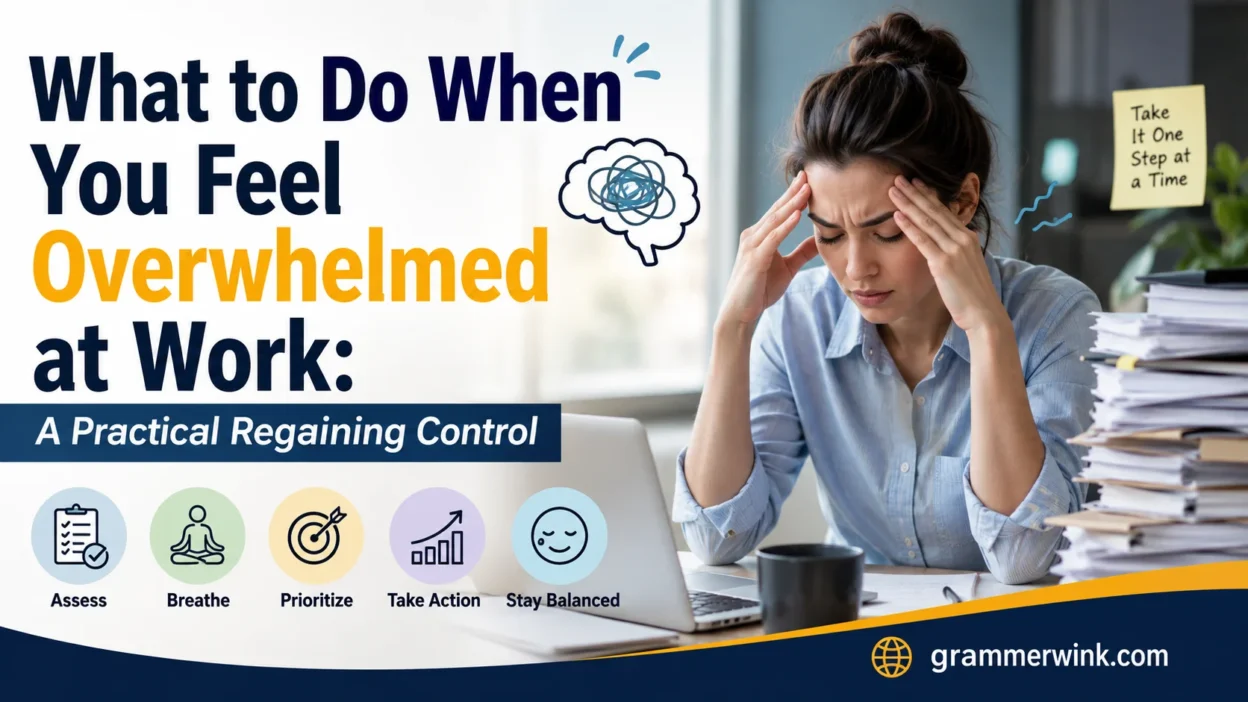
When work starts piling up, it can feel like everything needs attention at once. Deadlines, meetings, emails, and unexpected tasks can quickly create stress, pressure, and mental exhaustion. You may find yourself struggling to focus, making small mistakes, or simply wondering where to begin first. These feelings are common, especially when your responsibilities seem larger than your available time. Instead of pushing yourself harder, it helps to pause and recognize what is causing the overwhelm. Understanding the problem is often the first step toward regaining control at work.
Knowing what to do when you feel overwhelmed at work can make challenging days much easier. Rather than trying to complete everything immediately, start by identifying the most important tasks and deadlines. Breaking large responsibilities into smaller steps can make your workload feel more manageable and less intimidating. Simple actions, such as creating a priority list, taking short breaks, and reducing distractions, can also restore focus, energy, and confidence. You don’t need to solve every problem at once; you simply need to take the next useful step.
Regaining control doesn’t mean becoming productive every minute or handling everything without support. It means learning how to manage your workload while protecting your mental energy and overall well-being. Clear communication with coworkers or managers can help when expectations become unclear, unrealistic, or difficult to manage. Setting boundaries can also prevent constant interruptions from taking over your time and attention. With practical strategies and a calmer approach, even overwhelming workdays can become more organized, focused, and achievable.
What It Really Means When You Feel Overwhelmed at Work
Work overwhelm isn’t about being “bad at handling pressure.” It’s about your brain hitting its processing limit.
Think of your mind like a browser. Open too many tabs, and everything slows down or freezes. That’s overwhelm.
When you feel overwhelmed at work, your brain is usually dealing with:
- Too many unfinished tasks competing for attention
- Constant interruptions that reset focus
- No clear priority order
- Pressure to perform without enough time or clarity
It’s not laziness. It’s cognitive overload.
A simple truth helps here:
You don’t fix overwhelm by trying harder. You fix it by reducing mental load.
Signs You’re Overwhelmed at Work (Before It Gets Worse)
Overwhelm doesn’t always show up loudly. Sometimes it creeps in quietly.
Mental signs
- You reread the same email without processing it
- You jump between tasks but finish none
- Simple decisions feel unusually hard
- You avoid starting tasks altogether
Emotional signs
- Irritability over small issues
- Feeling like you’re always behind
- Anxiety when checking messages
Physical signs
- Tight shoulders or jaw
- Head pressure or fatigue
- Restlessness without progress
Behavioral signs
- Constant multitasking
- Overchecking email or Slack
- Procrastinating on important tasks
A common pattern looks like this:
You open your laptop → see everything → feel stuck → switch to something “easy” → lose more time → feel worse.
That loop is the real problem.
Why You Feel Overwhelmed at Work in the First Place
If you want to fix overwhelm, you need to understand what creates it.
Too many active priorities
Most workplaces don’t truly prioritize. Everything is labeled “urgent,” which means nothing actually is.
Constant interruptions
Emails, chats, meetings, and notifications break focus repeatedly. Each interruption forces your brain to reload context.
Lack of task clarity
Vague tasks like “work on report” create mental resistance. Your brain doesn’t know where to start, so it delays starting.
Unrealistic workload
Even highly productive people hit a limit when time doesn’t match expectations.
Context switching overload
Switching between unrelated tasks burns mental energy fast. Each switch reduces efficiency.
Here’s a simple analogy:
Imagine trying to cook five meals at once in one small kitchen. Nothing gets finished properly, and everything burns.
That’s what your workday becomes when everything demands attention at the same time.
What to Do When You Feel Overwhelmed at Work in the Moment
This is the most important section. When overwhelm hits, your goal is not productivity. Your goal is stability first.
Stop adding new input
Before anything else:
- Close extra tabs
- Silence notifications
- Pause email and chat
You are not reducing work yet. You are reducing noise.
Even 2 minutes of silence helps your brain reset.
Do a full brain dump
Take everything in your head and put it somewhere outside your brain.
Write:
- Tasks
- Deadlines
- Random reminders
- Half-finished thoughts
Don’t organize yet. Just unload.
This step alone reduces mental pressure because your brain stops trying to “hold everything.”
Identify your next physical action
Overwhelm grows when tasks feel vague.
So instead of:
- “Finish presentation”
Break it down into:
- “Open slide deck”
- “Write title slide”
- “Add 3 bullet points”
Ask yourself:
What is the smallest action I can complete in 10–15 minutes?
That’s your starting point.
Reset your attention
You don’t need a long meditation session. You need a quick cognitive reset.
Try this simple method:
- Inhale slowly for 4 seconds
- Hold for 4 seconds
- Exhale for 6–8 seconds
- Repeat 3–5 times
This reduces stress activation and improves focus clarity.
How to Regain Control of Your Workload the Same Day
Once your mind is stable, you can start organizing your work.
Use a simple prioritization filter
Sort your tasks into four categories:
| Category | Meaning | Action |
| Urgent + Important | Must be done soon and matters | Do first |
| Important, Not Urgent | Valuable long-term work | Schedule |
| Urgent, Not Important | Interruptions or requests | Delegate |
| Not Urgent, Not Important | Low value tasks | Remove or delay |
This system works because it forces clarity instead of guessing.
Break work into visible steps
Big tasks create avoidance. Small steps create movement.
Example:
Task: Prepare report
Break it into:
- Gather data
- Create outline
- Write section 1
- Add charts
- Review and edit
Read More: CONEX vs CONNEX Containers: Complete Guide to Types
Time-block your next few hours
Instead of reacting to tasks, assign time to them.
Example structure:
- 9:00–10:00 → Deep work on report
- 10:00–10:15 → Email check
- 10:15–11:15 → Finish slides
Keep blocks realistic. Overplanning increases overwhelm again.
Protect focus aggressively
During focus blocks:
- Turn off notifications
- Avoid switching tabs unnecessarily
- Keep only one task visible
Focus is not about willpower. It’s about environment design.
How to Communicate When You Feel Overwhelmed at Work
Many people suffer in silence. That makes overwhelm worse.
You don’t need to complain. You need to clarify.
Use clear, professional communication
Instead of:
“I’m drowning in work.”
Say:
“To ensure quality, I can complete A and B today. Which should I prioritize?”
This does three things:
- Shows responsibility
- Forces prioritization clarity
- Protects your workload boundaries
Ask better questions
If priorities are unclear, ask:
- “What should I prioritize if everything is urgent?”
- “Which task has the highest impact this week?”
- “What can be delayed if needed?”
These questions shift responsibility from assumption to clarity.
Push back without conflict
You can say:
“I can deliver this by Friday if we adjust X or Y. Which option works best?”
This keeps control without confrontation.
Long-Term Systems to Prevent Feeling Overwhelmed at Work
Short-term fixes help you recover. Systems help you stay stable.
Use a single task systemScattered notes create scattered thinking.
Use one system only:
- One app
- One notebook
- One dashboard
Everything goes in one place.
Limit active work-in-progress
Your brain works better with fewer open loops.
Try this rule:
Never actively work on more than 2–3 tasks at once.
Create a weekly reset habit
Once a week:
- Review tasks
- Remove outdated items
- Re-prioritize goals
- Plan the upcoming week
This prevents buildup.
Reduce communication overload
Set boundaries like:
- Checking email 2–3 times per day
- Muting non-essential channels
- Using “focus time” blocks
Constant responsiveness creates constant stress.
Learn your overwhelm triggers
Common triggers include:
- Back-to-back meetings
- Unclear instructions
- Too many simultaneous deadlines
- Interrupt-driven environments
Once you identify triggers, you can plan around them.
Common Mistakes That Make Overwhelm Worse
People often try to fix overwhelm in ways that actually increase it.
Multitasking
It feels productive but reduces output quality and increases fatigue.
Working longer hours
More hours don’t solve confusion. They usually deepen it.
Ignoring small tasks
Small tasks pile up and turn into mental clutter.
Avoiding communication
Silence increases uncertainty, which increases stress.
Jumping into execution too fast
Without clarity, execution becomes wasted effort.
The RESET Method for When You Feel Overwhelmed at Work
This is a simple system you can reuse anytime.
Recognize
Notice the feeling early. Don’t ignore it.
Externalize
Write everything down immediately.
Select
Choose one priority task only.
Execute
Start with the smallest possible step.
Track
Review progress and adjust your plan.
Think of it like rebooting a frozen system. You don’t fix everything at once. You reset first, then rebuild order.
Case Study: A Realistic Workday Breakdown
Let’s look at a realistic scenario.
Situation
A marketing coordinator has:
- 3 urgent campaign deadlines
- 40 unread emails
- 6 Slack threads
- A report due tomorrow
They feel stuck and avoid starting anything.
What went wrong initially
- No prioritization system
- Constant switching between tasks
- Trying to handle everything mentally
What changed after applying the system
They did three things:
- Wrote everything down (brain dump)
- Identified top priority: campaign report
- Broke report into 4 small steps
They also:
- Silenced notifications for 90 minutes
- Completed the first draft section only
Result
- Mental clarity improved within 20 minutes
- Progress started immediately
- Anxiety reduced because work became visible and structured
The key shift wasn’t time. It was structure.
Quick Reference Table: What to Do When You Feel Overwhelmed at Work
| Situation | What You Feel | What You Should Do |
| Everything feels urgent | Panic, confusion | Brain dump + prioritize |
| Can’t start tasks | Mental block | Break into micro-steps |
| Too many interruptions | Frustration | Turn off notifications |
| No clear direction | Anxiety | Ask prioritization questions |
| Falling behind | Stress | Re-plan day in blocks |
Final Thought
When you feel overwhelmed at work, the instinct is to push harder. That usually backfires.What actually works is simpler:You slow down for a moment. You clear mental noise. Then you rebuild structure one step at a time.Overwhelm doesn’t disappear because you fight it. It disappears because you organize it.Once you do that, work stops feeling like a flood and starts feeling like a list you can actually manage.
FAQs
Why do I suddenly feel overwhelmed at work even when my workload seems normal?
For example, you might only have five tasks, but if none of them feel clearly defined, your mind treats them like ten unfinished problems.
What should I do immediately when I feel overwhelmed at work?
Think of it like clearing fog from a windshield. You don’t need to see the whole road at once. You just need enough clarity to take the next step.
How do I prioritize tasks when everything feels urgent?
Not everything urgent is actually important. That’s the trap.“If I only finish one thing today, which should it be?”That answer usually cuts through the noise fast.
Can overwhelm at work lead to burnout?
The key difference is duration. Overwhelm is short-term overload. Burnout is long-term depletion.That’s why early action matters. Small resets prevent bigger breakdowns later.
How do I stop feeling overwhelmed every day?
Daily overwhelm usually means your system, not your effort, is broken.Try adjusting these areas:Even one of these changes can reduce mental noise significantly.