English grammar can sometimes feel confusing, especially when two spellings appear to be correct at first glance. One of the most common examples is “well known” versus “well-known.” Many writers, students, bloggers, and professionals often wonder which version should be used in different sentences. The answer depends on grammar rules, word placement, hyphen usage, and the way the phrase functions within a sentence. Understanding this simple distinction can make your writing look more professional, accurate, and easy to read. This complete guide explains every important rule with clear examples so you can confidently choose the correct form every time.
Although both “well known” and “well-known” contain the same words, they are not always interchangeable. The hyphen plays an important role when the phrase acts as a compound adjective before a noun. On the other hand, when the phrase appears after a linking verb like is, was, or becomes, the hyphen is usually removed. Many grammar mistakes happen because writers overlook this small but important punctuation rule. Once you understand when the hyphen is needed, you’ll improve your clarity, readability, style, and overall grammar confidence.
Whether you’re writing a blog post, academic paper, business email, or social media caption, knowing the difference between “well known” and “well-known” helps you create polished, error-free, and natural-sounding content. This guide covers the grammar rules, real-life examples, common mistakes, and simple memory tips that make the distinction easy to remember. By the end, you’ll understand exactly when to use each version and avoid one of the most frequent English writing errors. Let’s explore the complete grammar guide and master this commonly misunderstood English expression with confidence.
Well Known or Well-Known? The Short Answer
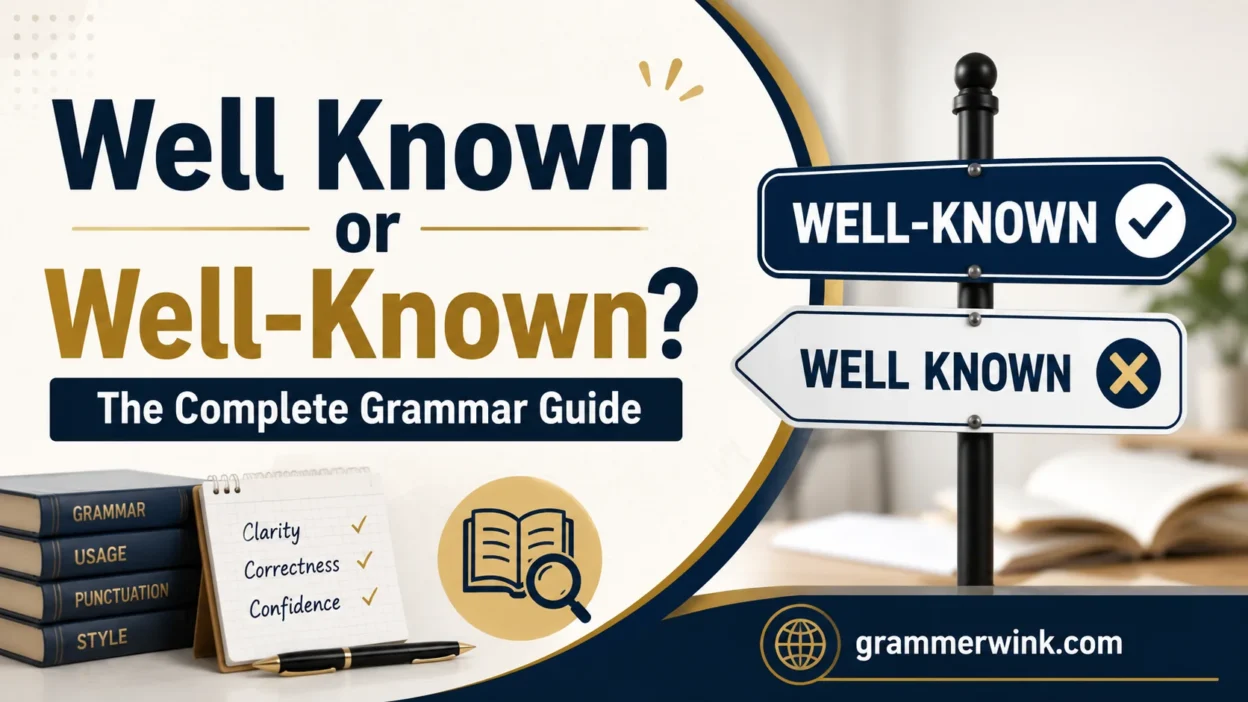
The basic rule is simple:
| Form | When to Use It | Example |
| Well-known | Before a noun | A well-known author |
| Well known | After a verb | The author is well known |
Examples
✅ A well-known scientist spoke at the conference.
✅ The scientist is well known worldwide.
✅ We visited a well-known museum.
✅ The museum is well known among tourists.
The difference depends on where the phrase appears in the sentence.
What Does “Well Known” Mean?
The phrase well known means that a person, place, thing, brand, or idea is recognized by many people.
In other words, something that is well known has gained familiarity, popularity, or widespread recognition.
Common Definitions
Well known means:
- Widely recognized
- Familiar to many people
- Popular or famous
- Easily identifiable
Synonyms
Some common synonyms include:
- Famous
- Renowned
- Popular
- Recognized
- Celebrated
- Distinguished
- Notable
- Eminent
Examples
- The company is well known for innovation.
- Her research is well known throughout the scientific community.
- The landmark is well known among travelers.
Although the phrase often refers to famous people, it can describe almost anything that many people recognize.
What Does “Well-Known” Mean?
Well-known has the same meaning as well known. The only difference is grammatical function.
When the phrase appears before a noun and acts as a single descriptive unit, it becomes a compound adjective.
In these situations, English grammar usually requires a hyphen.
Examples
- A well-known musician
- A well-known restaurant
- A well-known historical event
- A well-known technology company
The hyphen helps readers understand that the two words work together to describe the noun.
Without the hyphen, the sentence can appear awkward or confusing.
Why the Hyphen Matters in English Grammar
Hyphens are not random punctuation marks.
They serve an important purpose by connecting words that function together.
What Is a Compound Modifier?
A compound modifier consists of two or more words working together to describe another word.
Examples include:
- Well-known actor
- High-quality product
- Long-term strategy
- Full-time employee
- Well-written article
Because the words function as one idea, a hyphen connects them.
Why Writers Use Hyphens
Hyphens help:
- Improve readability
- Prevent ambiguity
- Clarify meaning
- Create smoother sentence flow
Consider this example:
Without hyphen:
A well known author
With hyphen:
A well-known author
The second version immediately signals that “well” and “known” belong together.
Understanding Compound Adjectives
To fully understand well-known, you need to understand compound adjectives.
A compound adjective is formed when multiple words combine to describe a noun.
Examples
| Compound Adjective | Example Sentence |
| Well-known | A well-known chef |
| High-quality | A high-quality camera |
| Long-term | A long-term solution |
| Fast-growing | A fast-growing company |
| State-of-the-art | State-of-the-art equipment |
These expressions function as single descriptive units.
Because they operate together, they are usually hyphenated before nouns.
When to Use “Well-Known”
Use well-known when it appears directly before a noun.
This is the most important rule to remember.
Examples
- A well-known actor
- A well-known athlete
- A well-known university
- A well-known landmark
- A well-known company
More Examples
- We stayed at a well-known hotel.
- She interviewed a well-known journalist.
- The book became a well-known bestseller.
- They visited a well-known tourist attraction.
- He is a well-known expert in cybersecurity.
In each example, well-known directly modifies the noun that follows.
Read More: In Front or Infront? Which Is Correct?
When to Use “Well Known”
Use well known without a hyphen when the phrase appears after a verb.
Most commonly, it follows linking verbs such as:
- Is
- Are
- Was
- Were
- Become
- Became
- Remain
- Remains
Examples
- The author is well known.
- The restaurant is well known in the city.
- Her work remains well known today.
- The company became well known for customer service.
- The landmark is well known around the world.
In these examples, the phrase does not appear before a noun, so the hyphen is unnecessary.
Well Known vs. Well-Known: Side-by-Side Comparison
| Feature | Well Known | Well-Known |
| Hyphen | No | Yes |
| Grammar Role | Predicate adjective | Compound adjective |
| Position | After a verb | Before a noun |
| Example | The singer is well known. | A well-known singer. |
| Usage | Describes subject | Describes noun |
Easy Rule
Before a noun = use a hyphen
After a verb = no hyphen
This rule solves most situations instantly.
Real-World Examples in Academic Writing
Academic writing frequently uses both forms.
Correct Usage
- The researcher is well known in the field of linguistics.
- A well-known theory explains the phenomenon.
- The scientist became well known after publishing groundbreaking research.
- The article references a well-known study.
Why It Matters
Academic readers expect precise grammar.
Using the correct form improves:
- Professionalism
- Credibility
- Readability
- Editorial consistency
Real-World Examples in Business Writing
Business communication often includes these phrases.
Examples
- The brand is well known internationally.
- A well-known corporation announced the merger.
- The company became well known for excellent customer service.
- We partnered with a well-known industry leader.
Clear grammar strengthens professional communication and creates a polished impression.
Real-World Examples in Journalism
News organizations frequently use compound modifiers.
Examples
- A well-known politician addressed reporters.
- The athlete is well known throughout the country.
- A well-known technology executive attended the event.
- The organization is well known for humanitarian work.
Journalists often follow style guides that carefully regulate hyphen usage.
Real-World Examples in Marketing Content
Marketing copy relies heavily on descriptive language.
Examples
- Our product was developed by a well-known expert.
- The company is well known for quality craftsmanship.
- This partnership includes several well-known brands.
- The destination is well known among travelers.
Proper punctuation enhances trust and professionalism.
Common Mistakes Writers Make
Many writers know the phrase but misuse the hyphen.
Let’s examine the most frequent errors.
Mistake: Omitting the Hyphen Before a Noun
❌ A well known actor
✅ A well-known actor
Because the phrase modifies the noun directly, the hyphen is required.
Mistake: Adding an Unnecessary Hyphen After a Verb
❌ The actor is well-known.
While some publishers may allow this, many grammar authorities prefer:
✅ The actor is well known.
The hyphen is generally unnecessary after linking verbs.
Mistake: Being Inconsistent
Some writers alternate between both forms without following the rule.
Example:
❌ A well known author who is well-known worldwide.
Better:
✅ A well-known author who is well known worldwide.
Consistency improves clarity.
Similar Hyphenated Expressions You Should Know
The same grammar rule applies to many English expressions.
Well-Made vs. Well Made
Before noun:
- A well-made table
After verb:
- The table is well made
Well-Written vs. Well Written
Before noun:
- A well-written article
After verb:
- The article is well written
Well-Designed vs. Well Designed
Before noun:
- A well-designed website
After verb:
- The website is well designed
Well-Respected vs. Well Respected
Before noun:
- A well-respected professor
After verb:
- The professor is well respected
Well-Educated vs. Well Educated
Before noun:
- A well-educated population
After verb:
- The population is well educated
Understanding this pattern helps you master dozens of English grammar situations.
Case Study: How Hyphenation Changes Readability
Consider these sentences.
Version One
A well known public speaking expert delivered a presentation.
Version Two
A well-known public speaking expert delivered a presentation.
Most readers process the second version more quickly.
The hyphen instantly signals that the words belong together.
This small punctuation mark improves reading flow and reduces cognitive effort.
That’s why editors pay close attention to compound modifiers.
What Major Style Guides Say
Professional style guides generally support the same principle.
AP Style
The Associated Press Stylebook typically hyphenates compound modifiers before nouns when clarity requires it.
Example:
- A well-known actor
Chicago Manual of Style
The Chicago Manual of Style also favors hyphenating compound modifiers before nouns.
Example:
- A well-known historian
MLA Style
MLA writing generally follows standard compound adjective rules.
Example:
- A well-known literary critic
APA Style
APA style similarly recommends hyphenating compound modifiers when they appear before nouns.
Example:
- A well-known psychological theory
Across major style guides, the core rule remains remarkably consistent.
Memory Tricks to Remember the Difference
The Before-and-After Rule
Think of it this way:
Before a noun → hyphen
After a verb → no hyphen
Examples:
- A well-known singer
- The singer is well known
The Noun Test
Ask yourself:
“Does a noun immediately follow the phrase?”
If yes:
Use well-known
If no:
Use well known
The Editor’s Shortcut
Many editors use this quick formula:
“Compound adjective before noun? Add a hyphen.”
This shortcut works in countless situations.
Quick Reference Table
| Sentence | Correct Form |
| A ___ author | Well-known |
| The author is ___ | Well known |
| A ___ scientist | Well-known |
| The scientist is ___ | Well known |
| A ___ company | Well-known |
| The company is ___ | Well known |
Keep this table handy whenever you’re proofreading.
Practice Quiz
Choose the correct option.
Questions
- A _____ musician performed tonight.
- The musician is _____ internationally.
- A _____ restaurant opened downtown.
- The restaurant is _____ for seafood.
- A _____ professor wrote the textbook.
Answers
- Well-known
- Well known
- Well-known
- Well known
- Well-known
Conclusion
Understanding the difference between well known and well-known is easier than it first appears. Both expressions have the same meaning, but their usage depends on where they appear in a sentence. Use well-known with a hyphen when it comes before a noun as a compound adjective, such as in a well-known author. Use well known without a hyphen when it follows a verb, such as in the author is well known.
This simple grammar rule not only improves clarity but also helps your writing look more professional and polished. Whether you’re creating blog content, academic papers, business documents, or everyday emails, proper hyphenation ensures your message is easy to read and grammatically correct.