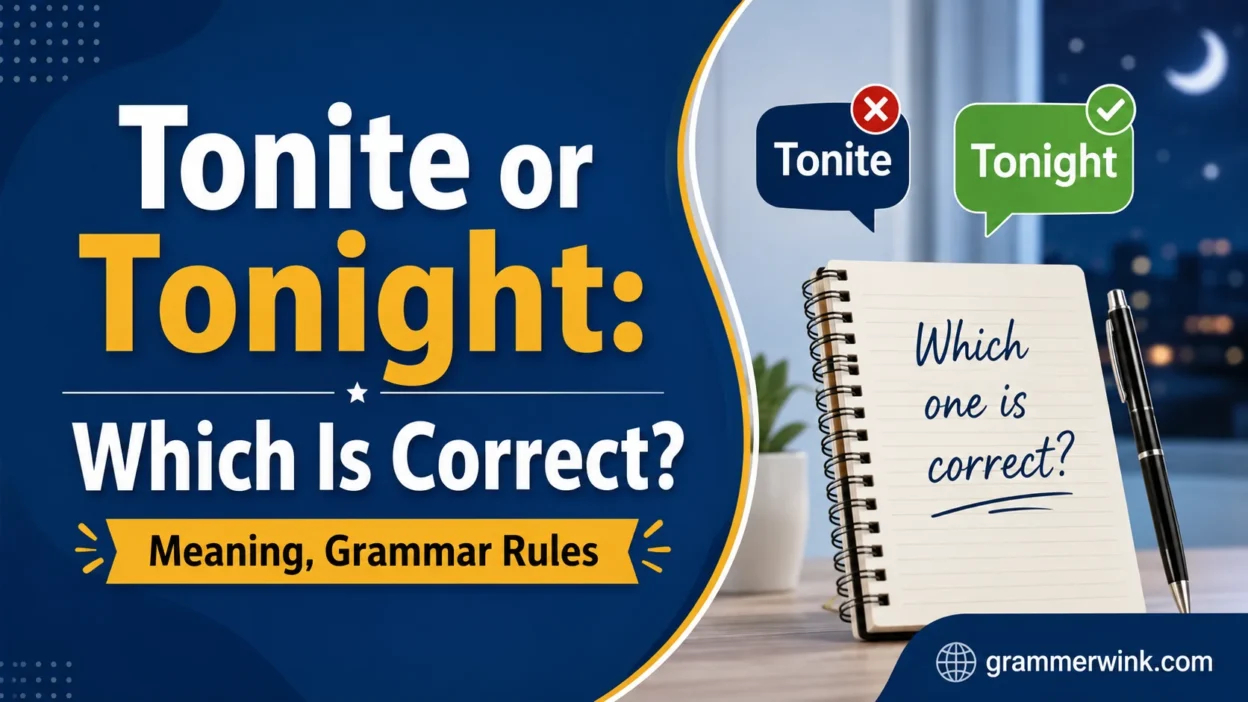
Choosing between “Tonite” and “Tonight” can be confusing for many English learners. The word “tonight” is the correct standard spelling used in everyday and formal English. It refers to the evening or night of the current day. You’ll commonly find it in conversations, emails, books, and professional writing. On the other hand, “tonite” is an informal spelling that appears mostly in casual communication. Understanding this simple difference can help you improve your spelling, grammar, and writing clarity.
The word “tonight” functions as an adverb and is used to describe something happening during the current night. For example, you might say, “I’m going home tonight” or “We have dinner tonight.” Although “tonite” has the same meaning, it is generally viewed as nonstandard or highly informal. It may appear in text messages, advertisements, song titles, and casual online posts. However, writers should usually choose “tonight” for formal writing and professional communication.
In this guide, we’ll explore “Tonite or Tonight” and explain the correct usage clearly. You’ll learn about their meanings, grammatical roles, spelling differences, and common sentence examples. We’ll also explain when “tonite” may be acceptable and why “tonight” remains the preferred choice. This information can help students, writers, professionals, and English learners avoid common mistakes. By understanding these simple grammar rules and usage tips, you can confidently choose the right word for every situation.
Quick Comparison: Tonite or Tonight
Here’s a clean snapshot before we go deeper.
| Feature | Tonight | Tonite |
| Standard English | ✅ Yes | ❌ No |
| Dictionary acceptance | Yes (standard form) | Limited / nonstandard variant |
| Formal writing | Correct | Incorrect |
| Academic use | Required | Not accepted |
| Business communication | Required | Not recommended |
| Advertising / branding | Sometimes used | Common |
| Text messaging | Common | Sometimes used |
| Clarity for global readers | High | Medium to low |
This table already tells you the truth: “tonight” wins in every serious context.
What Does “Tonight” Mean in English?
The word “tonight” refers to the night of the current day or upcoming night.
It works in two main ways:
As an adverb
It modifies verbs.
- I will study tonight.
- We are going out tonight.
As a noun
Less common, but still valid.
- Tonight feels special.
- I’ve been waiting for tonight all week.
Simple definition
Tonight = the period of time between evening and early morning of the current day.
It’s one of the most frequently used time expressions in English conversation and writing.
Is “Tonite” a Real Word or Just a Mistake?
This is where things get interesting.
Yes, “tonite” exists, but it is not standard English.
You will find it in:
- Advertising slogans
- Brand names
- Song titles
- Social media captions
- Informal texting
- Event posters
However, most major dictionaries classify it as a nonstandard spelling variant.
What that means in practice
It is not “wrong” in a creative sense, but it is not acceptable in formal communication.
Think of it like this:
“Tonite” is like wearing sneakers to a wedding. You can do it, but everyone notices.
Why Do People Write “Tonite” Instead of “Tonight”?
Language doesn’t change randomly. There are real reasons behind this spelling.
Faster communication
Shortening words saves time and space.
- tonight → tonite (one letter less, but visually shorter)
This mattered more in older advertising formats like billboards and print ads.
Phonetic spelling
People write words the way they sound.
“Tonight” and “tonite” sound identical when spoken.
So writers assume:
“If it sounds the same, it should look simpler.”
Marketing psychology
Brands often prefer shorter spellings because they:
- Look more memorable
- Fit better on logos
- Feel casual and approachable
- Stand out visually
Example:
- “Club Tonite” feels more stylized than “Club Tonight”
Digital culture influence
Texting and social media encourage relaxed spelling.
People often drop letters when typing quickly:
- tonight → tonite
- going to → gonna
- want to → wanna
Over time, these patterns stick.
Why “Tonight” Is the Standard Spelling
Now let’s talk about authority.
English spelling standardization didn’t happen overnight. It evolved through centuries of printing, publishing, and education systems.
Standardization matters because:
- It improves readability
- It reduces misunderstanding
- It supports global communication
- It keeps academic and professional writing consistent
Major style systems like:
- AP Stylebook
- Chicago Manual of Style
- MLA Handbook
all consistently support “tonight” as the correct form.
None of them recommend “tonite” for formal use.
Tonite vs Tonight: A Deep Side-by-Side Breakdown
Let’s go deeper than the basic table.
| Category | Tonight | Tonite |
| Readability | Very high | Moderate |
| Professional tone | Strong | Weak |
| Academic acceptance | Full | Rejected |
| Search engine clarity | High ranking consistency | Mixed interpretation |
| Brand identity use | Neutral | Trendy / informal |
| Global understanding | Universal | Regionally influenced |
| Longevity in writing | Stable | Declining in formal use |
Key insight
“Tonite” creates style impact, not grammatical accuracy.
“Tonight” creates clarity and authority.
When Should You Use “Tonight”? (Real Situations)
You should use “tonight” almost everywhere, especially in structured communication.
Formal writing
Use it in:
- Essays
- Research papers
- Reports
- Journalism
- Academic submissions
Example:
The meeting will take place tonight at 7 PM.
Professional communication
Use it in:
- Emails
- Business proposals
- Work chats
- Presentations
Example:
The client call is scheduled for tonight.
Everyday writing
Use it in:
- Messages
- Notes
- Invitations
Example:
Let’s meet tonight for dinner.
When Is “Tonite” Acceptable? (Limited but Real Use Cases)
Let’s be fair. “Tonite” isn’t useless. It just lives in specific spaces.
Branding and marketing
Companies sometimes use it to feel modern or edgy.
Examples:
- “Saturday Tonite Live” style event branding
- Nightclubs using stylized spelling
The goal is visual identity, not grammar correctness.
Creative works
You will often see “tonite” in:
- Song titles
- Album names
- Movie titles
- Performance events
Artists often break spelling rules to stand out.
Example:
- A pop track titled “Tonite Is Ours”
Social media and texting
People sometimes shorten it in informal chats.
Example:
u free tonite?
However, even here, autocorrect often changes it back to “tonight.”
Example Sentences: Tonight vs Tonite in Real Context
Correct usage of “tonight”
- I will finish the project tonight.
- She arrives tonight from New York.
- We have a dinner reservation tonight.
- Tonight feels different somehow.
- The weather forecast predicts rain tonight.
“Tonite” in context (nonstandard use)
- Club Tonite opens at 9 PM.
- Live Tonite: The Summer Concert Series
- Meet me tonite at the usual spot (informal texting)
Notice the difference:
- “Tonight” communicates information.
- “Tonite” creates style or branding.
Common Mistakes People Make With Tonite or Tonight
Let’s clear up real-world errors.
Using “tonite” in professional emails
This weakens credibility instantly.
Bad:
The report is due tonite.
Better:
The report is due tonight.
Assuming “tonite” is interchangeable everywhere
It isn’t.
Context decides everything.
Overusing informal spelling in academic writing
Teachers and editors consistently reject it.
Why People Get Confused Between Tonite and Tonight
This confusion is more psychological than grammatical.
Sound-based spelling habits
English is not fully phonetic, so people rely on sound.
Exposure to branding
People see “tonite” in ads and assume it’s correct.
Social media shortcuts
Typing fast leads to simplified spelling.
Visual similarity
Both words look almost identical at a glance, which reinforces confusion.
What Dictionaries Say About Tonite or Tonight
Let’s ground this in real references.
Merriam-Webster
- Lists “tonight” as the standard form.
- Recognizes “tonite” as a variant, but labels it informal/nonstandard.
Oxford English Dictionary
- Treats “tonight” as the accepted spelling.
- Marks “tonite” as informal usage tied to modern slang or branding.
Cambridge Dictionary
- Only recommends “tonight” for correct usage.
Collins Dictionary
- Aligns with standard spelling conventions.
- Does not endorse “tonite” for formal writing.
Clear conclusion from all sources
Every major dictionary agrees: “tonight” is correct standard English.
What Style Guides Recommend
Style guides shape professional writing across industries.
AP Style
- Uses “tonight” exclusively in formal journalism.
Chicago Manual of Style
- Requires standard spelling in all editorial content.
MLA Style
- Requires standard academic spelling in all submissions.
Key takeaway
If you follow any professional writing standard, “tonight” is mandatory.
Read More: What Does WTV Mean in Text & Chat? Full Meaning, Usage
Why “Tonite” Still Survives in Modern Language
Even though it’s nonstandard, it refuses to disappear.
Here’s why:
- It looks catchy in branding
- It fits tight visual spaces
- It signals informality or creativity
- It taps into nostalgia from older advertising eras
But here’s the catch:
It survives as style, not as grammar.
Case Study: Branding Choices and “Tonite” Usage
Let’s look at how spelling changes perception.
Scenario 1: Formal announcement
- “Grand Opening Tonight at 8 PM”
Perception:
- Professional
- Trustworthy
- Clear
Scenario 2: Stylized branding
- “Grand Opening Tonite at 8 PM”
Perception:
- Trendy
- Casual
- Youth-focused
- Slightly less formal credibility
What businesses actually do
Many brands intentionally switch spelling to:
- Target younger audiences
- Create memorable slogans
- Fit aesthetic designs
However, they still use “tonight” in official documentation.
What Happens If You Use “Tonite” in the Wrong Context?
This is where things get practical. Grammar rules matter less in theory and more in real consequences.
When you swap “tonight” for “tonite” in the wrong place, you don’t usually break a rule that gets you punished. Instead, you quietly change how people perceive you.
In professional settings
If you write:
The deadline is tonite.
Most readers won’t stop to analyze grammar. They’ll just feel something is off.
What they may think:
- “This looks unprofessional.”
- “Did they rush this message?”
- “Is this person detail-oriented?”
That reaction happens fast, almost subconsciously.
Now compare:
The deadline is tonight.
That version disappears into the message. No distractions. No friction. Just clarity.
In academic writing
In school or university work, “tonite” creates a stronger problem.
Even one informal spelling can:
- Lower perceived writing quality
- Signal carelessness
- Affect grading in strict evaluation systems
Many instructors treat it like other informal spellings such as:
- “gonna”
- “wanna”
- “u” instead of “you”
Not because they are incomprehensible, but because academic writing demands consistency.
In global communication
English often serves as a bridge language. Readers may not be native speakers.
Here’s the issue:
- “Tonight” is universally taught
- “Tonite” is often never formally learned
So when you use “tonite,” you introduce unnecessary ambiguity. Even if meaning stays clear, readability drops.
How “Tonite” Affects and Online Writing
Now let’s switch gears. This matters if you write online content, blogs, or product pages.
Search engines like Google prioritize:
- Standard spelling
- Consistency
- User familiarity
Keyword behavior
Most users search:
- “tonight weather”
- “tonight meaning”
- “events tonight”
Very few search:
- “events tonite”
That means:
Using “tonight” improves visibility. Using “tonite” narrows your reach.
Content indexing reality
Search engines map language patterns based on usage frequency.
- “Tonight” appears in billions of indexed pages.
- “Tonite” appears mostly in brand names and informal posts.
So if you want content to rank, “tonight” aligns with how users actually search.
Example comparison
| Query Type | Result Strength |
| “what to do tonight” | High relevance |
| “what to do tonite” | Lower relevance |
Even though both queries make sense, only one matches dominant search behavior.
A Linguistic Look: Why English Keeps “Tonight” Instead of Simplifying It
English spelling doesn’t always match pronunciation. That frustrates learners, but it has historical reasons.
Word origin
“Tonight” comes from Old English structure:
- “to niht” → meaning “at night” or “this night”
Over time:
- “to niht” merged into “tonight”
So the modern form carries historical structure, not phonetic simplicity.
Why spelling didn’t simplify
English resisted full phonetic reform because:
- Printing standardization locked spelling early
- Dictionaries preserved forms
- Education systems reinforced consistency
As a result, English keeps many “non-phonetic” words like:
- knight (silent k)
- through (silent letters)
- night (complex vowel pattern)
“Tonight” fits this system naturally.
Memory Trick to Never Confuse Tonite or Tonight Again
Here’s a simple mental shortcut:
“Night has a ‘gh’, so tonight keeps its full form.”
Another way to remember:
- Tonight = full English (formal, complete)
- Tonite = shortened style (casual, decorative)
If you’re writing anything important, ask yourself:
“Am I trying to communicate or decorate?”
If the answer is communicate → use tonight.
Real-World Examples From Media and Branding
Let’s look at how both forms appear in the real world.
“Tonight” in media and news
You’ll see “tonight” in:
- News headlines
- TV schedules
- Weather reports
- Event announcements
Example:
Breaking news: Heavy rain expected tonight across multiple regions.
Why it works:
- Neutral tone
- Clear meaning
- Professional structure
“Tonite” in entertainment culture
You’ll often see “tonite” in:
- Concert posters
- Nightclub flyers
- Song titles
- Retro branding campaigns
Example:
“Summer Jam Tonite – Doors open at 8 PM”
Why it works:
- Visual punch
- Artistic styling
- Emotional tone
It signals vibe more than information.
Psychology Behind Spelling Choices
Language is not just grammar. It’s perception.
“Tonight” feels like:
- Reliable
- Neutral
- Structured
- Informational
“Tonite” feels like:
- Casual
- Stylized
- Youthful
- Playful
Neither is inherently “better” in emotion. But they serve different communication goals.
Think of it like clothing:
- “Tonight” = formal outfit
- “Tonite” = streetwear or custom design
Same person. Different impression.
Expert Opinion Snapshot
Linguists and style experts generally agree on one principle:
Standard spelling exists to reduce friction in communication.
That’s why most writing systems prefer consistency over creativity in spelling.
A simplified interpretation from language research:
- Standard spelling improves comprehension speed
- Nonstandard spelling increases cognitive load slightly
That means readers process “tonight” faster than “tonite,” even if only by a fraction of a second.
Practical Writing Guide: Choosing Between Tonite or Tonight
Here’s a simple decision framework you can actually use.
Use “tonight” when:
- You are writing anything formal
- You want clarity over style
- You are unsure of the audience
- You are publishing online content
- You are writing for school or work
Use “tonite” only when:
- You are naming a brand or event
- You are designing a slogan
- You want a retro or stylized feel
- You are intentionally breaking rules for effect
Quick decision rule
Ask yourself:
“Will someone judge my grammar here?”
- Yes → use tonight
- No, only style matters → you can use tonite
Final Expanded Summary: Tonite or Tonight in Real Life
At this point, the difference should feel obvious.
- Tonight is the foundation of correct English usage.
- Tonite is a stylistic variation that lives in branding, culture, and informal expression.
They are not equals in grammar, but they are cousins in expression.
If you write professionally, academically, or publicly, you will almost always win by choosing tonight. It keeps your message clean, respected, and easy to understand.
If you ever feel tempted to use “tonite,” pause for a second and ask what you want the reader to feel. If you want clarity, trust, and smooth reading flow, the answer is already sitting there:
Tonight is the right choice. Always, unless style deliberately says otherwise.
FAQs
Is “tonite” ever considered correct English?
No, not in standard English. Writers use “tonite” as a nonstandard spelling. You’ll mainly see it in branding, entertainment titles, or casual online posts. It works stylistically, but it doesn’t follow formal grammar rules.
Why do people still use “tonite” if it’s incorrect?
People use it for style and speed. It looks shorter, feels casual, and fits marketing designs better. For example, a nightclub poster might use “Tonite” to create a modern or edgy vibe.
Can I use “tonite” in professional emails?
You shouldn’t. In professional communication, “tonight” keeps your message clear and credible. “Tonite” can make your writing look rushed or careless, even if your message is correct.
Is “tonite” slang or just a spelling mistake?
It sits somewhere in between. It’s not slang in the traditional sense, but it is a nonstandard spelling. Think of it as a stylistic shortcut rather than an accepted form of English.
Do dictionaries recognize “tonite”?
Most major dictionaries list “tonight” as the standard form. Some may mention “tonite” as an informal or variant spelling, but they do not recommend it for formal writing.
Conclusion
The difference between “tonite” and “tonight” comes down to one simple idea: purpose.If you want clear, correct, and universally accepted English, “tonight” is the only right choice. It fits every formal situation, from academic writing to business communication. It reads smoothly, avoids confusion, and aligns with standard English rules.“Tonite,” on the other hand, plays a different role. It belongs to creative spaces—branding, music, advertising, and informal expression. It trades correctness for style. That trade can work in the right setting, but it can also weaken your credibility if you use it carelessly.