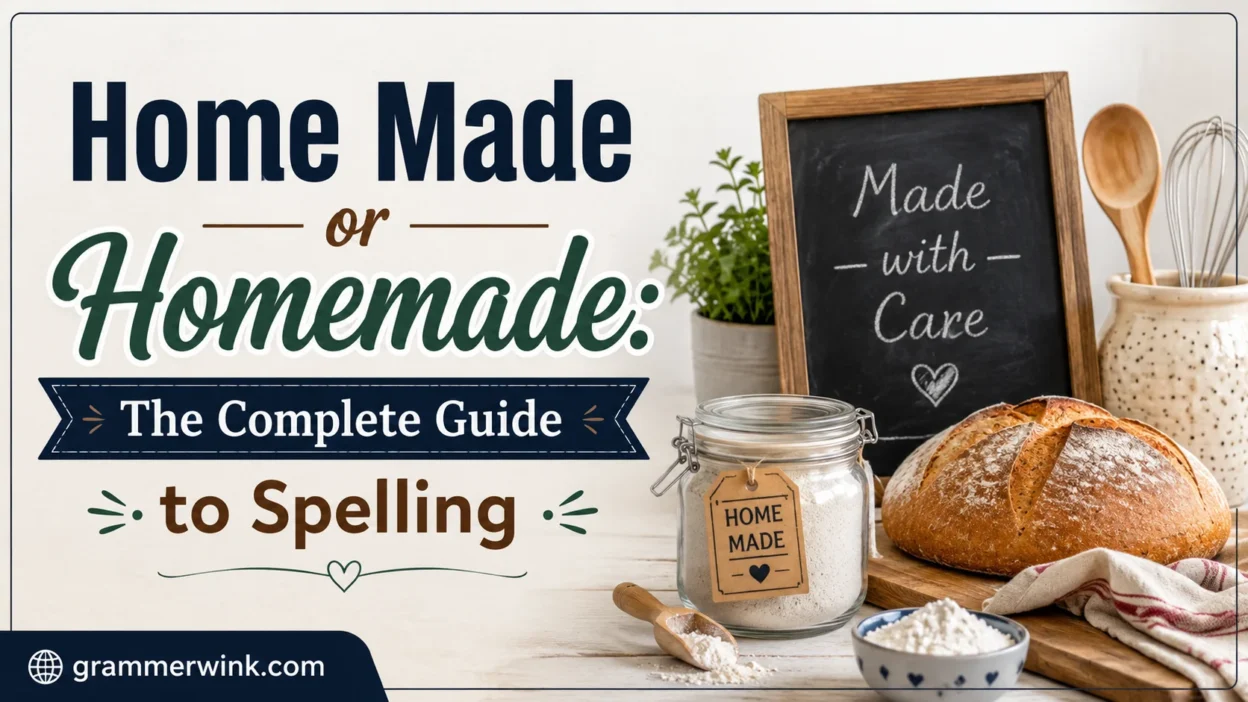
When writing in English, even small spelling differences can create big confusion for readers. One of the most common questions people ask is whether “Home Made” or “Homemade” is the correct spelling. Although both forms may appear online, only one is considered standard English in most situations. Understanding the correct usage, grammar rules, writing style, and dictionary guidance helps you write with greater confidence. This guide will explain the difference, proper spelling, common mistakes, and real-life examples so you always choose the right form.
The word “Homemade” is a compound adjective that describes something made at home rather than produced in a factory or purchased from a store. It is widely accepted in American English, British English, professional writing, and everyday communication. On the other hand, writing “Home Made” as two separate words is usually considered incorrect in modern English unless it appears in a very specific context, historical writing, or creative styling. Knowing this distinction improves your grammar accuracy, writing quality, professional communication, and language confidence.
Whether you are creating blog articles, school assignments, business emails, or social media posts, using the correct spelling leaves a better impression on your audience. This complete guide covers the meaning, grammar rules, usage examples, common errors, and easy memory tips to help you remember the correct form. By the end of this article, you’ll understand exactly when to use “Homemade”, why “Home Made” is rarely correct, and how to avoid spelling mistakes, grammar errors, writing confusion, and common misconceptions in everyday English.
Home Made or Homemade: The Quick Answer First
Before diving deep, here is the rule most modern writers follow:
- Homemade (one word) → standard modern form
- Home-made (hyphenated) → older or British style usage
- Home made (two words) → rare and generally nonstandard in modern writing
If you remember only one thing, remember this:
“Homemade” is the safest and most correct choice in modern English writing.
Now let’s understand why.
What “Homemade” Really Means in English
The word homemade describes something created at home rather than produced in a factory or commercial setting.
It often signals:
- Personal effort
- Craftsmanship
- Non-industrial production
- Traditional or artisanal quality
Everyday examples:
- Homemade bread baked in a kitchen oven
- Homemade soap crafted in small batches
- Homemade jam made from fresh fruit
You will notice something important here.
The word does not just describe location. It describes origin and method of production.
That is why it behaves like a single concept in modern English.
Why “Homemade” Became One Word
English has a habit of merging commonly used word pairs into single units over time. Linguists call this compound formation.
Here is what happens:
- Two words appear together frequently
- Their combined meaning becomes obvious
- Speakers start treating them as a single idea
- Spelling gradually fuses into one word
We see this in many everyday examples:
| Older Form | Modern Form |
| web site | website |
| mail box | mailbox |
| note book | notebook |
| home made | homemade |
This process improves reading flow. It also reduces hesitation during writing.
So instead of thinking “home + made,” writers naturally think:
“homemade = a single concept”
Breaking Down “Home Made” (Two Words Version)
The two-word version “home made” still appears occasionally, but it behaves differently.
When you separate the words, you shift the meaning slightly.
It emphasizes:
- The home as a physical place
- The act of making something there
- A literal interpretation instead of a conceptual one
Example comparison:
- Homemade soup → natural, standard meaning
- Home made soup → sounds segmented and outdated
You might still see “home made” in:
- Older books
- Informal handwritten notes
- Experimental poetic writing
However, in modern digital writing, it often looks inconsistent or unpolished.
The Hyphenated Form: “Home-made”
Before “homemade” became standard, many style guides used the hyphen:
- home-made cake
- home-made goods
- home-made crafts
The hyphen helped readers understand that the two words function together as a single adjective.
Why hyphens were used historically:
English readers once relied heavily on visual cues. Hyphens helped prevent confusion in compound modifiers.
For example:
- a home-made cake (cake made at home)
- a home made cake (could confuse reading flow in older typography systems)
Read More: One Third or One-Third? Which Is Correct?
Why it changed:
Modern English favors:
- faster reading
- simpler spelling
- reduced punctuation clutter
So hyphens slowly disappeared in this case.
Today, most American English writing prefers “homemade” without a hyphen.
What Style Guides Actually Say About “Homemade”
Different editorial systems treat the word slightly differently, but the trend is clear.
| Style Guide | Preferred Form |
| AP Style | homemade |
| Chicago Manual of Style | homemade |
| Oxford style (modern usage) | homemade (hyphen optional but declining) |
| British historical usage | home-made |
Key takeaway:
Most modern editorial systems agree:
Use “homemade” unless you have a specific stylistic reason not to.
Even British English, which historically favored hyphenation, now leans toward the closed form.
Grammar Role: Why “Homemade” Works So Well
“Homemade” functions as a compound adjective.
It modifies nouns directly:
- homemade cookies
- homemade furniture
- homemade pasta
Why it works smoothly:
- It behaves like a single word
- It reduces visual clutter
- It improves reading rhythm
Compare these two:
- The homemade cake tasted better.
- The home made cake tasted better.
The first version flows naturally. The second forces your brain to pause.
That small pause matters more than you think, especially in web writing.
Real Usage Examples You Can Trust
Let’s look at how the word appears in natural contexts.
Correct usage (modern English):
- I prefer homemade food because it feels healthier.
- She started a homemade candle business last year.
- We brought homemade cookies to the meeting.
Less common or outdated usage:
- We ate home made soup at her house.
- He sells home-made crafts online.
The second group still makes sense, but it feels slightly dated or stylistically inconsistent.
Common Mistakes Writers Make With “Home Made or Homemade”
Writers often struggle with consistency more than correctness.
Here are the most frequent issues:
Mixing forms in one article
- Using “homemade” in one paragraph
- Then switching to “home made” later
This creates a fragmented reading experience.
Overthinking hyphens
Many writers add hyphens out of habit, even when unnecessary.
Forcing emphasis incorrectly
Some writers separate the words to stress meaning:
- “This is truly home made food”
But modern English already carries that meaning in the single word.
When “Home Made” Still Works
Even though it is rare, “home made” can still appear in specific contexts.
Situations where it might fit:
- Poetry or creative writing
- Intentional stylistic fragmentation
- Historical storytelling
- Emphasis on literal meaning of “home”
Example:
The smell of home made bread drifted through the open window.
Here, the separation may create a slower, more nostalgic tone.
However, this is stylistic rather than standard usage.
Simple Rule to Remember
If you want a practical shortcut, use this:
- Use “homemade” in almost all modern writing
- Only split it if you want artistic or historical emphasis
- Avoid mixing forms in the same document
Think of it like this:
“Homemade” is the default setting. Everything else is customization.
FAQs
Is “homemade” one word or two?
It is one word in modern English. Most style guides prefer it.
Is “home made” grammatically correct?
It is understandable but not standard in modern writing.
Should I use a hyphen?
Only if you follow older British style rules or specific editorial guidelines.
Which version is best for ?
“Homemade” performs best in search engines and keyword targeting.
Can I mix versions in writing?
You should avoid it. Consistency matters more than variation here.
Final Thoughts on Home Made or Homemade
English does not always follow strict logic. It evolves through usage, not rules carved in stone.
This word shows that evolution clearly.
What once appeared as “home made” slowly became “home-made,” then eventually settled into “homemade.”
Today, the single-word form wins in almost every context that matters:
- academic writing
- blogging
- content
- marketing copy
- everyday communication
So when you hesitate mid-sentence, remember this simple truth:
You do not need to split it. Just write “homemade” and move on.
It keeps your writing cleaner. It improves readability. It matches how people actually use the language today.
And most importantly, it lets your reader focus on your message instead of your spelling choices.
Conclusion
When you strip everything back, the answer becomes surprisingly simple. “Homemade” is the modern, standard, and widely accepted form in almost every context that matters today. It appears in recipes, blogs, marketing copy, academic writing, and content because it reads smoothly and matches how English has evolved.
The two-word version, “home made,” still exists, but it feels like a leftover from an earlier stage of the language. You might spot it in older books or in creative writing where someone wants a more literal or stylistic effect. Still, it rarely shows up in polished modern text.