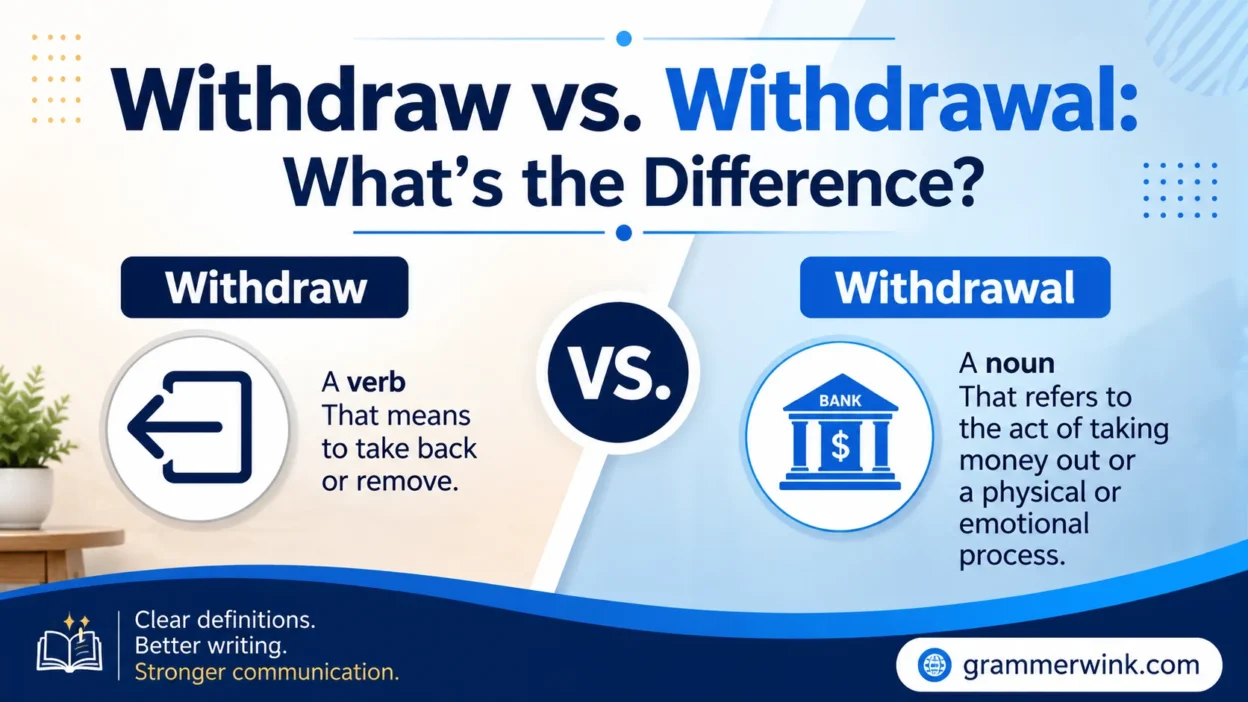
When learning English grammar, many people confuse withdraw and withdrawal because they come from the same root word but serve different grammatical roles. Withdraw is a verb, meaning to remove, take back, or leave something, while withdrawal is a noun that refers to the act or process of withdrawing. Understanding this simple distinction helps improve both writing accuracy and spoken communication. Whether you’re discussing banking, business, medicine, or everyday conversations, choosing the correct word makes your message much clearer.
The difference between withdraw and withdrawal becomes easier when you focus on how each word functions in a sentence. If someone decides to withdraw money from a bank account, the action is described with the verb withdraw. However, the completed action is called a withdrawal, such as a cash withdrawal or a withdrawal request. This pattern appears in many areas of English, making it important for students, professionals, and language learners to recognize when to use each form correctly.
In this guide, you’ll discover the meaning, grammar, examples, and common mistakes related to withdraw and withdrawal. We’ll explain their definitions, compare them in real-life situations, and provide easy-to-understand examples that strengthen your vocabulary and confidence. By the end of this article, you’ll know exactly when to use withdraw as a verb and withdrawal as a noun, helping you communicate with greater clarity, precision, and fluency in both formal and informal English.
Withdraw vs. Withdrawal: The Quick Answer
Before diving deeper, here’s the easiest way to remember the difference.
What Does Withdraw Mean?
Withdraw is a verb.
It means to remove, take back, pull away, or leave something.
Examples:
- I need to withdraw cash from the ATM.
- She decided to withdraw her application.
- The athlete chose to withdraw from the competition.
In each example, someone is performing an action.
What Does Withdrawal Mean?
Withdrawal is a noun.
It refers to the act, process, or result of withdrawing something.
Examples:
- The withdrawal was processed today.
- His withdrawal from the race surprised everyone.
- The bank recorded a large withdrawal.
In each case, withdrawal names an event, action, or occurrence.
Withdraw vs. Withdrawal Comparison Table
| Word | Part of Speech | Meaning | Example |
| Withdraw | Verb | To remove, take back, or leave | Please withdraw your application. |
| Withdrawal | Noun | The act of withdrawing | The withdrawal was approved. |
What Does “Withdraw” Mean?
The word withdraw is an action word.
Whenever a person, company, organization, or government removes something or steps away from something, withdraw is often the correct choice.
Definition of Withdraw
According to standard English usage, withdraw means:
- To remove something
- To take something back
- To retreat
- To stop participating
- To move away from a situation
Think of withdraw as describing what someone does.
Common Uses of Withdraw
The word appears in many everyday situations.
Let’s examine the most common ones.
Withdraw Money
This is one of the most frequent uses.
People withdraw money from:
- Banks
- ATMs
- Savings accounts
- Investment accounts
Examples:
- I need to withdraw $200 before the weekend.
- She withdrew cash from the ATM.
- Customers can withdraw funds online.
Withdraw an Application
Job seekers and students often withdraw applications.
Examples:
- He withdrew his university application.
- The candidate decided to withdraw from consideration.
- She withdrew her scholarship request.
Withdraw From a Course
Educational institutions regularly use this term.
Examples:
- Students may withdraw before the deadline.
- He withdrew from the chemistry course.
- She plans to withdraw from the program next semester.
Withdraw From a Competition
Athletes and contestants frequently withdraw due to injury or personal reasons.
Examples:
- The tennis player withdrew before the final.
- Several teams withdrew from the tournament.
- The runner withdrew because of illness.
Withdraw Troops or Forces
Governments and military organizations use withdraw when discussing movement or removal.
Examples:
- The country withdrew troops from the region.
- Officials announced plans to withdraw forces.
- The military withdrew after negotiations.
Read More: Success or Sucess: Which Is Correct?
Examples of Withdraw in Sentences
Understanding real-world examples helps reinforce proper usage.
Here are several correct examples:
- Please withdraw your complaint if the issue has been resolved.
- The investor withdrew funds from the account.
- She withdrew her support for the proposal.
- They decided to withdraw from the partnership.
- He withdrew from social activities temporarily.
- The company withdrew the product from stores.
- Students may withdraw before the registration deadline.
- The athlete withdrew because of an injury.
- The customer withdrew money from the bank.
- The government withdrew sanctions after negotiations.
Notice something important?
Every sentence contains an action.
That action makes withdraw a verb.
What Does “Withdrawal” Mean?
Now let’s look at the noun form.
Definition of Withdrawal
Withdrawal refers to:
- The act of withdrawing
- The process of removing something
- The state resulting from withdrawing
Unlike withdraw, withdrawal names a thing rather than an action.
Understanding Withdrawal Through a Simple Example
Consider these sentences:
- I will withdraw money tomorrow.
- The withdrawal occurred yesterday.
The first sentence describes an action.
The second sentence names the event.
That distinction explains the difference between the two words.
Common Types of Withdrawal
The noun appears in many specialized fields.
Bank Withdrawal
Banks use withdrawal constantly.
Examples include:
- Cash withdrawal
- ATM withdrawal
- Electronic withdrawal
- Savings withdrawal
Example sentence:
- The withdrawal appeared on the account statement.
Medical Withdrawal
Healthcare professionals use withdrawal to describe symptoms that occur after stopping certain substances.
Common examples include:
- Alcohol withdrawal
- Nicotine withdrawal
- Opioid withdrawal
- Caffeine withdrawal
Symptoms can vary depending on the substance involved.
Social Withdrawal
Psychologists often discuss social withdrawal.
This refers to reduced interaction with others.
Examples:
- Social withdrawal may occur during stressful periods.
- Teachers noticed signs of social withdrawal.
Academic Withdrawal
Universities frequently use this term.
Examples:
- Course withdrawal
- Program withdrawal
- Student withdrawal
Example sentence:
- The withdrawal deadline is Friday.
Legal Withdrawal
The legal field uses withdrawal in numerous contexts.
Examples:
- Withdrawal of charges
- Withdrawal of consent
- Withdrawal of a lawsuit
- Withdrawal of testimony
Example sentence:
- The court approved the withdrawal of the claim.
Examples of Withdrawal in Sentences
The following examples demonstrate correct noun usage.
- The withdrawal was completed successfully.
- A large withdrawal triggered a security alert.
- Her withdrawal from the event disappointed fans.
- The withdrawal of troops began immediately.
- The withdrawal process took several days.
- His withdrawal from the course became official.
- The withdrawal of funding affected the project.
- The withdrawal of charges ended the case.
- The withdrawal caused significant changes.
- The bank confirmed the withdrawal.
Notice that withdrawal functions as a thing, event, or process.
That makes it a noun.
Grammar Rule: Verb vs. Noun
Many grammar questions become easy when you identify the part of speech.
Why Withdraw Is a Verb
A verb shows action.
Ask yourself:
What is someone doing?
Examples:
- Withdraw money.
- Withdraw support.
- Withdraw troops.
- Withdraw an application.
Each phrase contains an action.
Why Withdrawal Is a Noun
A noun names a person, place, thing, event, or idea.
Ask yourself:
What thing or event is being discussed?
Examples:
- A withdrawal from the bank.
- The withdrawal of support.
- The withdrawal process.
- A withdrawal request.
Each phrase names something.
Quick Memory Trick
A simple trick can help.
Withdraw = Do
Withdrawal = Thing
If someone performs an action, use withdraw.
If you’re naming the action or event, use withdrawal.
Withdraw vs. Withdrawal Side-by-Side
| Feature | Withdraw | Withdrawal |
| Part of Speech | Verb | Noun |
| Purpose | Shows action | Names action |
| Usage | What someone does | What happened |
| Example | Withdraw funds | A fund withdrawal |
| Example | Withdraw support | Withdrawal of support |
| Example | Withdraw application | Application withdrawal |
This table alone solves most confusion.
Common Mistakes People Make
Even native English speakers occasionally mix these words up.
Mistake: Using Withdrawal as a Verb
Incorrect:
❌ Please withdrawal your application.
Correct:
✅ Please withdraw your application.
Why?
Because the sentence requires an action word.
Mistake: Using Withdraw as a Noun
Incorrect:
❌ The bank processed my withdraw.
Correct:
✅ The bank processed my withdrawal.
Why?
Because the sentence needs a noun.
Mistake: Confusing Verb Tenses
Incorrect:
❌ She withdraw yesterday.
Correct:
✅ She withdrew yesterday.
Remember:
| Tense | Form |
| Present | Withdraw |
| Past | Withdrew |
| Past Participle | Withdrawn |
| Present Participle | Withdrawing |
Examples:
- I withdraw money regularly.
- I withdrew money yesterday.
- I have withdrawn money already.
- I am withdrawing money now.
Conclusion
Understanding the difference between withdraw and withdrawal becomes much easier once you recognize their grammatical roles. While the two words share the same root, they serve different purposes in a sentence.Withdraw is a verb, which means it describes an action. Whenever someone removes money, leaves a course, takes back an application, or steps away from a situation, the correct word is withdraw.
Withdrawal, on the other hand, is a noun. It refers to the act, process, or result of withdrawing. Whether you’re discussing a bank withdrawal, a course withdrawal, or the withdrawal of support,you’re naming an event or occurrence rather than describing an action.