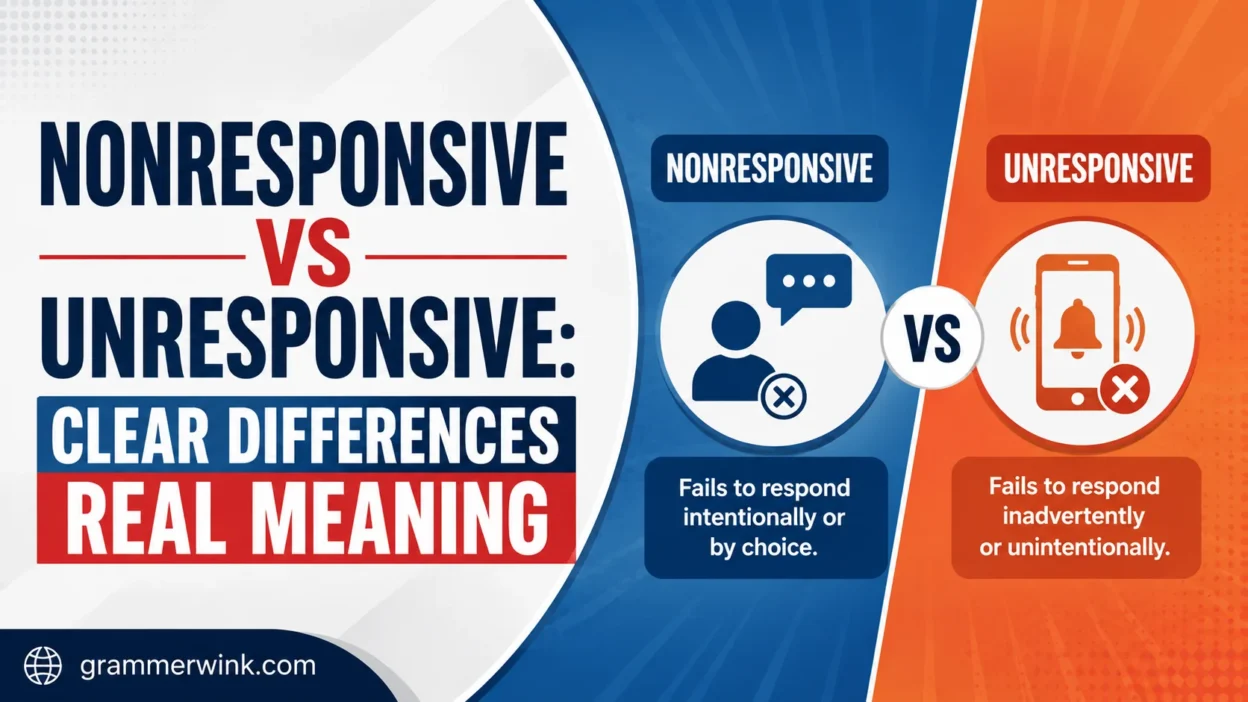
Understanding the difference between Nonresponsive vs Unresponsive is important for clear and effective communication. Although both words describe a lack of response, they can be used in slightly different situations. The word nonresponsive commonly refers to someone who does not reply to messages, questions, requests, or communication. In contrast, unresponsive can describe someone who does not react to a person, situation, or external stimulus. These terms may appear similar in everyday language, but their meanings can change depending on the context. Knowing the difference can help you make your writing more precise, natural, and professional.
In everyday communication, nonresponsive and unresponsive are often used interchangeably. However, understanding their specific uses can make your word choice more accurate and easier to understand. For example, a customer who repeatedly ignores emails may be described as nonresponsive to communication or requests. Meanwhile, someone who does not react when spoken to may be described as unresponsive to questions or conversation. The difference becomes even more noticeable in professional, technical, and formal situations, where choosing the right term can make your meaning clearer. Learning these distinctions can help prevent confusion and awkward expressions.
This guide explores Nonresponsive vs Unresponsive with clear definitions, practical examples, and simple explanations. You will learn how both words are used in sentences, conversations, workplaces, and everyday situations. We will also look at their similarities, differences, common meanings, and appropriate contexts. Real examples can make it easier to understand why one word may sound more suitable than the other in a particular sentence. By understanding the context and purpose behind each term, you can improve your vocabulary, grammar, and communication skills. By the end, choosing between nonresponsive and unresponsive will feel much easier.
Understanding Nonresponsive vs Unresponsive in Simple Terms
Before going deep, here’s the plain-English difference:
- Unresponsive means a person or system shows no reaction at all.
- Nonresponsive means there is no reaction to a specific input, stimulus, or treatment.
That difference may feel small, but it changes interpretation in medicine and technology.
Think of it like this:
- Unresponsive = “Nothing works”
- Nonresponsive = “This thing doesn’t work with that input”
That distinction is subtle but critical.
Why the Difference Between Nonresponsive and Unresponsive Matters
In healthcare and technical fields, words are not just descriptions. They are decisions.
A doctor documenting a patient as “unresponsive” is describing a potentially life-threatening condition. A technician calling a system “nonresponsive” might just mean a single feature failed.
Misusing these terms can:
- Delay emergency response
- Create confusion in medical records
- Lead to incorrect troubleshooting steps
- Affect legal or insurance documentation
Real-world example
A hospital report might say:
“Patient is unresponsive to verbal and painful stimuli.”
This signals a neurological emergency.
But a clinical note might say:
“Patient is nonresponsive to intravenous medication.”
This means the patient is awake, but the treatment did not work.
What Does “Unresponsive” Really Mean?
The term unresponsive is broader, more serious, and often used in emergency contexts.
Medical meaning of unresponsive
In medicine, unresponsive typically means:
- No reaction to voice
- No reaction to touch
- No reaction to pain
- Possible loss of consciousness
Doctors often assess responsiveness using the AVPU scale:
Read More: Ally vs Allie: Meaning, Differences, Usage
| Level | Meaning |
| A | Alert |
| V | Responds to voice |
| P | Responds to pain |
| U | Unresponsive |
If a patient is “U,” that’s an emergency classification.
Clinical situations where “unresponsive” is used
- Stroke
- Cardiac arrest
- Drug overdose
- Severe head trauma
- Hypoglycemic coma
Everyday usage of unresponsive
Outside medicine, the word describes total failure:
- A frozen phone screen
- A crashed operating system
- A locked application
Example:
“My laptop became unresponsive after the update and I had to restart it.”
What Does “Nonresponsive” Mean?
The term nonresponsive is more specific and conditional.
It does NOT usually imply total failure. Instead, it means something is not reacting to a defined input.
Medical meaning of nonresponsive
In clinical environments, nonresponsive often refers to:
- No reaction to a specific drug
- No improvement after treatment
- No change in test results
For example:
“The tumor is nonresponsive to chemotherapy.”
This does NOT mean the patient is unconscious. It means the treatment failed to produce a result.
Technical meaning of nonresponsive
In technology or systems:
- A button does not respond to clicks
- A module ignores input signals
- A feature fails under certain conditions
Example:
“The payment gateway is nonresponsive to API requests during peak hours.”
Key idea
Nonresponsive = selective failure, not total failure.
Key Differences Between Nonresponsive and Unresponsive
Let’s break this down clearly.
| Feature | Unresponsive | Nonresponsive |
| Scope | Entire system or person | Specific input or condition |
| Severity | Often critical or emergency | May be partial or situational |
| Medical use | Loss of consciousness or awareness | Lack of treatment or stimulus response |
| Technical use | Full system freeze or crash | Feature/input failure |
| Context sensitivity | Low (general condition) | High (specific trigger) |
Real-World Medical Examples That Clarify Everything
Let’s move beyond definitions and look at how doctors actually use these terms.
Case Study: Emergency Room Scenario
A 58-year-old male arrives at the ER.
- He does not respond to voice
- He does not react to pain stimuli
- He has no eye movement
Doctor notes:
“Patient is unresponsive on arrival.”
This indicates a critical condition. The team immediately checks:
- Oxygen levels
- Brain activity
- Heart rhythm
Now contrast that with another case:
A cancer patient receives chemotherapy.
- Patient is awake and alert
- Tumor does not shrink after 3 cycles
Doctor notes:
“Tumor is nonresponsive to chemotherapy.”
Here, the patient is stable. The treatment is what failed.
Same root word. Completely different meaning.
Real-World Technology Examples
The confusion also happens in IT systems.
Example 1: Unresponsive system
- Entire operating system freezes
- Mouse and keyboard stop working
- Requires forced restart
This is unresponsive behavior
Example 2: Nonresponsive feature
- “Save” button doesn’t respond
- API endpoint fails under load
- One module stops working while others function
This is nonresponsive behavior
Simple analogy
Think of a car:
- Unresponsive = engine stops completely
- Nonresponsive = windshield wipers don’t work, but the car runs fine
Why People Confuse Nonresponsive vs Unresponsive
There are three main reasons:
1. Everyday language overlap
In casual speech, people don’t distinguish them.
They might say:
- “My phone is unresponsive”
- “My phone is nonresponsive”
Both feel correct, even if only one is precise.
2. Medical shorthand
Doctors and nurses sometimes use abbreviations or shorthand in notes. That leads to inconsistent usage across hospitals.
3. Media simplification
Movies and news reports rarely respect technical accuracy. They use “unresponsive” for dramatic effect.
When to Use Each Term Correctly
Here’s a practical guide you can actually use.
Use “unresponsive” when:
- A person shows no awareness or reaction
- You describe emergency medical conditions
- A system completely stops working
- You need to signal urgency
Use “nonresponsive” when:
- A treatment does not produce results
- A system fails under a specific input
- A feature ignores certain commands
- You are describing partial failure
Common Misuses That Create Confusion
These mistakes happen more often than you think.
Misuse examples
- ❌ “The patient is nonresponsive to voice and pain”
- ✔ Correct: “The patient is unresponsive”
- ❌ “The system is unresponsive to API requests”
- ✔ Better: “The system is nonresponsive to API requests under load”
- ❌ Mixing both in the same report without clarity
Why it matters
In medicine, ambiguity can delay treatment.
In engineering, it can lead to misdiagnosis of system failures.
Memory Trick to Never Confuse Them Again
Here’s a simple way to remember:
- Unresponsive = nothing responds
- Nonresponsive = something doesn’t respond to something specific
Analogy
Imagine a smart home system:
- Unresponsive = entire system offline
- Nonresponsive = smart light ignores voice commands, but app works fine
Expert Insight: How Professionals Actually Think About It
Medical professionals often prioritize clarity over strict grammar rules.
A neurologist might say:
“Unresponsive patients require immediate stabilization before diagnostics.”
A clinical oncologist might say:
“Nonresponsive tumors often require a change in treatment protocol.”
Engineers think similarly:
- Unresponsive system → crash handling, reboot, recovery
- Nonresponsive module → debugging specific input paths
The key idea is scope of failure.
Quick Reference Table for Everyday Use
| Situation | Correct Term |
| Person in coma | Unresponsive |
| Phone frozen completely | Unresponsive |
| Drug doesn’t work | Nonresponsive |
| Button doesn’t click | Nonresponsive |
| System crash | Unresponsive |
| API fails under condition | Nonresponsive |
FAQs
Are nonresponsive and unresponsive the same thing?
No, they are not exactly the same. People often mix them up, but the meaning changes based on context.Think of it like this: one is total silence, the other is selective silence.
Which term is more serious in medicine: nonresponsive or unresponsive?
Unresponsive is more serious.When a patient is unresponsive, it usually signals a medical emergency. Doctors may suspect:
Can a patient be nonresponsive but still conscious?
A patient can be fully conscious and still be nonresponsive in certain cases, such as:So consciousness does not always equal responsiveness to everything.
Is “nonresponsive” used in everyday language?
Yes, but less commonly than “unresponsive.”In casual conversation, people usually say “unresponsive” even when “nonresponsive” would be more precise.
Can technology be both nonresponsive and unresponsive?
Your phone crashes → unresponsiveYour phone works, but the camera button doesn’t respond nonresponsive
Conclusion
At first glance, nonresponsive vs unresponsive looks like a minor language detail. In reality, it plays a big role in how professionals describe urgency, failure, and system behavior.Unresponsive describes a total lack of reaction. In medicine, it often signals an emergency where immediate action matters. In technology, it usually means a system has completely frozen or crashed Nonresponsive, on the other hand, narrows the focus. It describes a situation where something fails to react to a specific input, treatment, or condition, while other functions may still work normally.


