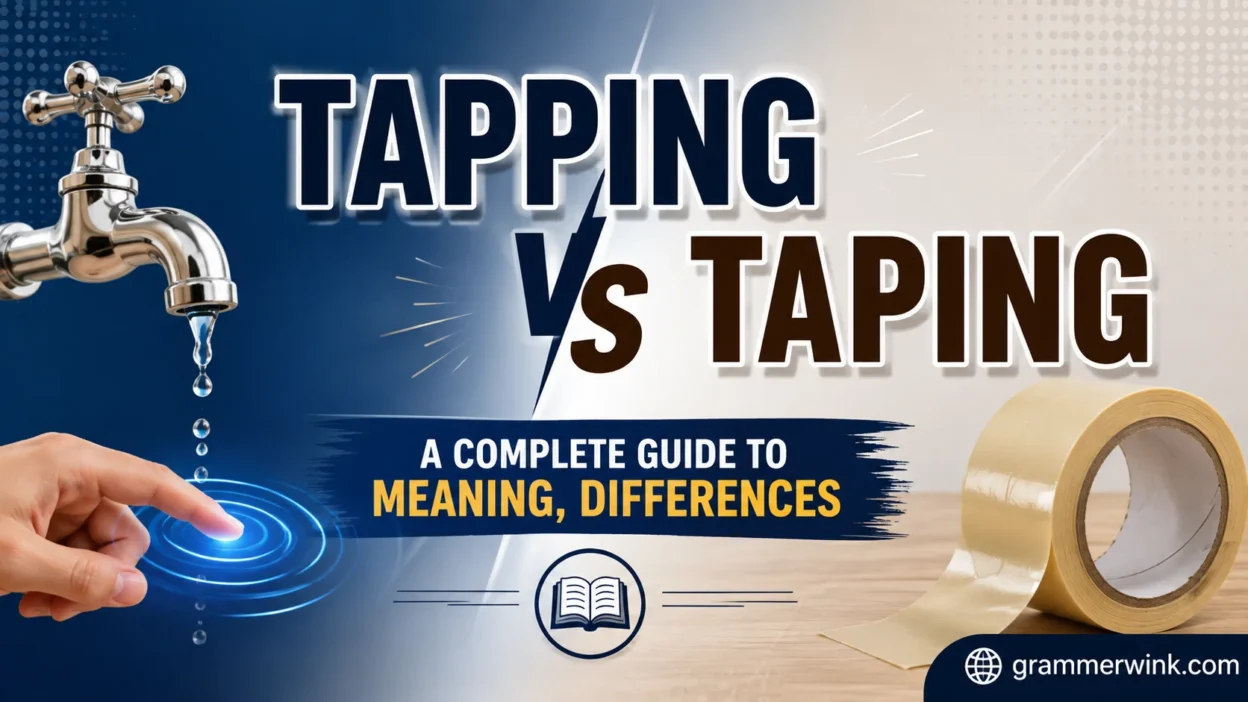
Tapping vs Taping can be confusing because these two words look and sound very similar. However, they have different meanings, uses, and grammatical roles. Tapping usually refers to lightly striking, touching, or knocking something, such as tapping on a screen, door, or table. Taping, on the other hand, means using tape to attach, cover, or secure something. Understanding this small spelling difference can help you avoid common mistakes in writing, texting, work, and everyday communication. Although both words come from the verb forms tap and tape, their meanings are clearly different.
The word tapping comes from the verb tap, which means to touch or strike something gently, often repeatedly. You might be tapping your phone screen, tapping your fingers on a desk, or tapping someone on the shoulder to get attention. The word taping comes from tape, meaning to attach or cover something with adhesive material. For example, you might be taping a package, taping a broken wire, or taping a note to a wall. These examples show why choosing the correct spelling and meaning matters in different situations.
Knowing the difference between tapping and taping becomes especially useful when you’re writing emails, articles, messages, instructions, or professional documents. A simple spelling change can completely alter the meaning of a sentence and may confuse your reader. If you’re talking about touching or striking, use tapping; if you’re talking about using adhesive tape, use taping. In this complete guide, we’ll explore their definitions, differences, examples, grammar, and common mistakes. By the end, you’ll have a clear understanding of when to use each word confidently.
What Is Tapping vs Taping? Quick Clarity First
Before going deeper, here’s the simplest way to understand the difference:
- Tapping: A technique that uses rhythmic finger tapping on specific points of the body to influence emotional or psychological states
- Taping: A physical method of applying adhesive tape to the body to support muscles, joints, or injuries
That’s it in one line each. But the real understanding comes when we break them down.
Think of it like this:
Tapping works on your nervous system and emotions.
Taping works on your muscles, joints, and physical structure.
Same sounding word. Totally different purpose.
What Is Tapping? (Meaning, Science, and Real Uses)
Tapping usually refers to a method called Emotional Freedom Technique (EFT), often known as “tapping therapy.”
It involves gently tapping with your fingertips on specific points on the body while focusing on thoughts, emotions, or stress triggers.
How Tapping Works (Simple Breakdown)
Tapping is based on a combination of:
- Physical stimulation of acupressure points
- Cognitive focus on emotional stress
- Breathing and calming attention shifts
These elements work together to help regulate the body’s stress response.
When you tap, you’re essentially sending calming signals to your nervous system while your mind processes emotional stress.
Key idea
Your brain cannot fully stay in a high-stress state while your body receives calming rhythmic stimulation.
That mismatch helps reduce emotional intensity.
Common Tapping Points
Practitioners typically use specific points on the body:
- Top of the head
- Eyebrow area
- Side of the eye
- Under the eye
- Under the nose
- Chin point
- Collarbone
- Under the arm
These points are loosely inspired by acupuncture pathways, though tapping does not use needles.
What Tapping Is Used For
Tapping is widely used in emotional and psychological wellness contexts:
Stress and anxiety relief
People use tapping to calm racing thoughts before exams, interviews, or presentations.
Emotional processing
It can help people revisit stressful memories in a controlled way.
Sleep support
Some users report improved sleep when tapping before bed.
Performance anxiety
Athletes and performers sometimes use tapping to reduce mental pressure.
Example of Tapping in Real Life
Imagine a student sitting outside an exam hall.
- Heart is racing
- Hands feel sweaty
- Thoughts are spiraling
They begin tapping lightly on their collarbone and eyebrow point while repeating:
“Even though I feel nervous, I accept how I feel.”
Within a few minutes, the emotional intensity often drops.
It doesn’t erase the exam pressure. It just makes it more manageable.
What Tapping Is NOT
Let’s clear up confusion:
- It is not physical therapy
- It does not strengthen muscles or joints
- It does not replace medical treatment
- It is not a physical injury tool
Tapping works on emotional regulation, not physical repair.
Scientific Perspective on Tapping
Research on EFT tapping is still developing. Some studies suggest:
- Reduced cortisol (stress hormone) levels after sessions
- Improved anxiety scores in small clinical groups
- Short-term emotional relief in stress conditions
However, scientific communities still debate the mechanism. Some believe it works through:
- Exposure therapy elements
- Mindfulness focus
- Placebo and expectation effects
Regardless of the mechanism, many users report noticeable emotional relief.
What Is Taping? (Sports, Therapy, and Physical Support)
Now let’s switch gears completely.
Taping refers to the application of adhesive tape on the body to support muscles, joints, and ligaments.
You’ve probably seen athletes with colorful strips of tape on shoulders, knees, or backs. That’s kinesiology taping.
Types of Taping
Kinesiology Taping
- Elastic tape
- Designed to move with the body
- Supports muscles without restricting motion
Athletic (Rigid) Taping
- Stiff, non-elastic tape
- Limits movement
- Used for injury protection and stabilization
Medical Taping
- Used in physiotherapy settings
- Helps during rehabilitation
How Taping Works
Taping works through mechanical and sensory support:
- Supports weak or injured joints
- Reduces strain on muscles
- Improves body awareness (proprioception)
- Helps guide movement patterns
In simple terms, it acts like a temporary external support system for your body.
Common Uses of Taping
Sports injury prevention
Athletes tape ankles, knees, and wrists to avoid strain.
Post-injury recovery
It helps stabilize joints during healing.
Pain reduction support
Some people experience reduced discomfort through improved alignment and reduced pressure.
Physical therapy
Therapists use taping to reinforce movement correction.
Example of Taping in Real Life
Picture a basketball player with a slightly sprained ankle.
- The joint feels unstable
- Movement causes discomfort
A trainer applies athletic tape around the ankle.
Now the player can:
- Move with more confidence
- Reduce risk of re-injury
- Continue light training safely
Taping doesn’t heal the injury. It supports the healing process.
What Taping Is NOT
Taping often gets misunderstood too:
- It does not cure injuries instantly
- It does not replace rehabilitation
- It does not fix severe structural damage alone
Think of it as support, not a solution.
Scientific View on Taping
Research on kinesiology taping shows mixed results:
Some studies suggest:
- Small improvements in pain perception
- Slight improvements in range of motion
- Better proprioception in some cases
However, other studies show minimal measurable physical change.
What is consistent:
Taping provides support and confidence, which can indirectly improve movement quality.
Tapping vs Taping: Key Differences Explained Clearly
Now let’s break the comparison down in a structured way.
Purpose
- Tapping: Emotional regulation and stress relief
- Taping: Physical support and injury management
Method
- Tapping: Finger tapping on body points
- Taping: Applying adhesive tape on skin or clothing
Primary System Targeted
- Tapping: Nervous system and emotional response
- Taping: Muscles, joints, and physical mechanics
Speed of Effect
- Tapping: Often immediate emotional shift
- Taping: Gradual physical support during activity
Tools Used
- Tapping: Human fingers
- Taping: Medical or athletic tape
Main Environments
- Tapping: Therapy, wellness, psychology
- Taping: Sports, physiotherapy, rehabilitation
Comparison Table
| Feature | Tapping | Taping |
| Focus | Emotional state | Physical structure |
| Tool | Fingers | Adhesive tape |
| Goal | Calm the mind | Support the body |
| Field | Psychology, wellness | Sports medicine, physiotherapy |
| Application | Stress points on body | Joints and muscles |
| Duration of effect | Short-term emotional relief | Temporary physical support |
| Movement impact | None | Can restrict or guide movement |
When to Use Tapping
Tapping works best when your issue is emotional or psychological.
Use tapping when you feel:
- Overwhelmed
- Anxious before performance
- Emotionally stuck
- Mentally scattered
Real-life scenarios
Before an exam
A student uses tapping to reduce panic and focus better.
Before public speaking
A speaker taps to calm nerves backstage.
During emotional stress
Someone uses tapping after a stressful conversation to reset emotionally.
Simple tapping routine example
- Identify emotion (“I feel anxious”)
- Tap through points slowly
- Repeat calming phrases
- Focus on breathing
It usually takes 2–10 minutes.
When to Use Taping
Taping is a physical support tool.
Use taping when:
- You have mild joint instability
- You’re recovering from injury
- You need extra support during sports
- You want to prevent strain
Real-life scenarios
Running support
A runner tapes their knee before a long race.
Ankle sprain recovery
A football player tapes the ankle for stability.
Shoulder strain
A swimmer uses taping during rehab training.
Important note
Taping works best with proper guidance. Incorrect application can reduce effectiveness or even cause discomfort.
Can You Use Tapping and Taping Together?
Yes, and in some cases it actually makes sense.
They don’t overlap because they target different systems:
- Tapping → mind and emotions
- Taping → body and structure
Example combined scenario
An athlete preparing for competition:
- Uses tapping to reduce performance anxiety
- Uses taping to support a weak knee
One prepares the mind. The other stabilizes the body.
Common Myths About Tapping vs Taping
Let’s clear up confusion.
Myth 1: Tapping is just placebo
Not entirely accurate. While psychological effects play a role, studies suggest physiological stress reduction can also occur.
Myth 2: Taping cures injuries
False. Taping supports healing but does not replace it.
Myth 3: They are basically the same
Completely wrong. They come from entirely different disciplines.
Myth 4: Taping always improves performance
Not always. It depends on proper application and context.
Why People Confuse Tapping and Taping
This confusion happens for a few reasons:
- Similar spelling and pronunciation
- Overlap in wellness and sports conversations
- Search engine mix-ups
- Lack of clear explanation online
In reality, the similarity ends at the word itself.
Case Study: Stress vs Injury Support in Real Life
Let’s look at two real-world-style examples.
Case Study 1: Student Under Pressure
A university student struggles with exam anxiety.
- Symptoms: fast heartbeat, racing thoughts
- Solution used: tapping technique
- Result: calmer emotional state within minutes
Case Study 2: Athlete with Knee Strain
A runner develops mild knee instability.
- Symptoms: discomfort during movement
- Solution used: kinesiology taping
- Result: improved stability during training
Same idea of “support,” but completely different systems.
Expert Insight: Why Both Matter in Their Own Way
Professionals in sports therapy and psychology often agree on one thing:
The human body and mind work together, but they need different tools.
Tapping supports emotional regulation.
Taping supports physical structure.
When used correctly, each one fills a specific gap.
Tapping vs Taping: A Complete Guide to Meaning, Differences, Uses, and Real-World Applications
If you’ve ever mixed up tapping vs taping, you’re not alone. The two words sound almost identical, yet they sit in completely different worlds. One deals with the mind and emotional regulation. The other focuses on physical support, injury prevention, and movement stability.
This confusion shows up in fitness, therapy, sports medicine, and even casual conversations. People often search one and accidentally land on the other. That leads to misunderstandings, wasted effort, and sometimes even wrong treatment choices.
In this guide, you’ll get a clear, practical, and deeply detailed breakdown of tapping vs taping. You’ll learn what each one actually does, when to use it, how it works, and how to avoid common mistakes.
Let’s clear the confusion once and for all.
What Is Tapping vs Taping? Quick Clarity First
Before going deeper, here’s the simplest way to understand the difference:
- Tapping: A technique that uses rhythmic finger tapping on specific points of the body to influence emotional or psychological states
- Taping: A physical method of applying adhesive tape to the body to support muscles, joints, or injuries
That’s it in one line each. But the real understanding comes when we break them down.
Think of it like this:
Tapping works on your nervous system and emotions.
Taping works on your muscles, joints, and physical structure.
Same sounding word. Totally different purpose.
What Is Tapping? (Meaning, Science, and Real Uses)
Tapping usually refers to a method called Emotional Freedom Technique (EFT), often known as “tapping therapy.”
It involves gently tapping with your fingertips on specific points on the body while focusing on thoughts, emotions, or stress triggers.
How Tapping Works (Simple Breakdown)
Tapping is based on a combination of:
- Physical stimulation of acupressure points
- Cognitive focus on emotional stress
- Breathing and calming attention shifts
These elements work together to help regulate the body’s stress response.
When you tap, you’re essentially sending calming signals to your nervous system while your mind processes emotional stress.
Key idea
Your brain cannot fully stay in a high-stress state while your body receives calming rhythmic stimulation.
That mismatch helps reduce emotional intensity.
Common Tapping Points
Practitioners typically use specific points on the body:
- Top of the head
- Eyebrow area
- Side of the eye
- Under the eye
- Under the nose
- Chin point
- Collarbone
- Under the arm
These points are loosely inspired by acupuncture pathways, though tapping does not use needles.
What Tapping Is Used For
Tapping is widely used in emotional and psychological wellness contexts:
Stress and anxiety relief
People use tapping to calm racing thoughts before exams, interviews, or presentations.
Emotional processing
It can help people revisit stressful memories in a controlled way.
Sleep support
Some users report improved sleep when tapping before bed.
Performance anxiety
Athletes and performers sometimes use tapping to reduce mental pressure.
Example of Tapping in Real Life
Imagine a student sitting outside an exam hall.
- Heart is racing
- Hands feel sweaty
- Thoughts are spiraling
They begin tapping lightly on their collarbone and eyebrow point while repeating:
“Even though I feel nervous, I accept how I feel.”
Within a few minutes, the emotional intensity often drops.
It doesn’t erase the exam pressure. It just makes it more manageable.
What Tapping Is NOT
Let’s clear up confusion:
- It is not physical therapy
- It does not strengthen muscles or joints
- It does not replace medical treatment
- It is not a physical injury tool
Tapping works on emotional regulation, not physical repair.
Scientific Perspective on Tapping
Research on EFT tapping is still developing. Some studies suggest:
- Reduced cortisol (stress hormone) levels after sessions
- Improved anxiety scores in small clinical groups
- Short-term emotional relief in stress conditions
However, scientific communities still debate the mechanism. Some believe it works through:
- Exposure therapy elements
- Mindfulness focus
- Placebo and expectation effects
Regardless of the mechanism, many users report noticeable emotional relief.
What Is Taping? (Sports, Therapy, and Physical Support)
Now let’s switch gears completely.
Taping refers to the application of adhesive tape on the body to support muscles, joints, and ligaments.
You’ve probably seen athletes with colorful strips of tape on shoulders, knees, or backs. That’s kinesiology taping.
Types of Taping
Kinesiology Taping
- Elastic tape
- Designed to move with the body
- Supports muscles without restricting motion
Athletic (Rigid) Taping
- Stiff, non-elastic tape
- Limits movement
- Used for injury protection and stabilization
Medical Taping
- Used in physiotherapy settings
- Helps during rehabilitation
How Taping Works
Taping works through mechanical and sensory support:
- Supports weak or injured joints
- Reduces strain on muscles
- Improves body awareness (proprioception)
- Helps guide movement patterns
In simple terms, it acts like a temporary external support system for your body.
Common Uses of Taping
Sports injury prevention
Athletes tape ankles, knees, and wrists to avoid strain.
Post-injury recovery
It helps stabilize joints during healing.
Pain reduction support
Some people experience reduced discomfort through improved alignment and reduced pressure.
Physical therapy
Therapists use taping to reinforce movement correction.
Example of Taping in Real Life
Picture a basketball player with a slightly sprained ankle.
- The joint feels unstable
- Movement causes discomfort
A trainer applies athletic tape around the ankle.
Now the player can:
- Move with more confidence
- Reduce risk of re-injury
- Continue light training safely
Taping doesn’t heal the injury. It supports the healing process.
Read More :Hustle vs Hussle: Meaning, Difference,
What Taping Is NOT
Taping often gets misunderstood too:
- It does not cure injuries instantly
- It does not replace rehabilitation
- It does not fix severe structural damage alone
Think of it as support, not a solution.
Scientific View on Taping
Research on kinesiology taping shows mixed results:
Some studies suggest:
- Small improvements in pain perception
- Slight improvements in range of motion
- Better proprioception in some cases
However, other studies show minimal measurable physical change.
What is consistent:
Taping provides support and confidence, which can indirectly improve movement quality.
Tapping vs Taping: Key Differences Explained Clearly
Now let’s break the comparison down in a structured way.
Purpose
- Tapping: Emotional regulation and stress relief
- Taping: Physical support and injury management
Method
- Tapping: Finger tapping on body points
- Taping: Applying adhesive tape on skin or clothing
Primary System Targeted
- Tapping: Nervous system and emotional response
- Taping: Muscles, joints, and physical mechanics
Speed of Effect
- Tapping: Often immediate emotional shift
- Taping: Gradual physical support during activity
Tools Used
- Tapping: Human fingers
- Taping: Medical or athletic tape
Main Environments
- Tapping: Therapy, wellness, psychology
- Taping: Sports, physiotherapy, rehabilitation
Comparison Table
| Feature | Tapping | Taping |
| Focus | Emotional state | Physical structure |
| Tool | Fingers | Adhesive tape |
| Goal | Calm the mind | Support the body |
| Field | Psychology, wellness | Sports medicine, physiotherapy |
| Application | Stress points on body | Joints and muscles |
| Duration of effect | Short-term emotional relief | Temporary physical support |
| Movement impact | None | Can restrict or guide movement |
When to Use Tapping
Tapping works best when your issue is emotional or psychological.
Use tapping when you feel:
- Overwhelmed
- Anxious before performance
- Emotionally stuck
- Mentally scattered
Real-life scenarios
Before an exam
A student uses tapping to reduce panic and focus better.
Before public speaking
A speaker taps to calm nerves backstage.
During emotional stress
Someone uses tapping after a stressful conversation to reset emotionally.
Simple tapping routine example
- Identify emotion (“I feel anxious”)
- Tap through points slowly
- Repeat calming phrases
- Focus on breathing
It usually takes 2–10 minutes.
When to Use Taping
Taping is a physical support tool.
Use taping when:
- You have mild joint instability
- You’re recovering from injury
- You need extra support during sports
- You want to prevent strain
Real-life scenarios
Running support
A runner tapes their knee before a long race.
Ankle sprain recovery
A football player tapes the ankle for stability.
Shoulder strain
A swimmer uses taping during rehab training.
Important note
Taping works best with proper guidance. Incorrect application can reduce effectiveness or even cause discomfort.
Can You Use Tapping and Taping Together?
Yes, and in some cases it actually makes sense.
They don’t overlap because they target different systems:
- Tapping → mind and emotions
- Taping → body and structure
Example combined scenario
An athlete preparing for competition:
- Uses tapping to reduce performance anxiety
- Uses taping to support a weak knee
One prepares the mind. The other stabilizes the body.
Common Myths About Tapping vs Taping
Let’s clear up confusion.
Myth 1: Tapping is just placebo
Not entirely accurate. While psychological effects play a role, studies suggest physiological stress reduction can also occur.
Myth 2: Taping cures injuries
False. Taping supports healing but does not replace it.
Myth 3: They are basically the same
Completely wrong. They come from entirely different disciplines.
Myth 4: Taping always improves performance
Not always. It depends on proper application and context.
Why People Confuse Tapping and Taping
This confusion happens for a few reasons:
- Similar spelling and pronunciation
- Overlap in wellness and sports conversations
- Search engine mix-ups
- Lack of clear explanation online
In reality, the similarity ends at the word itself.
Case Study: Stress vs Injury Support in Real Life
Let’s look at two real-world-style examples.
Case Study 1: Student Under Pressure
A university student struggles with exam anxiety.
- Symptoms: fast heartbeat, racing thoughts
- Solution used: tapping technique
- Result: calmer emotional state within minutes
Case Study 2: Athlete with Knee Strain
A runner develops mild knee instability.
- Symptoms: discomfort during movement
- Solution used: kinesiology taping
- Result: improved stability during training
Same idea of “support,” but completely different systems.
Expert Insight: Why Both Matter in Their Own Way
Professionals in sports therapy and psychology often agree on one thing:
The human body and mind work together, but they need different tools.
Tapping supports emotional regulation.
Taping supports physical structure.
When used correctly, each one fills a specific gap.
Final Thoughts
Here’s the clean takeaway: If your problem sits in your mind, use tappingIf your problem sits in your body, use tapingThey don’t compete. They complement understanding of human health.Think of it like this:Tapping is like calming the “internal storm” Taping is like reinforcing the “physical framework” Same sounding words. Completely different worlds. And once you understand that difference, you never confuse them again.
FAQs
What is the main difference between tapping and taping?
The main difference comes down to purpose.Tapping focuses on emotional and mental regulation through rhythmic finger tapping on specific body points.
Is tapping scientifically proven?
Tapping (especially EFT or Emotional Freedom Technique) has shown promising but mixed scientific results.However, researchers still debate why it works. Some believe it combines:
Does tapping actually help with anxiety?
Yes, many people report reduced anxiety after tapping.For example, someone about to give a presentation might tap for a few minutes and feel noticeably calmer. Results vary from person to person.
What is taping used for in sports?
Taping is widely used in sports medicine to:Athletes often use it during training or competition to feel more secure while moving.
Does taping actually heal injuries?
No, taping does not heal injuries directly.Instead, it:Supports the injured areaReduces strain during movementHelps the body heal more safelyHealing still depends on rest, rehab, and proper medical care.