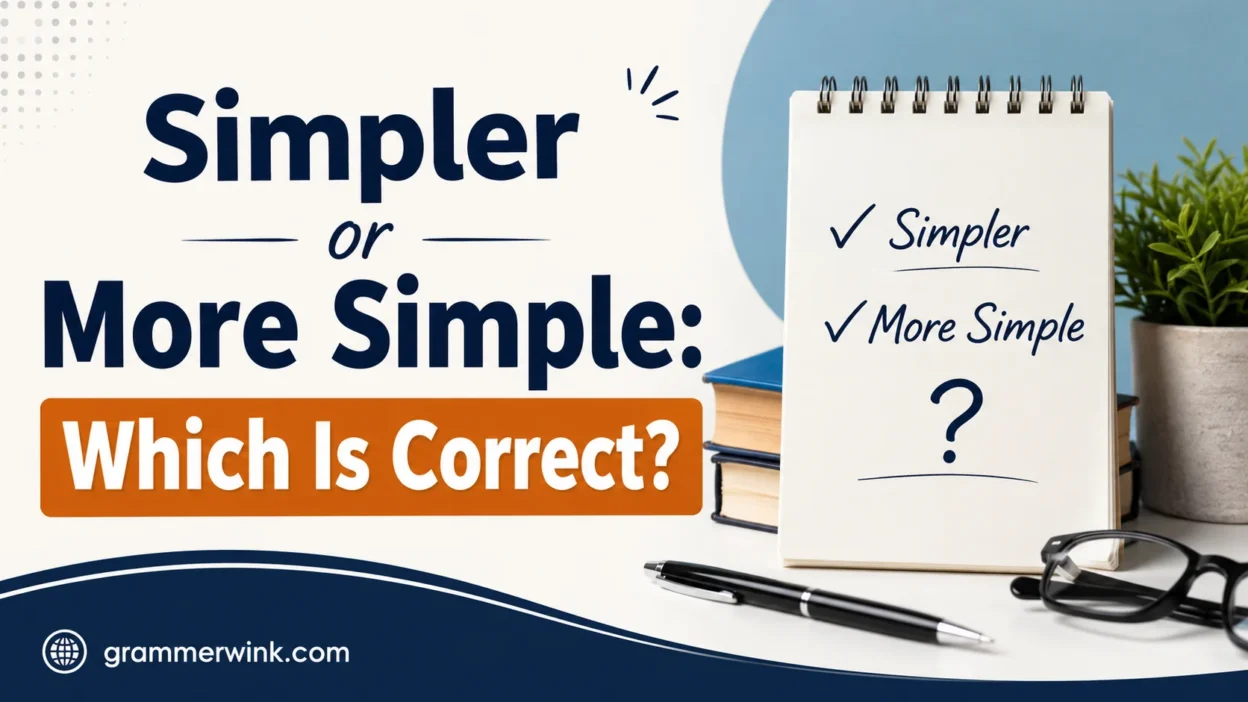
Learning English grammar correctly often means understanding small comparisons that make a big difference in everyday writing. One of the most common questions learners ask is whether “simpler” or “more simple” is the correct form when comparing something. Both expressions are grammatically correct, but their usage, tone, context, and natural flow can vary depending on the sentence. Knowing when to choose each form helps you write with greater confidence, clarity, accuracy, and fluency. This guide explains the difference in a clear and practical way.
In most everyday conversations, academic writing, and professional communication, “simpler” is the preferred comparative because “simple” is a short adjective that naturally takes the “-er” ending. Native English speakers usually find this version more natural, concise, smooth, and easy to understand. However, “more simple” is not incorrect and may be used when a writer wants extra emphasis, a specific stylistic effect, or a comparison that highlights degrees of simplicity. Understanding this distinction helps you choose the most appropriate expression for different situations.
If you’ve ever wondered which form sounds more natural, formal, correct, or professional, you’re not alone. Many English learners, students, teachers, and even native speakers occasionally question the best choice. Throughout this guide, you’ll discover the grammar rules, real-life examples, common mistakes, and helpful tips that make the comparison easy to understand. By the end, you’ll know exactly when to use “simpler”, when “more simple” fits better, and how to improve your overall English communication skills with confidence.
Simpler vs. More Simple: The Short Answer
If you’re looking for a quick answer, here it is:
Both “simpler” and “more simple” are grammatically correct.
However, “simpler” is far more common in everyday English.
Most native speakers naturally say:
- This solution is simpler.
- The new process is simpler than the old one.
- We need a simpler explanation.
While these sentences are also grammatically acceptable:
- This solution is more simple.
- We need a more simple explanation.
The second set sounds less natural to many English speakers.
Quick Comparison Table
| Form | Grammatically Correct | Common in Modern English | Natural Sounding |
| Simpler | Yes | Very Common | Yes |
| More Simple | Yes | Less Common | Sometimes |
| More Simpler | No | Never | No |
| Most Simpler | No | Never | No |
The Practical Rule
If you’re unsure which one to use, choose simpler.
In most situations, it will sound more fluent and natural.
Understanding Comparative Adjectives
To understand why “simpler” is usually preferred, it helps to understand comparative adjectives.
A comparative adjective compares two things.
For example:
- John is taller than Mike.
- This car is faster than that one.
- The blue route is shorter than the red route.
The words taller, faster, and shorter all compare one thing with another.
Why Comparatives Matter
Comparatives make communication more precise.
Instead of saying:
This solution is good.
You can say:
This solution is simpler than the previous one.
Now the reader understands exactly how the two options differ.
Comparatives appear everywhere:
- Business reports
- Academic papers
- Conversations
- Marketing materials
- Technical documents
Because they are so common, English has developed predictable patterns for forming them.
Read More: Targeted or Targetted: The Simple Guide to Getting It Right
How English Forms Comparative Adjectives
English generally creates comparative adjectives in two ways:
Adding “-er”
Many short adjectives become comparative by adding -er.
Examples include:
| Base Adjective | Comparative |
| Tall | Taller |
| Fast | Faster |
| Short | Shorter |
| Small | Smaller |
| Smart | Smarter |
This pattern is extremely common.
Native speakers learn it naturally from an early age.
Using “More”
Longer adjectives usually form comparisons with more.
Examples:
| Base Adjective | Comparative |
| Beautiful | More Beautiful |
| Expensive | More Expensive |
| Comfortable | More Comfortable |
| Interesting | More Interesting |
| Difficult | More Difficult |
Trying to add “-er” to these words would sound awkward.
For example:
❌ Beautifuler
❌ Comfortabler
❌ Interestinger
Instead, English uses “more.”
Where Does the Word “Simple” Fit?
This is where things become interesting.
The adjective simple has two syllables:
sim-ple
Some two-syllable adjectives take “-er.”
Others use “more.”
A few can use either form.
Simple belongs to this flexible category.
That means both of these are grammatically acceptable:
- Simpler
- More simple
Yet modern English overwhelmingly favors one choice.
Why “Simpler” Is Usually Preferred
Although both forms are correct, simpler has become the standard choice in contemporary English.
Several factors explain why.
It Follows Common English Patterns
Many two-syllable adjectives ending in:
- -le
- -er
- -ow
- -y
often take “-er.”
Examples include:
| Adjective | Comparative |
| Simple | Simpler |
| Gentle | Gentler |
| Narrow | Narrower |
| Clever | Cleverer |
| Happy | Happier |
Because English speakers regularly encounter these patterns, “simpler” sounds familiar and natural.
It Is Shorter
Language tends to favor efficiency.
Compare:
- simpler
- more simple
The first option uses one word.
The second uses two.
Over time, speakers naturally gravitate toward shorter constructions when both are acceptable.
This principle appears throughout language.
For example:
- easier instead of more easy
- quicker instead of more quick
- happier instead of more happy
The same preference influences the popularity of “simpler.”
It Sounds More Natural
Read these sentences aloud:
The instructions are simpler now.
The instructions are more simple now.
Most people instinctively feel that the first sentence flows better.
That’s because native speakers hear and use “simpler” far more often.
Frequent usage creates familiarity.
Familiarity creates a sense of correctness.
It Dominates Modern Writing
Look at contemporary examples from:
- Newspapers
- Educational websites
- Business reports
- Technical manuals
- Academic publications
You’ll find “simpler” used much more frequently than “more simple.”
This widespread adoption reinforces its status as the preferred option.
Examples of “Simpler” in Everyday English
Here are some common examples.
In Education
- The teacher provided a simpler explanation.
- This textbook uses simpler language.
- Students often prefer simpler instructions.
In Business
- The company adopted a simpler workflow.
- We need a simpler approval process.
- Management wants a simpler reporting system.
In Technology
- The update introduced a simpler interface.
- Developers created a simpler navigation menu.
- The new software offers a simpler user experience.
In Daily Life
- A simpler routine reduces stress.
- Sometimes the simpler option works best.
- We chose the simpler route home.
Notice how natural each sentence sounds.
That is one reason “simpler” remains the dominant choice.
Is “More Simple” Wrong?
Despite what some grammar enthusiasts claim, “more simple” is not wrong.
Many respected dictionaries and grammar references recognize it as a valid comparative form.
The issue isn’t correctness.
The issue is preference.
Why Some People Think It’s Wrong
Many English learners are taught a simplified rule:
Short adjectives use “-er.” Long adjectives use “more.”
While helpful, this rule doesn’t tell the whole story.
English contains numerous exceptions and flexible patterns.
Simple happens to be one of them.
As a result, some people mistakenly believe only “simpler” is acceptable.
In reality, both forms have existed for centuries.
Historical Usage
Older English texts often used both versions.
Writers historically had more freedom when forming comparatives.
Over time, however, “simpler” became the dominant option.
That doesn’t make “more simple” incorrect.
It simply makes it less common.
When “More Simple” May Be Used
Sometimes writers intentionally choose “more simple.”
Reasons include:
Emphasis
A writer may want extra emphasis on simplicity.
Example:
We need a more simple approach that anyone can understand.
The phrase draws attention to the degree of simplicity.
Stylistic Preference
Some authors prefer the rhythm of “more simple” in certain sentences.
For example:
The revised design feels more simple and approachable.
Avoiding Repetition
A writer who has already used “simpler” several times may switch wording for variety.
Example:
The first solution is simpler. The second offers a more simple framework for beginners.
While uncommon, this choice remains grammatically acceptable.
A Useful Analogy
Think of “simpler” and “more simple” like two roads leading to the same destination.
One road is wider, smoother, and used by most travelers.
That’s “simpler.”
The other road still works.
Fewer people use it, yet it remains perfectly valid.
That’s “more simple.”
The destination is the same. The journey simply feels different.
Reply with “Continue” and I’ll provide Part 2 and Part 3 to complete the full 2,500+ word articl.
Conclusion
The debate over “simpler” vs. “more simple” often causes confusion, yet the answer is surprisingly straightforward. Both forms are grammatically correct. However, “simpler” is the preferred choice in modern English because it sounds more natural, concise, and fluent.
Native speakers, professional writers, editors, and educators overwhelmingly use simpler in everyday conversation, business communication, academic writing, and digital content. While more simple isn’t wrong, it appears less frequently and is usually reserved for stylistic emphasis or specific contexts.
Faqs:
Is “simpler” grammatically correct?
Yes. Simpler is the standard comparative form of the adjective simple. It is widely used in spoken and written English and is generally the preferred choice.
Is “more simple” grammatically correct?
Yes. More simple is also grammatically correct. However, it is less common than simpler and may sound less natural in many contexts.
Which is better: simpler or more simple?
In most situations, simpler is the better choice because it is shorter, more natural, and preferred by native speakers and professional editors.
Is “more simpler” correct English?
No. More simpler is incorrect because it uses two comparative markers at the same time. The correct form is simply simpler.
What is the superlative form of simple?
The superlative form of simple is simplest. For example: “This is the simplest solution to the problem.”